Propaganda, Misinformation, and Psychological Manipulation: How to Recognize the Difference
GenZ Frontier Editorial | August 17, 2026
People often use propaganda, misinformation, disinformation, and psychological manipulation as if they were interchangeable. They overlap, but they describe different things. Misinformation is false or inaccurate information. Disinformation is false information deliberately intended to mislead. Propaganda is broader communication designed to shape attitudes or action, often through selective framing, identity, repetition, emotional language, or group pressure.
Psychological manipulation describes the influence process: reducing a person’s ability to make a fully informed, voluntary choice by exploiting emotion, confusion, social pressure, or hidden incentives. A persuasive message is not automatically manipulation, and an inaccurate statement is not automatically deliberate deception.
Editorial note: This article is politically neutral and focuses on verification and media literacy. It does not label current claims without evidence or tell readers which political position to adopt.
The short answer
Look for a combination of:
- emotionally charged language that encourages immediate fear, anger, or shame;
- false urgency, repetition, or claims that everyone already agrees;
- selective evidence presented as the complete story;
- scapegoating or a false “us versus them” choice;
- a demand to share, donate, attack, or distrust before checking the source; or
- a source, date, image, quote, or statistic that cannot be independently verified.
One emotional headline does not prove propaganda. Check the source, evidence, date, corrections, intended audience, and requested action.
For social-media mechanisms, read Social-Media Manipulation and Emotional Pressure.
Misinformation, disinformation, propaganda, and persuasion
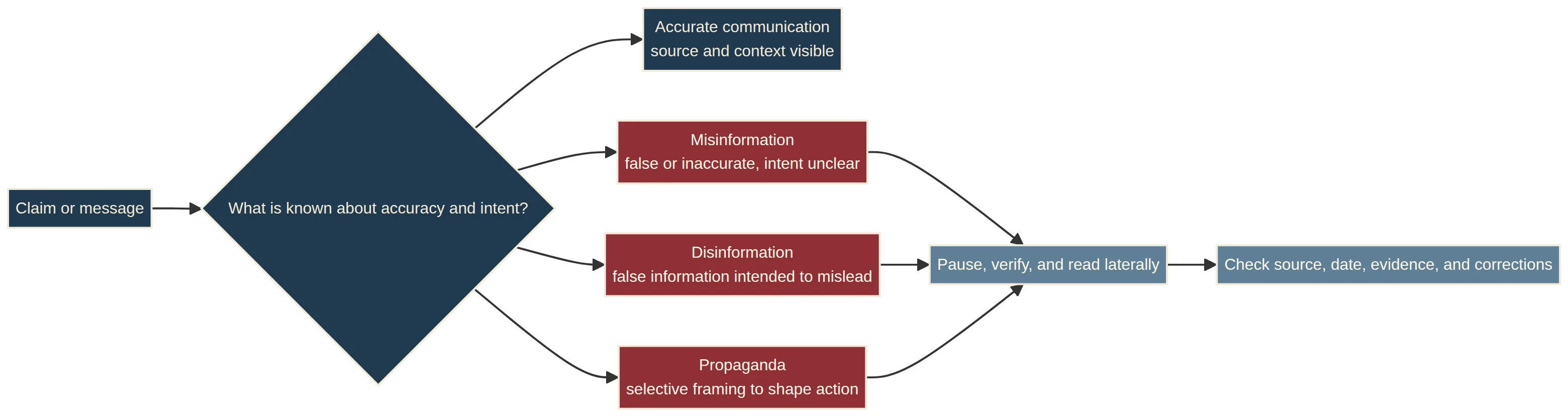
| Term | Core meaning | What a reader should avoid assuming |
|---|---|---|
| Misinformation | False or inaccurate information | An error proves deliberate intent |
| Disinformation | False information deliberately intended to mislead | Every disputed claim is disinformation |
| Propaganda | Communication designed to shape attitudes or action through selective framing or emotional appeal | Every persuasive message is propaganda |
| Psychological manipulation | Influence that exploits emotion, confusion, pressure, or hidden incentives to reduce informed choice | Influence and persuasion are always abusive |
| Persuasion | An attempt to change a belief or behavior through reasons, evidence, or appeal | A clear argument removes the need for verification |
Intent can be difficult to establish. When intent is unknown, describe the content and its effects rather than making a stronger accusation than the evidence supports.
Psychological mechanisms to notice
Emotional arousal
Fear, anger, disgust, shame, and triumph can make a message feel urgent and memorable. Emotion is part of normal communication, but strong arousal is a reason to pause before sharing or acting.
Repetition and familiarity
Repeated exposure can make a claim feel familiar. Familiarity is not evidence. Find the original source, look for independent reporting, and check whether the claim has been corrected.
Confirmation and belonging
A message may tell a group that it alone understands the truth or that asking questions proves disloyalty. Belonging matters, but a group identity should not replace evidence.
False dilemmas
“Either you share this now or you support the enemy” removes reasonable alternatives. Real situations often contain uncertainty, partial evidence, and more than two choices.
Scapegoating and dehumanization
Propaganda can simplify complex problems by blaming a group or person for everything. Check whether the message uses stereotypes, collective blame, or language that makes harm seem acceptable.
Source confusion
A screenshot may remove the date, a quote may lose its context, or a logo may be copied to make an account appear official. Search for the original document and verify the account or publication independently.
For language-level deception, read Paltering vs. Lying and Manipulative Communication Styles.
A verify-before-sharing process
Pause the first reaction
If a headline makes you furious, frightened, or eager to prove loyalty, wait before reposting. A pause does not mean the claim is false; it creates room to check it.
Find the original source
Trace a screenshot, quote, video, or statistic to its earliest available source. Check the author, publication, date, location, and whether the material has been edited.
Read laterally
Open independent sources rather than staying inside the original page. Look for primary documents, reputable reporting, official data, and expert explanations. Do not treat search ranking alone as proof.
Check what is missing
Ask whether the message leaves out a relevant date, comparison, limitation, correction, or competing explanation. A true fact can still mislead when presented without essential context.
Separate evidence from interpretation
Write down the exact claim, the evidence offered, and the conclusion being requested. This helps distinguish “the document says X” from “therefore everyone must do Y.”
Decide whether sharing helps
Even accurate information can cause harm when shared without context or when it exposes a private person. Consider whether sharing is necessary, respectful, and likely to improve understanding.
For design-level pressure, read Dark Patterns and Psychological Manipulation.
Prebunking common tactics
You can prepare before encountering a claim by learning common patterns: false urgency, impersonation, emotional bait, fake experts, fabricated consensus, selective statistics, decontextualized images, and demands for secrecy. Recognizing a tactic does not establish that a particular claim is false; it signals that closer verification is needed.
Do not share a suspicious message merely to criticize it if doing so would amplify it. Use reporting and correction tools appropriately, and prioritize reliable information over a dramatic counterclaim.
Frequently asked questions
What is the difference between misinformation and disinformation?
Misinformation is false or inaccurate information. Disinformation is false information deliberately intended to mislead. Intent is often difficult to prove, so describe evidence carefully.
Is propaganda always false?
No. Propaganda may include true facts, but it often uses selective framing, repetition, emotional appeals, identity, or omission to shape attitudes or action. A true statement can still be presented in a misleading way.
How does propaganda manipulate emotions?
It may use fear, anger, shame, pride, belonging, urgency, scapegoating, or dehumanizing language to make a preferred belief or action feel necessary before people examine evidence.
How can I spot a manipulated claim online?
Pause, find the original source, check the date and context, compare independent sources, inspect images and quotes, and separate evidence from the action the message wants you to take.
Should I call a claim propaganda?
Use the term when the evidence supports a coordinated or strategic effort to shape attitudes through selective or emotionally loaded communication. When intent is unclear, describe the observable framing and missing evidence instead.
Final takeaway
Misinformation, disinformation, propaganda, and psychological manipulation overlap, but they are not the same label. The safest response is not to react faster; it is to pause, trace the source, verify laterally, check what is missing, and decide whether sharing is responsible.
Strong emotion can be a signal to investigate, not a substitute for evidence.
References
Canonical URL: Open the canonical article page