Psychological Manipulation Styles: Types, Tactics, Examples, and Safe Ways to Recognize Them
GenZ Frontier Editorial | August 17, 2026
Psychological manipulation is a pattern of influence that may use pressure, deception, emotional exploitation, withdrawal, social control, or other methods to steer another person’s decisions, perceptions, feelings, or behavior. It becomes more concerning when a person’s ability to make an informed choice or safely say no is repeatedly reduced.
The phrase “psychological manipulation styles” is used in everyday relationship advice, communication research, workplace discussions, and popular culture. It does not describe one universally accepted checklist. Researchers may classify manipulation by the behavior used, while readers often use labels such as gaslighting, guilt-tripping, love bombing, triangulation, or silent treatment. These labels can overlap, but they do not all describe the same level of analysis.
This guide organizes the topic in a practical way. It explains the difference between a style, a tactic, a pattern, an effect, and a context; compares a research taxonomy with common reader-facing terms; provides cautious fictional examples; and outlines safer ways to think about boundaries and support.
Safety note: This article is for education and recognition. It is not a diagnosis, legal assessment, or instruction manual for controlling people. A single argument, lie, awkward joke, emotional reaction, or disagreement does not prove manipulation. If a boundary or confrontation could increase danger, retaliation, surveillance, stalking, financial control, or physical risk, prioritize confidential support and safety planning instead of trying to win an argument.
Quick answer: What are the main psychological manipulation styles?
A useful reader-facing classification groups manipulation styles by the mechanism they may use:
| Style family | What it may involve | Common labels that can overlap |
|---|---|---|
| Pressure and coercion | Threats, urgency, intimidation, or making refusal feel unsafe or impossible | Coercion, threats, emotional blackmail |
| Deception and information control | Hiding relevant facts, selective disclosure, misleading statements, or changing the story | Paltering, lying, omission, reality distortion |
| Emotional leverage | Using guilt, fear, shame, sympathy, or another person’s empathy to obtain compliance | Guilt-tripping, playing the victim, emotional blackmail |
| Withdrawal and conditional reward | Offering or removing affection, attention, access, approval, or contact to shape behavior | Silent treatment, love bombing, intermittent reinforcement |
| Social control | Dividing people, restricting support, creating competition, or making outside relationships seem disloyal | Triangulation, isolation, smear campaigns |
| Degradation and identity pressure | Undermining confidence, using humiliation, contempt, or repeated attacks on competence or worth | Negging, belittling, debasement |
| Digital and public influence | Steering choices through interface design, social pressure, outrage, repetition, or manufactured consensus | Dark patterns, engagement pressure, propaganda, misinformation |
These are mechanism families, not diagnoses. The same behavior can have different meanings in different contexts. For example, taking time to cool down can be healthy space, while unexplained silence repeatedly used to punish disagreement may be part of a different pattern. Context, repetition, power, transparency, autonomy, and what happens after a boundary are more informative than a label alone.
Styles vs. tactics vs. techniques vs. patterns
Search results often use the words styles, types, tactics, and techniques as if they were interchangeable. They are related, but separating them makes the subject easier to understand and reduces overlabeling.
| Term | Practical meaning | Example |
|---|---|---|
| Style | A broad way of exerting influence | Using emotional pressure or information control |
| Tactic | A recognizable behavior within that style | Guilt-tripping, selective omission, or triangulation |
| Technique | The particular wording or method used in an interaction | “If you cared, you would do this” or repeatedly changing a deadline |
| Pattern | Repeated behavior over time, often with escalation or consequences | Pressure followed by punishment whenever someone says no |
| Effect | What the other person experiences | Confusion, fear, guilt, dependency, or self-doubt |
| Context | Where and through what relationship or system it occurs | A romantic relationship, family, workplace, social platform, or purchase flow |
A style is therefore not the same thing as a phrase. A phrase may be one tactic, while a style describes the broader mechanism. A pattern is stronger evidence than an isolated incident, but even a repeated pattern should be described carefully when the writer does not know the full context.
For a broader foundation, read what psychological manipulation means and how it differs from persuasion.
A research-based taxonomy of manipulation tactics
A frequently cited study by David Buss and colleagues examined manipulation tactics and identified six factors across the instruments they analyzed: charm, silent treatment, coercion, reason, regression, and debasement.1 This taxonomy is useful because it shows that manipulation is not limited to shouting, threats, or obvious deception. It can also involve persuasive presentation, withdrawal, helplessness, or attacks on another person’s confidence.
The study is a research framework from 1987, not a universal modern classification for every relationship or digital setting. It should be read alongside newer safety, abuse, communication, and digital-design research rather than treated as a diagnostic test.
1. Charm and ingratiation
Charm can become manipulative when flattery, admiration, gifts, helpfulness, or intense attention are repeatedly used to create obligation or reduce another person’s ability to evaluate a request freely. Charm itself is not harmful. Warmth, generosity, and affection are ordinary parts of healthy relationships.
The concern grows when the positive attention is conditional, unusually intense, followed by demands, or withdrawn as punishment. This is one reason love bombing and genuine affection should be compared by consistency, respect for pace, and response to boundaries rather than by grand gestures alone.
2. Silent treatment and strategic withdrawal
Withdrawal may involve refusing to speak, withholding ordinary contact, ignoring messages, or removing affection after someone disagrees. A person can also need quiet time, privacy, or a pause during conflict. The important difference is whether the pause is communicated, whether there is a plan to return to the issue, and whether silence is repeatedly used to punish or force compliance.
Read silent treatment versus taking space for a focused comparison. The presence of silence by itself is not enough to establish manipulation.
3. Coercion and threat-based pressure
Coercive pressure can involve threats, intimidation, force, retaliation, or consequences that make refusal unrealistic. In close relationships, threats may involve abandonment, humiliation, financial retaliation, damage to property, harm to a pet, stalking, or physical violence. In a workplace, pressure may involve retaliation or abuse of authority.
When immediate danger is present, the priority is safety rather than deciding which label fits. The existing guide to coercive control and emotional abuse explains how repeated control can extend beyond words.
4. Reason, argument, and selective rationality
Reasoning is not automatically manipulation. A person can present evidence, explain a preference, or make a sincere case while allowing another person to disagree. The concern is different when “reason” is used selectively to conceal relevant information, overwhelm the other person, move the standard of proof, or make refusal appear irrational.
A strong argument remains open to questions and correction. Manipulative reasoning may create a false choice, use technical language to establish superiority, or treat disagreement as evidence of stupidity or disloyalty. This is why transparency and the freedom to check information matter.
5. Regression, helplessness, and emotional dependency
Regression in the research taxonomy refers to behavior that may resemble helplessness, childishness, emotional collapse, or dependence in order to obtain care or avoid responsibility. People can genuinely become overwhelmed and need support, so this label should never be applied simply because someone cries, struggles, or asks for help.
The concern grows when helplessness is repeatedly performed only when accountability is requested, when another person is made responsible for all emotional regulation, or when support is used to prevent reasonable boundaries. The behavior and pattern should be described rather than assuming an underlying motive.
6. Debasement and confidence reduction
Debasement involves lowering another person’s status, confidence, competence, or sense of worth. It may appear as repeated contempt, humiliation, insults disguised as jokes, public comparison, or attacks on identity. A single rude comment is harmful but does not automatically establish a long-term manipulation pattern.
Terms such as negging, belittling, and demeaning humor are commonly used for some of these behaviors. The key questions are whether the behavior is repeated, whether it creates a power advantage, whether objections are dismissed as oversensitivity, and whether the person can repair the harm.
A visual map of the main styles
The following visual summarizes six reader-facing mechanism families. It is an explanatory aid, not a clinical or diagnostic instrument.
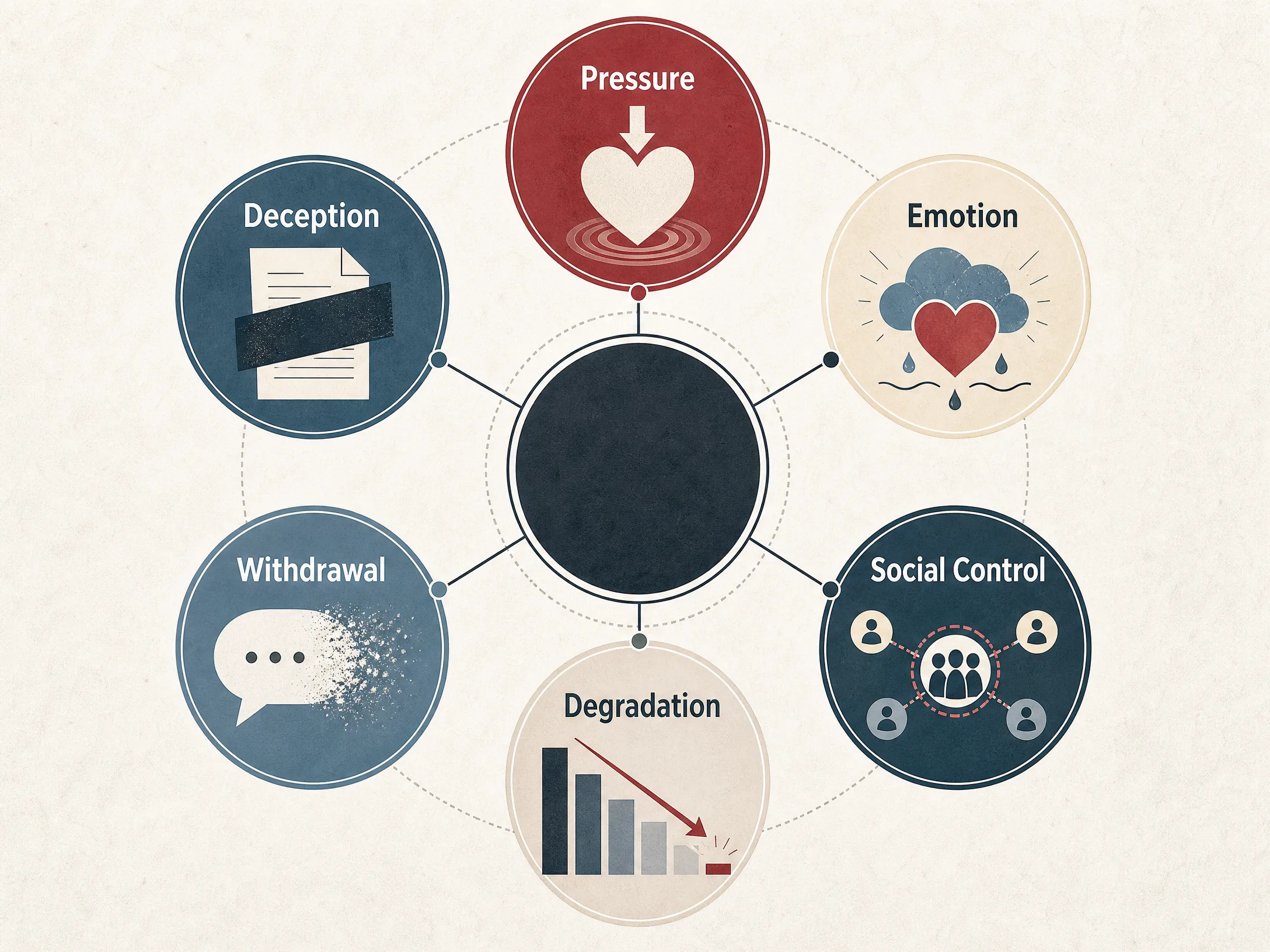
Seven common manipulation styles readers may encounter
The research taxonomy helps organize mechanisms, while popular terms help readers recognize specific behaviors. The following categories use common language but keep the necessary caution that labels are not proof.
1. Guilt-based and shame-based pressure
Guilt-based pressure uses a person’s sense of responsibility, empathy, loyalty, or morality to push them toward a desired action. It may sound like “After everything I have done for you,” “You are selfish if you say no,” or “If you really cared, you would do this.”
Guilt is not automatically manipulation. Someone can honestly explain that they feel disappointed or hurt. The pattern becomes more concerning when guilt is repeatedly used to override boundaries, make one person responsible for another person’s emotions, or punish independence.
2. Deception, omission, and paltering
Information control can involve direct lies, selective omission, misleading framing, or paltering—using technically truthful statements to create a false or incomplete impression. Academic research describes paltering as a form of misleading communication that can appear truthful at the sentence level while still distorting the listener’s understanding.5
Readers should look for missing context, changing explanations, resistance to reasonable questions, and whether the person benefits from the incomplete picture. An honest mistake or poor memory can look similar from the outside, so intent should not be assumed from one inconsistency.
3. Reality-undermining behavior and gaslighting
Gaslighting is a more specific and debated term for repeated behavior that can make someone question their memory, perception, or understanding. It is not a synonym for every lie or disagreement. A recent systematic review found inconsistency in how gaslighting is defined and warned that it is sometimes conflated with broader forms of manipulation.2
For examples and boundaries around the term, read gaslighting: meaning, signs, examples, and how it differs from lying.
4. Withdrawal, conditional affection, and push-pull reward
A person may use affection, contact, money, attention, approval, or access as a reward for compliance and remove it when the other person resists. A push-pull pattern can be emotionally confusing because periods of warmth are mixed with unpredictable withdrawal.
Inconsistent behavior can also result from stress, ambivalence, poor communication, or an unstable situation. The relevant questions are whether the pattern is repeated, whether it creates dependency, whether the person is punished for expressing needs, and whether there is meaningful repair.
5. Social division, triangulation, and isolation
Triangulation uses a third person or outside group to create competition, jealousy, secrecy, pressure, or confusion. Isolation restricts access to relationships, information, transportation, money, or other sources of support. These can overlap, but they are not identical.
Healthy support involves consent and direct communication. Asking a trusted person for advice is not triangulation. The concern rises when someone carries conflicting messages, demands that people choose sides, discourages independent confirmation, or makes outside relationships feel disloyal. Read triangulation in relationships, families, and friendships for a deeper context guide.
6. Responsibility reversal and strategic victimhood
Blame shifting redirects responsibility away from the person who caused harm. Strategic victimhood describes situations in which someone presents themselves as the injured party to avoid accountability or gain control of the conversation. A person can genuinely feel hurt and defend themselves, so the label should not be applied merely because both people disagree about what happened.
The concern is stronger when every boundary becomes an attack, the original issue is never addressed, and the other person repeatedly ends up apologizing for raising a reasonable concern. Read DARVO, blame-shifting, and playing the victim for the specific responsibility-reversal pattern.
7. Digital and public influence
Manipulation can also occur through digital systems and public information environments. A social platform may amplify outrage or comparison. An online service may use a dark pattern that makes cancellation difficult or privacy choices unclear. A campaign may use repetition, identity pressure, scapegoating, or false consensus to influence public beliefs.
These subjects should not be collapsed into interpersonal abuse. They involve different systems, evidence, and remedies. They are included here because “psychological manipulation styles” is increasingly used to describe both person-to-person pressure and digital influence. Future guides in this cluster will examine digital dark patterns and social-media manipulation separately.
How to tell whether a behavior may be part of a manipulation pattern
A useful framework asks seven questions. It is not a scorecard, and it should not be used to diagnose another person.
| Question | What to examine |
|---|---|
| Pattern | Is the behavior repeated, escalating, or part of a broader sequence? |
| Pressure | Is there urgency, guilt, fear, humiliation, or punishment for hesitation? |
| Autonomy | Can the person delay, disagree, or say no safely? |
| Transparency | Are important facts, motives, or consequences hidden or distorted? |
| Boundaries | Are clearly stated limits repeatedly ignored? |
| Power | Is there financial dependence, authority, age-related dependence, isolation, or another imbalance? |
| Repair | Can the person acknowledge harm, respect a boundary, and change behavior over time? |
Do not convert these questions into a numerical test. A result such as “five out of seven” cannot prove manipulation. The purpose is to organize observations and identify whether outside perspective or support may help.
What psychological manipulation is not
The following are not automatically manipulation:
- disagreeing with someone;
- offering criticism respectfully;
- setting a boundary;
- saying no;
- asking for reassurance;
- expressing an emotion;
- changing your mind;
- taking healthy space with a clear plan to return;
- making a persuasive argument; or
- having a difficult conversation.
For example, “I need an hour to calm down, and I will talk after dinner” communicates a pause and a repair plan. Repeatedly refusing all communication to punish someone for disagreeing may describe a different pattern. Similarly, “I see the evidence differently” is not automatically gaslighting. Repeatedly denying observable events and insisting that another person cannot trust their own memory may raise a separate concern.
The goal is not to label every uncomfortable interaction. The goal is to understand whether a repeated pattern reduces autonomy, creates fear or confusion, violates boundaries, restricts support, or makes repair impossible.
Examples across different contexts
The examples below are fictional and intentionally cautious. They show how the same mechanism can look different depending on context.
Romantic relationship: guilt and conditional affection
Jordan says they will attend a planned family event. Alex replies, “If I mattered to you, you would stay with me,” and threatens to end the relationship if Jordan goes. One conversation could reflect distress or an argument. If this happens repeatedly and Jordan is punished whenever they maintain outside relationships, it may be consistent with guilt-based pressure and conditional affection.
A safer next step may be to slow down, preserve access to trusted people, and consider whether direct confrontation is safe. The priority changes if threats, stalking, financial control, or physical danger are present.
Friendship: triangulation and isolation
Taylor repeatedly tells Morgan that mutual friends are criticizing Morgan but refuses to share what was said. Taylor then pressures Morgan to stop speaking with those friends and says loyalty requires choosing sides. Taylor may have heard a real concern, but the pattern could also create dependency and isolation.
Morgan can avoid cutting off support based only on unverified claims, seek independent information, and pay attention to whether Taylor respects Morgan’s right to maintain other relationships.
Family: obligation and financial pressure
A parent repeatedly says that an adult child does not care about the family when the child refuses to provide money. The parent then threatens to stop speaking to the child whenever a financial limit is set. A family emergency may be genuine, but repeated punishment for reasonable financial boundaries may indicate an unhealthy control pattern.
Financial dependence, caregiving responsibilities, cultural expectations, and housing should be considered. The safest response may involve confidential financial, therapeutic, legal, or community support before a confrontation.
Workplace: changing standards and blame
A manager denies giving instructions that are documented in email, changes expectations after work is completed, and publicly blames an employee for missing information. Workplaces often involve changing priorities and disorganized communication, so one contradiction is not enough to establish gaslighting or manipulation.
The employee can keep factual records where safe, clarify instructions in writing, seek trusted workplace advice, and use appropriate reporting channels. Legal claims and secret recordings should not be assumed without jurisdiction-specific advice.
Online platform: pressure and dark patterns
A subscription page emphasizes a free trial but hides the renewal cost, makes the cancellation path difficult to find, and uses shame-based language when a person tries to leave. This is not the same as a manipulative partner, but it may be an example of design that interferes with informed choice. The Federal Trade Commission has described dark patterns as digital practices that can trick or manipulate consumers into making choices they would not otherwise make.6
The appropriate response may involve checking terms, saving receipts, reviewing account settings, and reporting deceptive design through the relevant consumer-protection channel.
How to respond safely when you are concerned
If you suspect a manipulative pattern, slowing down can reduce pressure. You may want to identify what is being requested, what information is missing, what consequences are being threatened, and whether you can safely delay the decision.
If it is safe, a short boundary can be clearer than a long explanation:
“I need time to think before I answer.”
“That does not work for me.”
“I remember the conversation differently, and I am going to check the details before deciding.”
These are not magic phrases. They may help in an ordinary difficult conversation, but they cannot guarantee that another person will respect a boundary. If the other person controls housing, money, employment, immigration status, transportation, devices, or physical safety, confidential planning may be safer than direct confrontation.
Maintain trusted relationships where possible. Document important events only when safe; documentation can create risk if someone monitors devices, accounts, locations, or communications. For safety-conscious guidance, read how to document gaslighting or emotional abuse safely.
For response strategies, see how to respond to emotional manipulation without escalating risk. For recovery and rebuilding self-trust, read recovering from manipulation.
Psychological manipulation and mental-health labels
Manipulative behavior does not automatically mean that someone has narcissistic personality disorder, another personality disorder, or a fixed “manipulative personality.” Diagnoses require qualified assessment and cannot be made from a list of behaviors on the internet.
It is also inaccurate to imply that people with a particular diagnosis are inherently manipulative. The more responsible subjects of analysis are behavior, pattern, context, power, impact, and the possibility of repair. Labels such as “gaslighter,” “abuser,” “trauma bond,” and “toxic person” can be meaningful in some contexts, but they can also become misleading when used as casual synonyms for selfishness, poor communication, conflict, or emotional discomfort.7
Frequently asked questions
What are the different types of manipulation in psychology?
Common reader-facing categories include pressure and coercion, deception and information control, emotional leverage, withdrawal and conditional reward, social control, degradation, and digital or public influence. Academic taxonomies may classify tactics differently. The categories should be used to recognize patterns, not diagnose people.
What is the difference between a manipulation style and a tactic?
A style is a broad way of exerting influence, such as pressure or information control. A tactic is a specific behavior within that style, such as guilt-tripping, selective omission, or triangulation. A pattern is repeated behavior over time, and an effect is what the other person experiences.
Is every guilt trip manipulation?
No. Someone can explain disappointment or ask for support without trying to control another person. Guilt-based manipulation becomes more concerning when guilt is repeatedly used to override boundaries, punish independence, or make one person responsible for another person’s emotional state.
Is gaslighting the same as psychological manipulation?
No. Gaslighting is a more specific and debated term for repeated reality-undermining behavior that can cause someone to question their perceptions, memory, or understanding. It can overlap with manipulation, but not every lie, disagreement, criticism, or memory difference is gaslighting.
Can manipulation happen unintentionally?
Harmful influence can occur without a person clearly understanding or admitting its effect, and intent can be difficult to establish. That does not mean every harmful interaction should be labeled manipulation. Consider repetition, the ability to say no, power, transparency, response to feedback, and whether behavior changes after a boundary.
How can I recognize manipulation without diagnosing someone?
Describe what happened instead of assigning a personality label. Record the behavior, context, repetition, pressure, consequences, and response to boundaries when doing so is safe. Seek outside perspective from a trusted person or qualified professional if the situation is causing fear, confusion, isolation, or significant distress.
What should I do if I feel unsafe?
Prioritize immediate safety and use a safe method to contact a trusted person, qualified professional, local emergency service, or specialist support organization. You do not need to settle the correct label before asking for help. If your device or account may be monitored, consider digital-safety risks before making contact.
Final takeaway
Psychological manipulation styles are best understood as ways of influencing people, not as a collection of magic phrases or a checklist for diagnosing someone. A research taxonomy may describe charm, withdrawal, coercion, reason, regression, and debasement, while everyday readers may recognize guilt-tripping, gaslighting, paltering, conditional affection, triangulation, blame shifting, or digital pressure.
The most useful questions are whether the behavior is repeated, whether someone can safely say no, whether relevant information is hidden or distorted, whether boundaries are respected, whether a power imbalance limits options, and whether genuine repair is possible.
If you are concerned, slow down and preserve access to trusted support where possible. Choose boundaries and documentation only when safe, and seek professional or specialist help when fear, threats, isolation, surveillance, financial control, retaliation, or physical danger are present.
References
Canonical URL: Open the canonical article page