Manipulative Communication Styles: Language Patterns, Examples, and Boundaries
GenZ Frontier Editorial | August 17, 2026
Manipulative communication is not simply rude, emotional, persuasive, or uncomfortable communication. The concern is a repeated pattern in which someone uses hidden pressure, deception, guilt, fear, humiliation, or dependency to narrow another person’s meaningful choices. The pressure may appear in words, silence, timing, tone, selective information, or the consequences that follow a refusal.
One sentence is rarely enough to establish manipulation. People can speak poorly when they are stressed, hurt, embarrassed, inexperienced, or afraid of conflict. A safer analysis looks at the whole interaction: what was requested, what information was available, whether the other person could say no, what happened after the boundary, and whether harm was acknowledged and repaired.
Safety note: This article is a recognition guide, not a diagnosis or a collection of scripts for controlling other people. If communication includes threats, stalking, surveillance, financial control, property damage, or physical danger, prioritize confidential support and safety planning over confrontation.
The short answer
A communication pattern may deserve closer attention when someone repeatedly:
- makes a request feel like a moral test of your love, loyalty, or character;
- denies, redefines, or selectively presents information so you doubt what you understood;
- turns a concern about their behavior into an attack on your tone, personality, or reaction;
- uses silence, affection, flattery, anger, or fear to make you comply;
- brings other people into a private issue to create pressure, competition, or isolation;
- changes the standard after you meet it so you can never be “good enough”; or
- describes a boundary as an attack while treating their own demands as reasonable.
These are possible signs, not proof. For the broader recognition guide, read Signs of Emotional Manipulation: How to Recognize Patterns by Style.
Assertive communication, ethical persuasion, and manipulation
The word “influence” is not automatically negative. People influence one another whenever they explain a preference, make a request, share evidence, negotiate, teach, or express a boundary. The ethical difference is whether the other person has enough information and freedom to make a genuine choice.
| Communication approach | Typical features | What happens if the other person says no? |
|---|---|---|
| Assertive communication | Direct need, respectful limit, clear request, honest emotion | The person may feel disappointed but does not use humiliation, threats, or punishment to remove the choice |
| Ethical persuasion | Transparent reasons, relevant evidence, room for questions, no hidden penalty | The person can decline without losing basic dignity, safety, or access to essential support |
| Manipulative communication | Hidden pressure, selective information, guilt, fear, deception, or dependency | Refusal triggers disproportionate pressure, retaliation, withdrawal, exposure, or a new test |
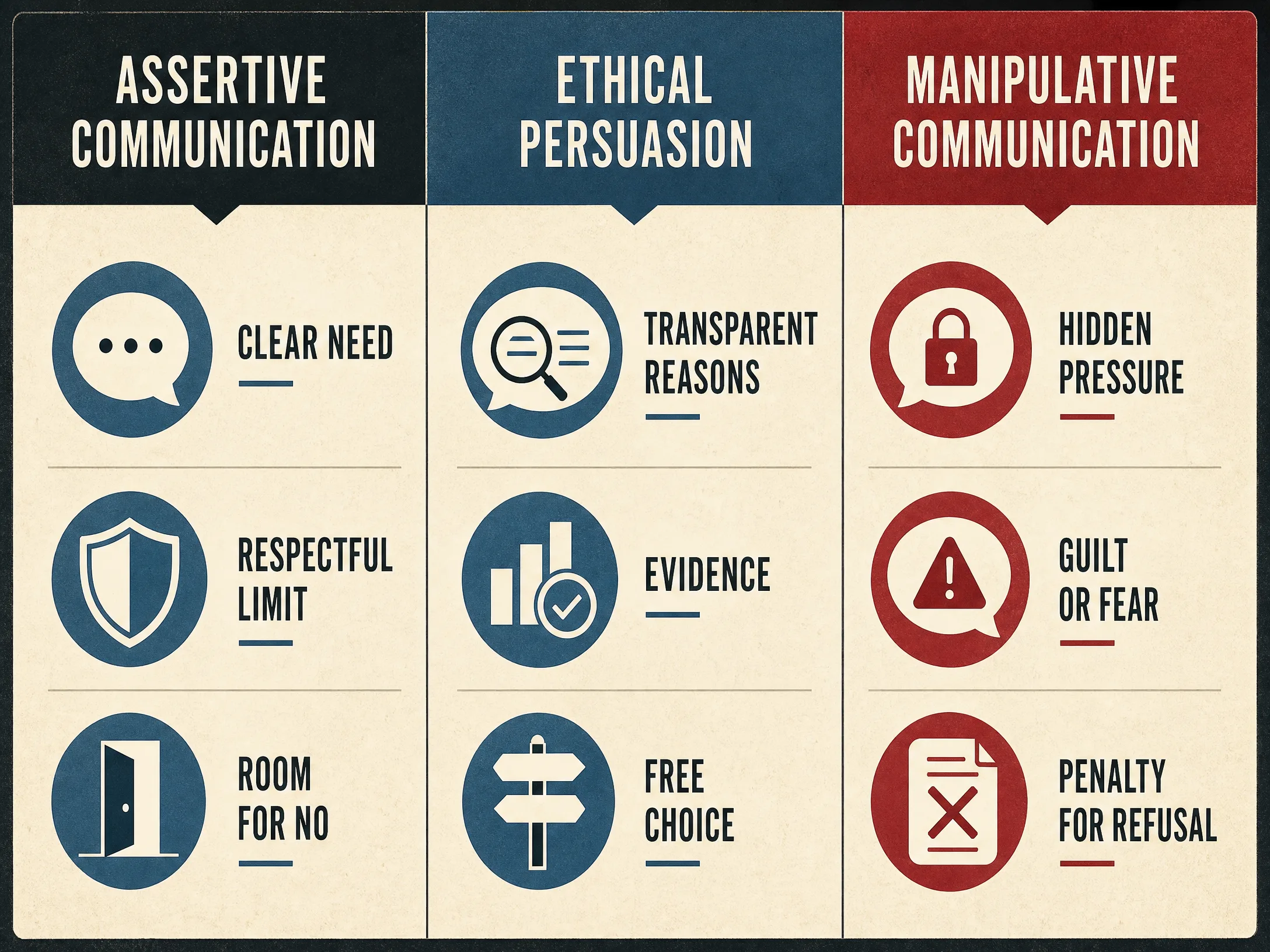
A boundary is not manipulation simply because another person dislikes it. “I will end the conversation if there is name-calling” describes what you will do to protect yourself. “You are not allowed to speak to anyone unless I approve” attempts to control another person’s life.
For the related distinction, read Psychological Manipulation vs. Persuasion.
Eight manipulative communication patterns
1. Guilt and obligation language
Guilt-based communication uses a person’s conscience, empathy, or sense of duty as leverage. It may sound like “After everything I have done for you,” “If you cared, you would,” or “I guess I know where I stand.” The speaker may be genuinely hurt, but the pattern becomes more concerning when the emotional message is repeatedly used to override a reasonable boundary.
A healthy request makes room for a voluntary answer. A manipulative pattern treats “no,” “not now,” or “I need to think” as evidence of bad character. For more examples and distinctions, read Manipulative Phrases: What They Mean and How to Respond.
2. Reality-undermining and denial language
Reality-undermining language disputes what happened, what was promised, or what a message says. Examples can include “That never happened,” “You are remembering it wrong,” or “You are too sensitive to understand.” A different memory or an ordinary disagreement is not automatically gaslighting.
The concern grows when denial is repeated despite reliable information, when your questions are treated as evidence that you are irrational, or when the other person expects you to rely only on their version of events. Gaslighting is a more specific and debated term for repeated reality-undermining behavior; it is not a synonym for every lie.
For the focused explanation, read Gaslighting: Meaning, Signs, Examples, and How It Differs From Lying.
3. Blame shifting and victim reversal
Blame shifting moves attention away from the original behavior and toward your reaction. You raise a concern about an insult, broken promise, or missed responsibility, and the conversation becomes an argument about your tone, timing, facial expression, or unrelated mistake.
Victim reversal can involve presenting the person who caused the harm as the only injured party. A person may say, “You are hurting me by bringing this up,” or “I would not have acted that way if you had behaved better.” Defensive feelings are human, but repeated refusal to address the original issue prevents repair.
For the related pattern, read DARVO: Deny, Attack, and Reverse Victim and Offender.
4. Passive aggression and indirect hostility
Passive-aggressive communication signals anger or resistance indirectly while denying that anything is wrong. It may involve sarcastic praise, deliberate delay, strategic forgetfulness, a cold tone, “Sure, whatever you want,” or a visible mood change followed by “I’m fine.”
Indirect communication can come from discomfort, conflict avoidance, or difficulty naming needs. The concern grows when the behavior repeatedly makes another person guess, apologize, or change plans to restore peace while the speaker refuses a direct conversation or accountability.
A safer question is: “Is there something you want to discuss directly?” If the response is retaliation or continued punishment, you do not have to keep chasing clarity.
5. Withdrawal, conditional affection, and intermittent reward
Silence, affection, attention, sex, praise, or contact can become communication tools when they are repeatedly offered after compliance and withdrawn after independence. A person may be warm when you agree, cold when you set a limit, and warm again when you apologize or give in.
People can need space after conflict, and relationships can include changing levels of closeness. Healthy space communicates the need and, when possible, includes a plan to return. Punitive withdrawal is more concerning when it is unexplained, repeated, and used to force a decision or apology.
For the distinction, read Silent Treatment vs. Taking Space.
6. Triangulation and social-pressure language
Triangulation brings a third person into a dispute to create competition, loyalty tests, secrecy, or pressure. Someone may say that a friend, family member, coworker, or partner agrees that you are the problem, without allowing you to verify what was actually said. They may encourage you to choose sides or threaten to tell others a selective version of events.
Seeking advice, using mediation, or involving a trusted person for safety is not automatically triangulation. The concern is whether third parties are being recruited to isolate you, discredit you, or force compliance rather than help resolve the issue fairly.
For a deeper context guide, read Triangulation in Relationships, Families, and Friendships.
7. Moving goalposts and impossible tests
Moving the goalposts means changing the standard after the other person meets it. You call when requested, but now you should have called earlier. You apologize, but it was not emotional enough. You provide information, but now you must prove that you are sincere in a new way.
Expectations can legitimately change when circumstances change. A manipulative pattern uses shifting standards to keep another person uncertain, exhausted, or permanently responsible for proving loyalty. Ask whether the expectation was clear, proportionate, mutually agreed, and stable enough to be met.
8. Flattery, urgency, and selective information
Flattery can be sincere, but it can also be used to create emotional leverage before a request. Urgency can be legitimate, but it can also prevent questions, comparison, or outside advice. Selective information can be an innocent omission, but it can also steer a decision by hiding a relevant cost or risk.
The issue is not whether a compliment, deadline, or partial explanation exists. Examine whether the person is transparent about what they want, whether you can verify the facts, and whether they remain respectful when you pause or decline.
For a broader tactics overview, read Common Psychological Manipulation Tactics.
What manipulative communication may sound like
The following examples are included for recognition, not as a complete test:
| Pattern | Possible language | Pattern question |
|---|---|---|
| Guilt | “After all I have done, you cannot do this one thing?” | Can disappointment be expressed without making refusal immoral? |
| Denial | “That conversation never happened; you are imagining it.” | Can the facts be checked without punishment? |
| Blame reversal | “I only shouted because you made me.” | Is the original behavior acknowledged? |
| Conditional affection | “If you really loved me, you would prove it.” | Is care being made dependent on compliance? |
| Triangulation | “Everyone agrees that you are the difficult one.” | Can the claim be verified, and is it being used to isolate you? |
| Moving goalposts | “That is not enough; you should have known what I meant.” | Was the expectation clear and reasonable from the beginning? |
| Indirect hostility | “Do whatever you want,” followed by punishment | Is the person willing to state the issue directly? |
Do not assume that a sentence has only one meaning. Context, repetition, power, and response to boundaries matter more than the words alone.
How to recognize a communication pattern safely
Write down the observable event rather than starting with a label. Note what was requested, what information was given, what you said, what happened after you paused or declined, and whether the same sequence has occurred before.
| Question | What it helps you examine |
|---|---|
| Was the request direct? | Whether hidden pressure or plausible deniability was used |
| Was information transparent? | Whether important facts, costs, or alternatives were withheld |
| Was refusal allowed? | Whether disagreement led to respect, guilt, retaliation, or fear |
| Was the issue repaired? | Whether the person acknowledged harm and changed behavior |
| Could you seek outside perspective? | Whether isolation or dependency was part of the pattern |
Avoid baiting, trapping, secretly recording, or publicly exposing someone without understanding safety and legal consequences. Documentation may create risk if devices or accounts are monitored. For safer documentation principles, read How to Document Gaslighting or Emotional Abuse Safely.
What to do when communication becomes controlling
Start with the least risky step that protects your choice. You may pause a decision, ask for the request in writing, separate the current issue from unrelated accusations, speak with a trusted person, or end a conversation that has become insulting or threatening.
Possible boundary statements include:
“I am willing to discuss the issue, but I am not agreeing while I am being pressured.”
“I remember the conversation differently. I will check the information before deciding.”
“I will continue this conversation when we can speak without insults or threats.”
These are not magic phrases. A person who is committed to control may ignore them or escalate. If there is surveillance, financial dependence, stalking, threats, or physical danger, seek confidential support and safety planning before direct confrontation.
For practical response guidance, read How to Respond to Emotional Manipulation Without Escalating Risk. For broader coercive patterns, read Coercive Control and Emotional Abuse.
Frequently asked questions
What are manipulative communication styles?
Common patterns include guilt and obligation, denial or reality-undermining language, blame shifting, passive aggression, conditional affection and withdrawal, triangulation, moving goalposts, and selective information combined with urgency or flattery. These labels describe possible patterns; they do not diagnose a person from a single conversation.
Is persuasive communication manipulative?
Not necessarily. Ethical persuasion uses transparent reasons, relevant information, and genuine freedom to decline. It becomes more concerning when a person hides important facts, uses fear or guilt, or imposes a disproportionate penalty for refusal.
What is the difference between assertive and manipulative communication?
Assertive communication states a need, feeling, request, or boundary directly and respectfully. Manipulative communication hides pressure or uses guilt, fear, deception, humiliation, or dependency to narrow another person’s options. A boundary remains valid even when someone dislikes it.
Is passive-aggressive communication always manipulation?
No. People can communicate indirectly because they are anxious, conflict-avoidant, or unsure how to express a need. It becomes more concerning when indirect hostility repeats, makes another person guess or apologize, and is used instead of honest discussion or accountability.
How do I respond to manipulative language?
Focus on one observable issue, ask for clear information, pause before deciding, state a boundary, and seek outside perspective when safe. You do not need to prove that the other person is manipulative. If the person escalates to threats, surveillance, stalking, or financial control, prioritize safety and confidential support.
Can someone manipulate without realizing it?
Possibly. Intent can be difficult to establish, and harmful communication may be habitual. The practical question is whether the person can hear the impact, accept a reasonable boundary, and change behavior consistently. Unintentional pressure still deserves a clear limit when it harms you.
Final takeaway
Manipulative communication styles are best understood as repeated patterns, not collections of forbidden words. Guilt, denial, blame shifting, passive aggression, conditional affection, triangulation, moving goalposts, flattery, urgency, and selective information can all become controlling when they reduce transparency and make a reasonable “no” unsafe or unusually costly.
Keep alternative explanations in view, describe what happened, protect your access to trusted perspective, and choose the safest next step. Healthy communication leaves room for honesty, questions, boundaries, repair, and free choice.
References
Canonical URL: Open the canonical article page