Paltering vs. Lying: When Truthful Statements Mislead
GenZ Frontier Editorial | August 17, 2026
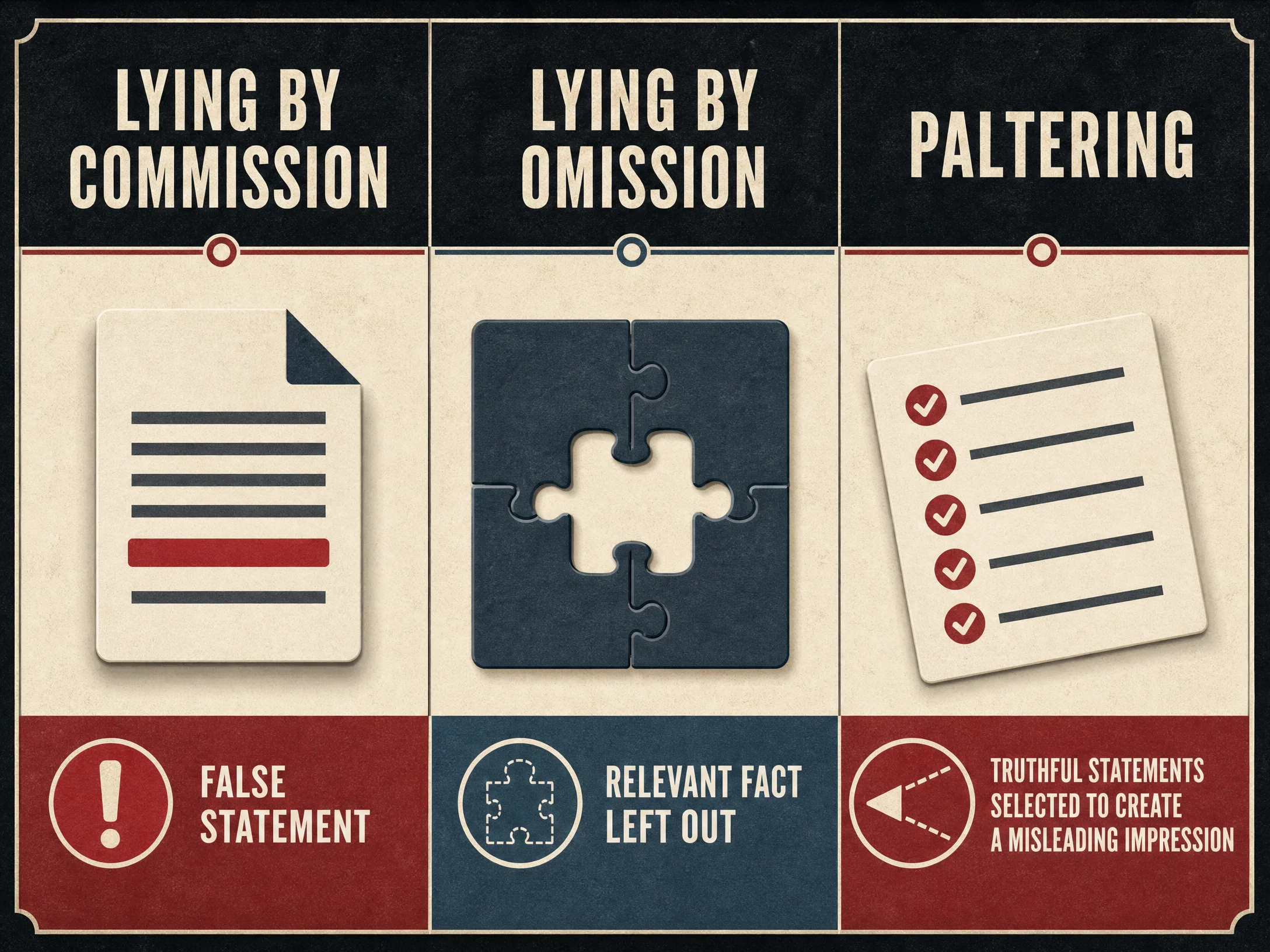
Paltering is a form of deceptive communication in which someone actively uses truthful statements to create a misleading impression. The speaker may be able to defend each sentence as literally true, while the listener is guided toward a conclusion that the speaker knows is incomplete or false. Researchers distinguish paltering from lying by commission, which uses false statements, and lying by omission, which involves failing to disclose relevant information.1
The concept matters because honest communication is about more than isolated sentence-level accuracy. Relevance, context, material information, reasonable expectations, and the impression created by the overall answer also matter. A person who answers a direct question with unrelated facts may not have uttered a false sentence, but they may still have avoided the information the question reasonably called for.
Safety note: This article explains paltering for ethical literacy and recognition. It is not a guide for deceiving people in negotiations, relationships, sales, politics, or work. Do not use the examples as a playbook for misleading another person.
The short answer
The difference can be summarized this way:
- Lying by commission: A person states something they know is false.
- Lying by omission: A person leaves out relevant information, often by failing to disclose it.
- Paltering: A person actively selects or emphasizes truthful statements to create a misleading impression.
The categories can overlap in real conversations. A person may palter by answering only the favorable part of a question and also omit a material limitation. The key issue is not whether every word can be defended in isolation. It is whether the communication intentionally or functionally steers another person toward a mistaken understanding.
For the broader communication framework, read Manipulative Communication Styles: Language Patterns, Examples, and Boundaries. For the distinction between ethical influence and manipulation, read Psychological Manipulation vs. Persuasion.
Paltering, omission, and lying compared
| Form of deception | What happens | Simple original example |
|---|---|---|
| Lying by commission | A false statement is presented as true | A seller says a device is new when they know it was previously used |
| Lying by omission | A relevant fact is not disclosed | A seller answers a question about features but does not mention a known safety recall when it is material to the decision |
| Paltering | Truthful statements are actively selected to create a misleading impression | Asked whether a device has had problems, a seller lists its popular features and says “thousands of people use it,” without addressing the direct question |
These examples are simplified. Whether a fact is relevant, material, or reasonably expected to be disclosed depends on context. The article is not legal advice, and the legal meaning of misrepresentation varies by jurisdiction and situation. The American Bar Association notes that, in professional-conduct contexts, partially true but misleading statements or omissions can sometimes amount to misrepresentation.4
What research says about paltering
A study by Rogers and colleagues, published in the Journal of Personality and Social Psychology, describes paltering as a distinct form of deception. The researchers report that paltering differs from false statements and passive omission, can occur in negotiations, and can create conflict because the speaker focuses on the literal truth of the words while the target focuses on the misleading impression.2
The same research found that targets can view paltering especially negatively when it is used in response to a direct question. The American Psychological Association’s summary explains that people may prefer paltering to an outright lie because it feels more defensible, but discovery can damage trust and reputation just as seriously.1
Harvard Kennedy School describes paltering as the active use of truthful statements to convey a misleading impression and notes that it may produce short-term advantages while increasing long-term relationship and reputation risks.3 These findings do not mean that every incomplete answer is paltering. They show why sentence-level truth and communicative honesty should not be treated as identical.
How paltering works without a false sentence
Selective truth
A person chooses true facts that support the impression they want and avoids facts that would complicate it. The selected facts may be accurate, but the selection is not neutral if the omitted information is central to the listener’s decision.
Answer substitution
Instead of answering the question asked, the speaker answers an easier question. Asked whether a contract includes a cancellation fee, they describe the service’s benefits. Asked whether a person made a promise, they discuss how busy they have been. The answer may contain true information but still avoid the relevant issue.
Technical precision
A speaker uses a narrow interpretation of the words to deny the reasonable meaning of the question. They may say, “I never said I would do it today,” even though they repeatedly created the expectation that it would happen today. Technical precision can be useful when clarifying facts; it becomes misleading when used to evade an obvious context.
Positive framing that hides a limitation
The speaker emphasizes a benefit while leaving the material limitation outside the frame. “This plan has unlimited messaging” may be true while failing to mention a restriction that is essential to the buyer’s decision. Positive framing is not automatically deceptive, but a relevant limitation should not be hidden behind a technically accurate headline.
Literal truth used as a shield
After the listener discovers the misleading impression, the speaker says, “But everything I said was true.” That response addresses sentence accuracy but not whether the speaker knowingly guided the listener away from a relevant understanding. A sincere person may clarify the context and answer the original question. A person committed to evasion may keep defending the wording without addressing the impression.
Paltering in everyday relationships
Paltering is often discussed in negotiations, but similar communication patterns can appear in relationships, families, friendships, and workplaces. The issue is not that every private answer must contain every detail. People have legitimate privacy boundaries. The issue is whether a person gives a selective answer to obtain a decision, avoid accountability, or control another person’s understanding.
A partner asks whether an agreement was made about shared money. The other person says, “I have always paid the rent,” while avoiding the separate question about an unapproved purchase. A friend asks whether a group criticized them. The answer is, “Everyone had a good time,” while withholding a specific conversation that would change how the friend understands the situation. A manager is asked whether a role includes weekend work and describes the team’s flexibility without answering the scheduling expectation.
These examples require context. People may misremember, misunderstand, or need time to gather information. Ask whether the person clarifies when the gap is pointed out and whether the withheld fact was relevant to the decision.
For broader recognition patterns, read Signs of Emotional Manipulation: How to Recognize Patterns by Style. For the relationship context, read Types of Emotional Manipulation in Relationships.
Paltering versus ordinary brevity and privacy
Not every short answer is dishonest. People may be tired, distracted, unsure, protecting confidential information, or responding to a question that does not create a reasonable expectation of full disclosure. A person can also decline to answer directly without lying: “I am not comfortable discussing that.”
A useful distinction is whether the speaker is protecting a legitimate boundary or creating a false impression to obtain an advantage. Privacy says, “I will not share that information.” Paltering often says something technically true that encourages the listener to believe the relevant information is favorable or nonexistent.
| Situation | More transparent option | More misleading pattern |
|---|---|---|
| Confidential information | “I cannot discuss that.” | A true but unrelated answer designed to make the listener stop asking |
| Uncertain memory | “I do not remember; let me check.” | A confident favorable detail used to replace the missing answer |
| Material limitation | “There is a limitation you should know before deciding.” | Benefits are emphasized while the limitation is kept out of view |
| Relationship question | “I need time to answer honestly.” | Selective facts are used to make the other person infer a false conclusion |
The standard should be proportionate. A casual conversation does not require a legal disclosure statement. A decision involving money, safety, consent, health, work, or major commitments requires greater care with relevance and material facts.
How to recognize possible paltering
You do not need to prove someone’s inner motive before asking for clarification. Notice whether the answer:
- directly addresses the question or changes the subject;
- supplies favorable facts while avoiding the central limitation;
- relies on narrow wording that conflicts with the reasonable context;
- becomes defensive when you ask a relevant follow-up;
- leaves you with a materially different impression from what later facts support; or
- repeats across situations where the speaker benefits from your misunderstanding.
A single evasive answer can have many explanations. The pattern becomes more concerning when a person repeatedly uses literal truth to avoid a relevant answer and then blames you for the mistaken impression.
How to ask clarifying questions
Keep the question specific and return to the information needed for the decision:
“That answers a different part of my question. Did the contract include a cancellation fee?”
“I understand that fact is true. What limitation or risk should I know before deciding?”
“Are you saying you did not make the promise, or that you made it but did not set a date?”
“I want to separate what we know from what we are inferring. Which part can we verify?”
You do not need to argue about whether the person is a “palterer.” Ask for the relevant fact, verify it independently when appropriate, and slow down a decision that does not need to be immediate.
Paltering and psychological manipulation
Paltering becomes part of a manipulation pattern when selective truthful statements are used to control another person’s choices, emotions, or access to support. For example, a person may use technically accurate statements to make you feel guilty, deny a boundary violation, isolate you from outside information, or avoid accountability.
The presence of paltering does not establish a mental disorder or a fixed personality type. It may be strategic, habitual, defensive, or situational. The safer focus is the behavior and its impact: Are you receiving enough relevant information to choose freely? Can questions be asked without punishment? Does the person correct the impression when it becomes clear?
For related patterns, read Covert Manipulation: Subtle Control and Hidden Emotional Pressure, Gaslighting, and DARVO: Deny, Attack, and Reverse Victim and Offender.
What to do when you think you were misled
Start with the least risky step that protects your choice. Pause a major decision, request the relevant information in writing, compare independent sources, consult a trusted person, or ask a qualified professional for context. If the issue concerns finances, employment, health, consent, or legal rights, obtain appropriate professional advice rather than relying on an online label.
If the person becomes threatening, surveils you, controls money or housing, or punishes you for seeking information, prioritize safety and confidential support. Do not bait, secretly record, expose, or confront someone without understanding the potential risks. For safer documentation principles, read How to Document Gaslighting or Emotional Abuse Safely.
Frequently asked questions
Is paltering the same as lying?
Paltering is a distinct form of deception that uses truthful statements to create a misleading impression. Lying by commission uses false statements, while lying by omission fails to disclose relevant information. In everyday situations, the categories can overlap, and the ethical assessment depends on context and materiality.
Can a truthful statement still be misleading?
Yes. A statement can be literally true while being misleading if it is selected, framed, or used to answer a different question in a way that creates a mistaken impression. Truthful communication also depends on relevance, context, and whether important limitations are hidden.
What is an example of paltering?
If someone is asked whether a product has a known limitation and responds only by listing its benefits, the statements may be true but still avoid the relevant question. A clearer example should identify the limitation rather than teach someone how to evade it.
Is lying by omission the same as paltering?
No. Lying by omission is generally described as failing to disclose relevant information. Paltering is the active use of truthful statements to create a misleading impression. A conversation can involve both: a person may actively emphasize favorable facts while omitting an important limitation.
Why do people palter?
Research suggests that people may find paltering easier to justify because they focus on the literal truth of their statements. They may also want to avoid a harmful answer, gain an advantage, protect an image, or reduce immediate conflict. Understanding a possible reason does not remove the effect on trust.
How can I respond to a misleading truthful answer?
Return to the exact question, ask for the relevant fact or limitation, verify important information independently, and slow down the decision if possible. You do not need to prove intent. If asking questions creates danger or retaliation, seek confidential support before continuing.
Final takeaway
Paltering is not simply “being technically correct.” It is the active use of truthful statements to create a misleading impression. Unlike a false statement, the words may be accurate; unlike a passive omission, the selection of facts may actively steer the listener away from the relevant understanding.
Honest communication leaves room for context, material limitations, clarifying questions, and free choice. When a person repeatedly uses literal truth to avoid a relevant answer and benefits from your mistaken impression, slow down, verify what matters, and protect your options.
References
Canonical URL: Open the canonical article page