Parental Psychological Control and Manipulation: Signs, Examples, and Safe Support
GenZ Frontier Editorial | August 17, 2026
Parents and caregivers can set rules, monitor safety, and make decisions for children. Parental psychological control is different: it describes intrusive or manipulative efforts to control a child’s thoughts, feelings, attachments, self-expression, or sense of worth. It can include guilt, shame, conditional affection, emotional withdrawal, invalidation, loyalty tests, and pressure to suppress independent opinions.
A household rule is not automatically manipulation. Children need age-appropriate limits, and parents may restrict unsafe behavior. The important distinction is whether the rule is explained and proportionate, or whether the parent uses the child’s love, identity, fear, or emotional security as leverage.
Safety note: This article does not tell minors to confront a caregiver, leave home, or take a risky action. If you are under 18 and feel unsafe, contact a trusted adult, school counselor, doctor, child-protection service, or emergency service when appropriate. If a device is monitored, seek help through a safer method.
The short answer
Possible psychological-control patterns include:
- “If you loved me, you would agree with me”;
- treating normal independence as betrayal or disrespect;
- making affection, approval, money, or contact conditional on obedience;
- dismissing feelings instead of discussing the behavior or safety issue;
- forcing a child to manage a parent’s emotions or relationship conflict; or
- using shame, silent treatment, threats of abandonment, or loyalty tests to enforce compliance.
One difficult conversation does not establish a pattern. Look at repetition, age and power, the child’s ability to disagree safely, and whether the adult can repair without making the child responsible for the adult’s feelings.
For the broader family context, read Manipulation in Friendships and Families.
Behavioral control versus psychological control
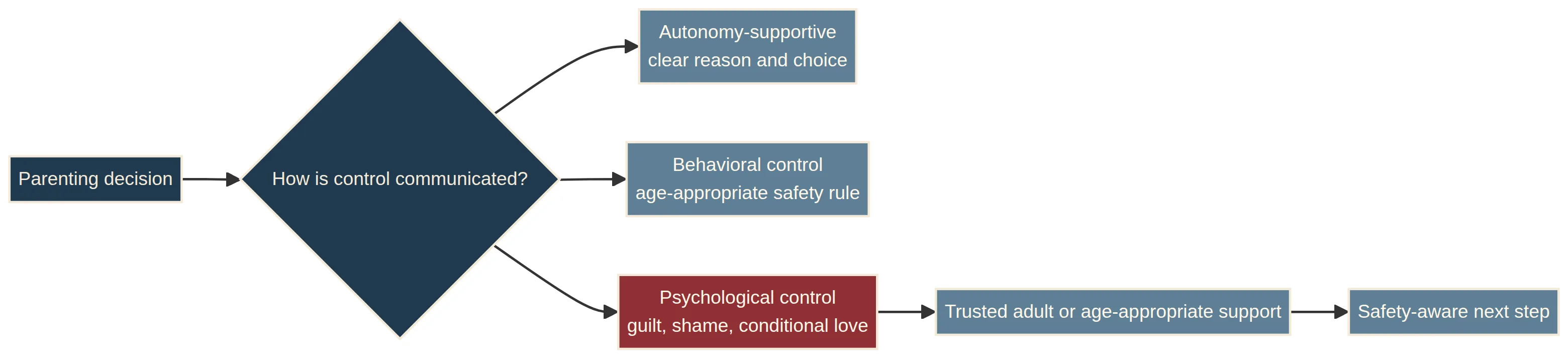
| Approach | What it may look like | Effect on autonomy |
|---|---|---|
| Autonomy-supportive boundary | Clear reason, age-appropriate choice, respectful explanation | Builds understanding while preserving a child’s voice |
| Behavioral control | A rule about safety, health, school, or shared responsibilities | Can be appropriate when proportionate and consistently explained |
| Psychological control | Guilt, shame, conditional love, invalidation, loyalty tests, or intrusion into feelings | Pressures the child to surrender emotional or personal autonomy |
Healthy parenting can include “no.” The question is not whether a parent ever disappoints a child; it is whether the child can have feelings and ask questions without losing love, safety, or basic respect.
Common patterns to recognize
Guilt and conditional affection
A parent may say, “After everything I do for you,” or “You are not my child when you act like that,” to make ordinary disagreement feel like moral failure. Appreciation can be requested directly. Turning love into a reward for obedience creates a different kind of pressure.
Invalidation
The parent may say the child is too sensitive, dramatic, ungrateful, or confused whenever the child reports an experience. A parent can disagree with an interpretation while still acknowledging a feeling: “I see that upset you; let’s talk about what happened.”
Loyalty tests and triangulation
A child may be pressured to choose between parents, keep secrets, reject a safe relative, or carry messages between adults. Children should not have to prove loyalty by giving up supportive relationships.
Parentification
Children may be expected to manage a parent’s emotions, finances, caregiving, or relationship conflict beyond what is age-appropriate. Helping with household responsibilities is not automatically parentification; the concern is when the child becomes responsible for adult stability or feels punished for having their own needs.
Privacy intrusion and enmeshment
Reasonable safety monitoring differs from demanding access to every thought, message, friendship, or feeling as proof of love. Children and teens need age-appropriate privacy and a growing opportunity to make decisions.
Emotional withdrawal and silent treatment
A caregiver may stop speaking, remove affection, or threaten abandonment to force compliance. A parent can take a calm pause and return to a discussion. Punishing a child with prolonged uncertainty is different from regulating an emotion safely.
For the distinction, read Silent Treatment vs. Taking Space.
Examples by age and context
Younger children
A caregiver may frame a normal need for rest, play, or comfort as proof that the child is selfish. Young children may not have the language or power to challenge the message. Another safe adult can help name the feeling and reinforce that care is not earned by perfect compliance.
Teenagers
Teens need supervision, but a parent can set safety rules without attacking identity, threatening abandonment, humiliating them, or making every independent opinion a betrayal. A teen who fears retaliation should not be pushed into a direct confrontation; a trusted adult can help assess safer options.
Adult children
Psychological control can continue after a child leaves home through financial threats, demands for constant access, conditional contact, family campaigns, or pressure to surrender relationships and decisions. Adult children can set boundaries gradually and seek support without needing the parent’s agreement.
How to seek support safely
If you are a minor, consider a trusted teacher, school counselor, nurse, doctor, coach, relative, or another adult who can listen without escalating the situation. Tell them what happens, how often, what you fear will happen if the caregiver finds out, and what support would feel safer.
If you are an adult, describe observable behavior rather than trying to diagnose a parent. Decide what contact, information, money, or topics you can safely share. If finances, housing, documents, or threats are involved, seek qualified advice and make a safety plan before changing arrangements.
Do not store sensitive documentation where a caregiver can find it or use a monitored device to seek help. For safe documentation context, read How to Document Gaslighting or Emotional Abuse Safely. For broader safety patterns, read Coercive Control and Emotional Abuse.
Frequently asked questions
What is parental psychological control?
It is intrusive or manipulative parenting that pressures a child’s thoughts, feelings, attachments, self-expression, or sense of worth. Examples include guilt, shame, conditional affection, invalidation, loyalty tests, and emotional withdrawal.
Is strict parenting psychological control?
Not automatically. Clear, age-appropriate safety rules can be behavioral control rather than psychological control. The concern is whether the parent uses fear, shame, conditional love, or identity attacks rather than a proportionate explanation and limit.
What are signs of manipulative parents?
Possible signs include guilt-tripping, conditional affection, invalidating feelings, demanding loyalty, involving a child in adult conflict, using silent treatment, threatening abandonment, and punishing healthy independence. Context and repetition matter.
What should a teenager do if a parent is emotionally controlling?
You do not have to confront the parent alone. Consider telling a trusted adult, school counselor, doctor, or child-protection professional what is happening and what you fear. If there is immediate danger, contact emergency services.
Can psychological control affect adult children?
Yes. The pattern may continue through financial dependence, threats to withdraw contact, family pressure, privacy demands, or punishment for independent choices. Adult children can set gradual boundaries and seek outside support.
Final takeaway
Parental psychological control differs from ordinary parenting limits because it uses a child’s emotional security, identity, attachment, or sense of worth to force compliance. A safe boundary can be firm without making love conditional or treating independence as betrayal.
Focus on observable patterns, age and power, safety, and supportive adults. You do not need a perfect label before asking for help.
References
Canonical URL: Open the canonical article page