Signs of Emotional Manipulation: How to Recognize Patterns by Style
GenZ Frontier Editorial | August 17, 2026
It can be difficult to tell whether someone is manipulating you, especially when the interaction involves a partner, relative, friend, coworker, caregiver, or another person you trust. You may leave conversations feeling guilty, confused, pressured, or unsure whether your reaction is reasonable. You may also notice that the same disagreement keeps returning even after you have explained your needs.
Those feelings deserve attention, but one uncomfortable conversation does not prove manipulation. People can communicate poorly, remember events differently, become defensive, feel hurt, or make mistakes without engaging in a sustained pattern of control. A more reliable assessment looks at repetition, pressure, transparency, power, boundaries, support, and what happens when you say no.
This guide explains possible warning patterns and safer ways to think about them. It does not diagnose another person, determine whether a relationship is legally abusive, or provide a guaranteed test. If you face threats, stalking, surveillance, financial control, or physical danger, prioritize safety and confidential support over confrontation.
The Short Answer
You may want to look more closely at an interaction when someone repeatedly:
- makes you feel responsible for their emotions or choices;
- pressures you after you have said no or asked for time;
- twists, withholds, or selectively presents important information;
- causes you to doubt your memory, perception, or reasonable needs;
- isolates you from trusted people or makes support feel disloyal;
- uses affection, money, fear, shame, or anger to obtain compliance;
- moves the standard so that nothing you do is ever enough; or
- punishes you when you set a normal boundary.
These are possible indicators, not proof. The central question is whether the behavior forms a repeated pattern that reduces your ability to make an informed, voluntary, and safe choice.
Signs organized by manipulation style
A behavior can have more than one explanation. Use the table to organize what you observe, then look at repetition, power, transparency, boundaries, and the response to “no.”
| Style | Observable signal | Alternative explanation to consider | Safer question |
|---|---|---|---|
| Pressure | Urgency, repeated requests, or punishment for delay | A real deadline or emergency | Can I verify the deadline and take reasonable time? |
| Emotional leverage | Guilt, shame, obligation, or fear used after a boundary | Honest disappointment or a request for support | Can the person express hurt without forcing compliance? |
| Information control | Omission, misleading framing, denial, or changing facts | Forgetfulness, confusion, or poor communication | Can the facts be checked independently? |
| Withdrawal / reward | Affection, contact, or approval appears after compliance and disappears after independence | Stress, ambivalence, or a need for space | Is the pattern communicated and consistent over time? |
| Social control | Isolation, triangulation, jealousy, or pressure to choose sides | A specific, evidence-based concern about one relationship | Are outside relationships and perspectives still allowed? |
| Degradation | Contempt, humiliation, negging, or attacks on competence | One clumsy joke or respectful criticism | Can the person hear the impact and repair it? |
| Resource control | Money, housing, work, passwords, location, or transport used as leverage | Mutual planning or voluntary sharing | Is consent genuine and safe to withdraw? |
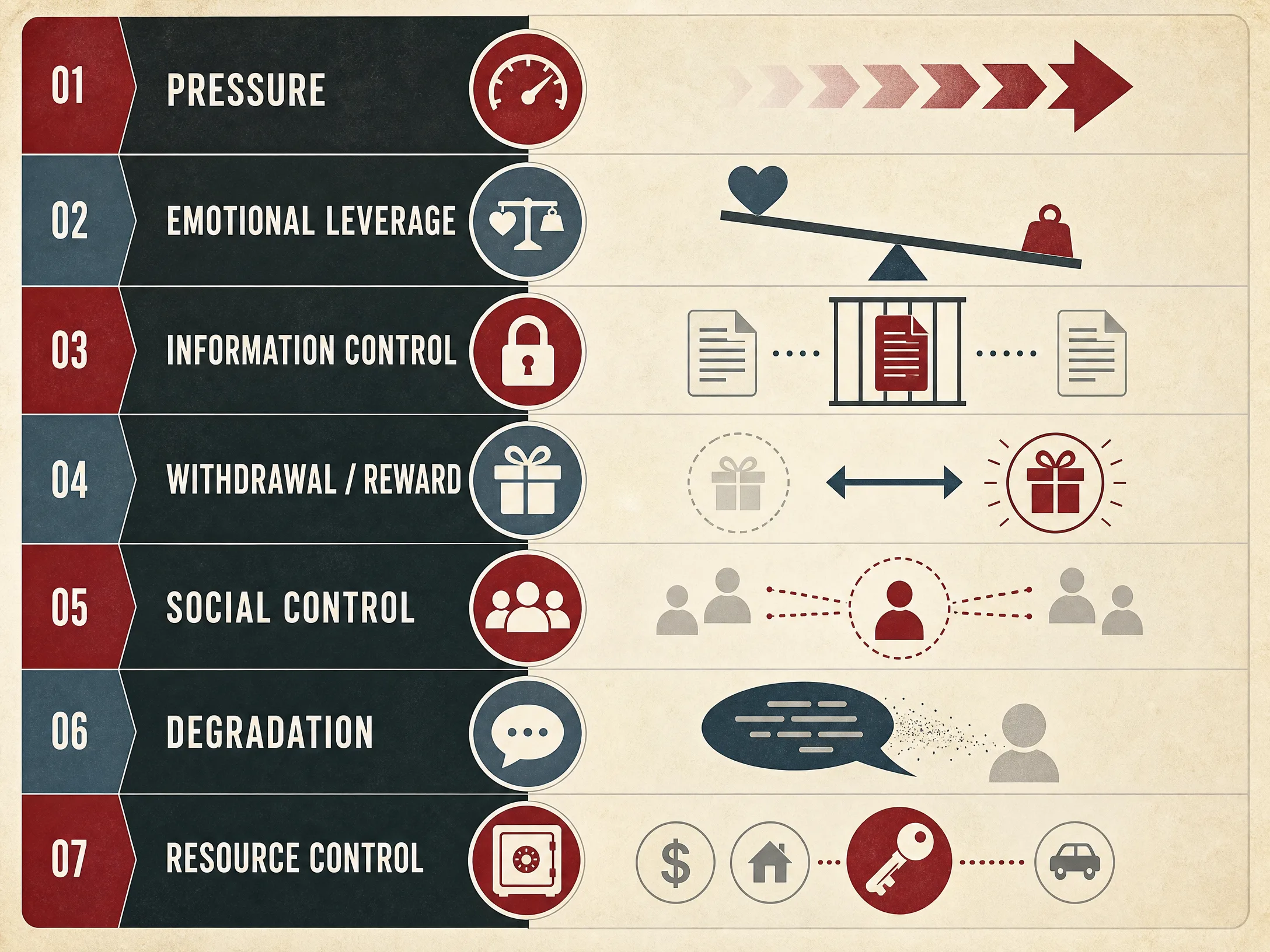
This framework is not a scorecard. A single sign does not prove manipulation, and readers should not diagnose another person from an online list. It is a way to identify which questions deserve more attention and whether outside support may be useful.
For the broader definition, read Psychological Manipulation: Definition, Types, Signs, Examples, and What to Do.
What Counts as a Pattern?
A pattern is more than a single phrase or isolated mistake. It may involve the same type of pressure appearing across different situations, an escalation when you resist, or a cycle in which the person apologizes briefly and then repeats the behavior.
Consider these questions:
| Question | What it helps you examine |
|---|---|
| How often does it happen? | Repetition and escalation rather than one event |
| What happens when you say no? | Respect, disappointment, pressure, retaliation, or threats |
| What information is available? | Transparency, selective facts, distortion, and missing context |
| Who has power? | Money, housing, employment, caregiving, status, age, or social influence |
| Can you seek support? | Isolation, monitoring, dependency, or freedom to consult others |
| Can the person repair harm? | Accountability, changed behavior, and respect for boundaries |
This is a reflection framework, not a scoring system. Do not conclude that “five signs means someone is a manipulator.” Human behavior is context-dependent, and online lists cannot establish intent or diagnosis.
Possible Signs of Manipulation
1. You feel pressured to decide immediately
A person may create false urgency so you cannot pause, ask questions, compare options, or consult someone you trust. They may say that you must decide right now, that waiting proves disloyalty, or that one missed opportunity will destroy everything.
Urgency is not automatically manipulation. Emergencies and time-sensitive decisions are real. The concern grows when urgency is used repeatedly for choices that could reasonably allow time for reflection.
A neutral response may be: “I am not making this decision under pressure. I need time to think.” If that response triggers retaliation or threats, focus on safety rather than winning the discussion.
2. Guilt is used to override a boundary
A person may remind you of everything they have done for you, describe you as selfish, or imply that your care can be measured by whether you comply with a request. Guilt can be part of ordinary emotional communication, but it becomes more concerning when it is repeatedly used to make a reasonable boundary feel immoral.
For example, “I am disappointed that you cannot help today” communicates feeling. “If you cared about me, you would cancel your plans, and I will never forgive you if you refuse” applies stronger pressure. The pattern and response to refusal matter more than one sentence.
3. Your feelings are dismissed or redefined
A person may tell you that you are too sensitive, too dramatic, irrational, or unable to understand what happened. Sometimes people disagree about an event or use poor wording during conflict. Concern grows when your feelings are repeatedly dismissed so that the other person does not have to address their behavior.
This pattern can make you stop raising concerns because you expect to be criticized rather than heard. Notice whether the person becomes willing to understand after you explain the impact, or whether every concern is turned into evidence that you are the problem.
4. Important facts are distorted or selectively withheld
Manipulation may involve lying, exaggeration, omission, misleading framing, or presenting only the information that supports one desired conclusion. A person may deny a written agreement, hide a relevant consequence, or change the story when you ask for details.
Incomplete information can also result from forgetfulness, embarrassment, confusion, or disorganization. The key questions are whether the pattern benefits the person, whether they correct the record when shown evidence, and whether they become hostile when you ask ordinary questions.
5. You are repeatedly made to doubt your memory or perception
Gaslighting is a more specific and debated term for repeated behavior that can undermine confidence in memory, perception, or understanding. It is not the same as every lie, disagreement, or different memory.
A concerning pattern might involve repeated denial of documented events, insistence that conversations never happened, attacks on your credibility, and pressure to rely only on the other person’s version of reality. A single factual disagreement does not establish gaslighting.
For a focused explanation, read Gaslighting: Meaning, Signs, Examples, and How It Differs From Lying.
6. The person punishes you for saying no
Punishment can take different forms: anger, withdrawal, ridicule, threats, financial consequences, public embarrassment, or sudden withdrawal of affection. A person is allowed to feel disappointed. The concern is whether disappointment becomes a repeated tool to make refusal too costly.
Ask what happens after you state a reasonable limit. Can the other person tolerate a different answer, or do they escalate until you give in? This question often reveals more than the original request.
7. Affection or approval becomes conditional
Love, praise, attention, sex, friendship, or professional approval may be offered only when you comply with the other person’s expectations. The relationship can begin to feel like a system in which independence leads to punishment and agreement earns temporary warmth.
Conditional affection is not the same as communicating a real relationship boundary. Someone may decide they cannot continue a relationship under certain conditions. The concern grows when affection is repeatedly threatened to control ordinary choices, friendships, clothing, work, or opinions.
8. You are isolated from support
Isolation may involve discouraging contact with family, friends, coworkers, counselors, or other sources of perspective. It can also involve monitoring your messages, creating conflict with people you trust, making you feel guilty for seeing them, or claiming that only the controlling person understands you.
Chayn’s survivor-centered resource describes isolation as a control tactic that can weaken support networks and increase dependence.2 However, privacy requests and concerns about one specific relationship are not automatically isolation. The pattern becomes more concerning when support is repeatedly restricted or made unsafe.
9. Money, work, housing, or resources are used as leverage
Financial control can include restricting access to money, demanding passwords, preventing work or education, taking out debt in someone else’s name, monitoring every purchase, or using gifts to create a sense of permanent obligation. Housing and employment can also be used as leverage.
Shared budgeting, temporary support, and discussions about expenses are not automatically financial abuse. Concern grows when one person removes the other’s ability to make reasonable financial choices or uses essential resources to force compliance.
If money or housing is involved, plan carefully and seek appropriate financial or domestic-abuse support. Do not assume that confronting the person will improve the situation.
10. The person uses comparison and humiliation
A person may compare you with a friend, sibling, coworker, or imagined ideal to make you feel inadequate. They may use “jokes” about your weaknesses, criticize you in public, or tell you that no one else would tolerate you.
Healthy feedback can identify a behavior and leave room for improvement. Repeated humiliation attacks a person’s worth, reduces confidence, or creates dependency. Context matters, but contempt and public degradation deserve attention.
11. Responsibility keeps moving back to you
Blame shifting occurs when a person avoids responsibility by focusing entirely on your reaction, your tone, or an unrelated mistake. You may raise a concern about a broken agreement and end up apologizing for bringing it up.
Defensiveness can happen in ordinary conflict. Look for repetition: Does the person ever acknowledge their part, or does every conversation end with you carrying all the blame? Can the original issue be discussed, or does it disappear under accusations about your character?
12. The standard keeps changing
Moving goalposts can make it feel as if compliance is always one explanation away. After you meet one request, the person introduces a new requirement or says that your response was not sincere enough.
Expectations can legitimately change as circumstances change. The warning pattern is the repeated use of shifting standards to deny progress, keep you uncertain, or make you responsible for an impossible level of proof.
13. The person recruits others to pressure you
Triangulation can involve bringing a third person into a conflict to create jealousy, competition, secrecy, or loyalty tests. A person may tell you what others supposedly said, pressure you to choose sides, or recruit mutual friends to criticize your decision.
Seeking advice, involving mediation, and asking a trusted person for help are not automatically triangulation. The concern grows when information is used to isolate you, create conflict, or make you dependent on the person controlling the messages.
14. You are encouraged to distrust your own support network
A person may describe everyone else as jealous, disloyal, stupid, or dangerous so that their own account becomes the only trusted one. They may insist that people who question the relationship are trying to destroy it.
It is possible for a friend or partner to raise a legitimate concern about someone in your life. Consider whether the person offers specific, verifiable reasons and respects your ability to decide, or whether they demand that you cut off support without discussion.
15. The interaction leaves you chronically confused or afraid
No single feeling proves manipulation, but a persistent pattern of confusion, anxiety, fear, obligation, or walking on eggshells can be important information. You may notice that you rehearse every sentence, apologize constantly, stop asking questions, or feel unable to make ordinary decisions without approval.
These feelings can also arise from anxiety, trauma, depression, stressful circumstances, or a difficult but non-manipulative conflict. The goal is not to diagnose the other person from your emotional response. The goal is to take your experience seriously enough to seek perspective and support.
Behaviors That Are Not Automatically Manipulation
A responsible guide must include false-positive cautions. The following can occur in healthy or complicated interactions without proving manipulation:
- taking time to cool down after an argument;
- expressing disappointment or hurt;
- asking for reassurance;
- giving a strong opinion or recommendation;
- correcting an inaccurate statement;
- needing help because of illness, disability, stress, or grief;
- setting a relationship boundary;
- changing a plan after new information appears;
- seeking advice from a trusted person; or
- making a mistake and becoming defensive once.
The difference is often visible over time. Does the person listen, answer questions, respect your decision, accept accountability, and change behavior? Or do they repeatedly increase pressure, distort the situation, and punish independence?
How to Check Your Interpretation Safely
If you are unsure, avoid relying on one dramatic phrase or one online checklist. Instead, write down what was requested, what information was shared, what you said, what happened after you set a boundary, and whether the same pattern has appeared before.
If it is safe, compare your understanding with a trusted person who is not controlled by the situation. Choose someone who can listen without forcing you to make a decision. Professional support may also help you separate ordinary conflict, trauma responses, communication problems, and coercive patterns.
Do not secretly record, bait, trap, or publicly expose someone without understanding the legal and safety consequences. Documentation can create risk if devices or accounts are monitored. If you need documentation for safety or legal reasons, seek jurisdiction-appropriate advice and use a safer method.
What to Do If You Think You Are Being Manipulated
Start with the least risky step that helps you preserve choice. You might pause the decision, ask for information in writing, speak with a trusted person, protect access to important accounts, or set a small boundary and observe the response.
Possible statements include:
“I need time to think before I answer.”
“I am willing to discuss the issue, but I am not agreeing to that demand.”
“I remember the situation differently, and I want to check the information before deciding.”
“I will continue this conversation when we can speak respectfully.”
These are not magic phrases. A person who is committed to control may ignore them or escalate. If retaliation, surveillance, financial control, stalking, or physical danger is present, direct confrontation may not be safest.
For practical response guidance, read How to Respond to Emotional Manipulation Without Escalating Risk. For documentation questions, read How to Document Gaslighting or Emotional Abuse Safely.
Frequently Asked Questions
How can I tell if someone is manipulating me?
Look for a repeated pattern of pressure, guilt, deception, isolation, boundary violations, or punishment for saying no. Also examine power, transparency, available choices, and whether the person can repair harm. One behavior or one difficult conversation does not prove manipulation.
What are common signs of emotional manipulation?
Possible signs include repeated pressure, guilt-based control, conditional affection, threats, selective facts, blame shifting, humiliation, silent treatment used as punishment, isolation from support, moving goalposts, resource control, and pressure that escalates after refusal. These are indicators for reflection, not a diagnosis.
What are the main emotional manipulation styles?
Common style families include pressure, emotional leverage, information control, withdrawal and conditional reward, social control, degradation, and resource control. Labels such as gaslighting, guilt-tripping, triangulation, silent treatment, and financial control can overlap with these families. The pattern and context matter more than the label.
Is it manipulation if someone makes me feel guilty?
Not always. People can express hurt or disappointment without trying to control you. Guilt becomes more concerning when it is repeatedly used to override a reasonable boundary, create fear of refusal, or make you responsible for another person’s choices and emotions.
Is gaslighting the same as lying?
No. Gaslighting is a more specific and debated term for repeated reality-undermining behavior that can cause someone to doubt their memory or perception. A single lie, disagreement, or different memory is not automatically gaslighting.
Is the silent treatment a sign of manipulation?
It can be, especially when silence is used repeatedly to punish, pressure, or force an apology. It is different from clearly communicating a need for time to calm down and returning to the conversation later.
Can someone manipulate without realizing it?
Possibly. Intent can be difficult to establish, and people may use pressure or poor communication without understanding its effect. Focus on the pattern, the impact on choice, the response to feedback, and whether the person changes behavior.
Should I confront someone I think is manipulating me?
Not automatically. If the relationship is safe and the power balance allows it, a clear boundary or request for information may help. If there are threats, surveillance, financial control, stalking, or physical danger, prioritize confidential support and safety planning instead of confrontation.
How do I know whether I am overreacting?
Try to separate the observable event from the label. Write down what happened, what was requested, how you responded, and what happened after you said no. Seek perspective from someone trustworthy or a qualified professional. You do not need to prove that another person is a manipulator before taking your discomfort seriously.
Final Takeaway
You may be dealing with a concerning manipulation pattern when pressure, guilt, deception, isolation, humiliation, conditional affection, resource control, or punishment repeatedly reduce your ability to make independent choices. The strongest clue is usually not a single phrase. It is the pattern over time and the response to reasonable boundaries.
Keep alternative explanations in view. Poor communication, stress, illness, disability, grief, insecurity, and ordinary conflict can resemble some warning signs. A careful assessment describes behavior rather than diagnosing a person.
If you feel unsafe, seek support in a way that protects your privacy. You deserve access to information, trusted relationships, and decisions that are not forced by fear.
References
Canonical URL: Open the canonical article page