Reverse Psychology and Autonomy Pressure: Meaning, Examples, and Safer Alternatives
GenZ Frontier Editorial | August 17, 2026
Reverse psychology is a popular term for encouraging someone to do something by suggesting, appearing to prefer, or arguing for the opposite. The idea is often connected to psychological reactance: when people feel that their freedom is being restricted, they may feel motivated to restore a sense of choice. Individual reactions vary, however, and reverse psychology is not a guaranteed psychological law or a clinical diagnosis.
In low-stakes situations, a playful indirect suggestion may be harmless. In higher-stakes relationships, reverse psychology can become manipulative when a person hides the real goal, exploits another person’s vulnerabilities, creates guilt or fear, or makes refusal costly. The safest alternative is usually direct communication that leaves room for an informed “no.”
Safety note: This article is for recognition and ethical communication. It does not provide tricks for controlling people, children, partners, coworkers, or customers. If indirect pressure occurs alongside threats, surveillance, financial control, stalking, or physical danger, prioritize confidential support and safety planning.
The short answer
Reverse psychology may look like:
- saying “You probably should not come” while hoping the other person insists on being invited;
- acting uninterested to provoke someone into proving that they care;
- presenting the opposite choice so that a person feels pushed to choose the desired one; or
- using a person’s independence, pride, fear of rejection, or need for approval as leverage.
The behavior is not automatically abusive or unethical. Ask whether the real goal is disclosed, whether the person can decline freely, whether important information is available, and whether a different choice leads to punishment.
For the broader distinction between influence and manipulation, read Psychological Manipulation vs. Persuasion.
Reverse psychology compared with ethical persuasion
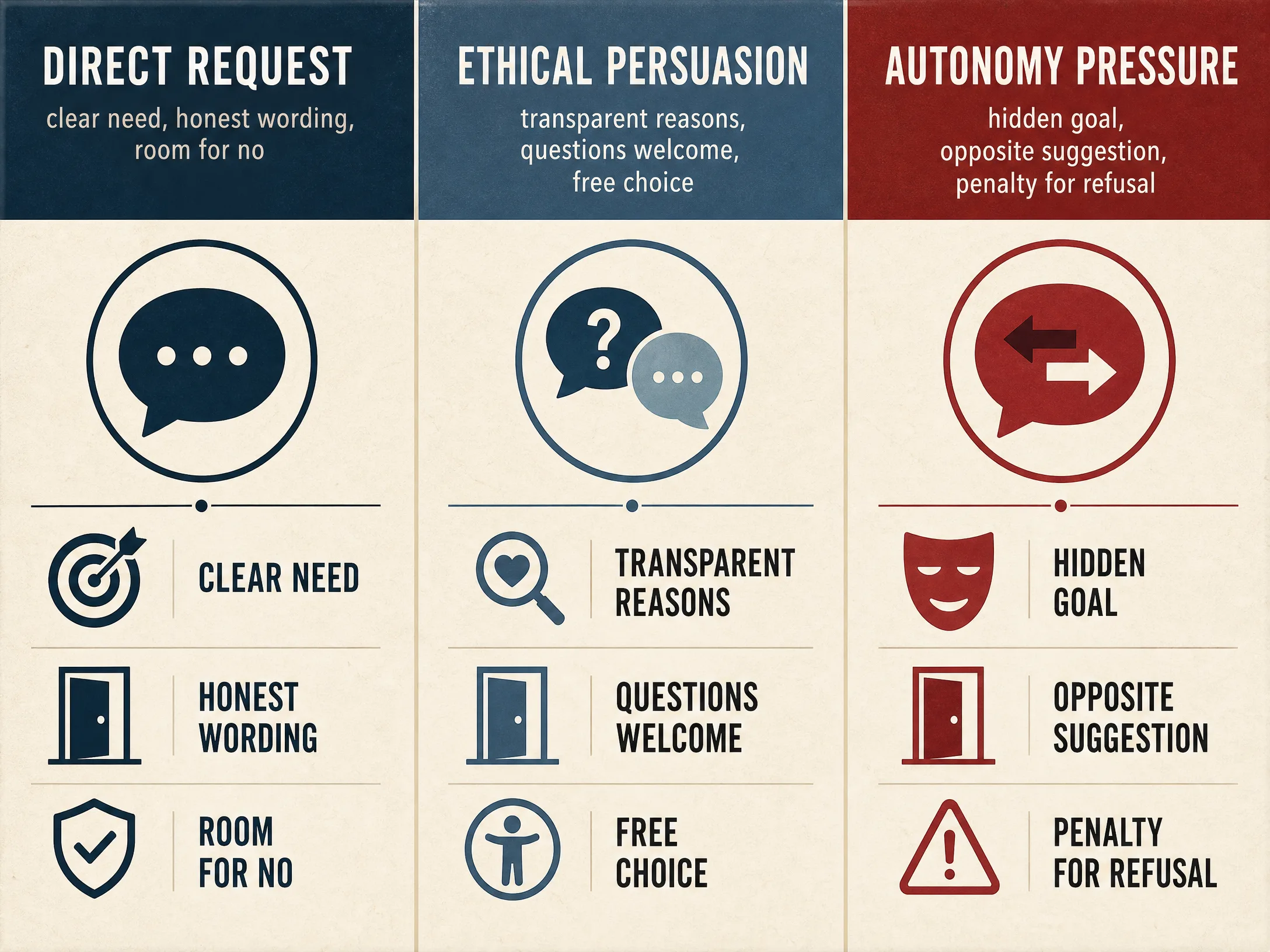
| Approach | What is visible | What happens when the person says no? |
|---|---|---|
| Direct request | The speaker states what they want and why | The other person can decline without being shamed or punished |
| Ethical persuasion | Reasons, evidence, limitations, and alternatives are available | Questions and refusal remain possible |
| Reverse psychology | The speaker presents or suggests the opposite of the real preference | The result depends on whether the indirect strategy is playful, transparent, or coercive |
| Autonomy pressure | The real goal is hidden and the other person’s independence is deliberately leveraged | Refusal triggers guilt, fear, withdrawal, humiliation, or another penalty |
A person does not lose autonomy merely because someone makes a suggestion. Autonomy pressure occurs when the communication narrows the practical ability to choose. A boundary is also not manipulation simply because someone dislikes it; “I will not continue this conversation while we are insulting each other” describes the speaker’s own action.
How reverse psychology is supposed to work
The common explanation is that people resist perceived restrictions on freedom. If someone is told that a choice is unavailable, forbidden, or expected, they may feel an urge to reassert independence. An indirect suggestion can appear to restore choice while still steering toward a preferred outcome.
That explanation is incomplete. People do not all respond with reactance, and the outcome depends on trust, context, age, power, relationship history, culture, available alternatives, and the importance of the decision. An indirect approach can also create confusion, resentment, or a sense of betrayal when the hidden goal becomes obvious.
Reverse psychology should therefore be treated as a communication pattern, not a dependable formula. The ethical question is not whether the technique “works.” It is whether the other person is being given a fair opportunity to understand the request and decide freely.
Recognizable examples without the “trick” framing
In romantic relationships
A partner may say, “You are too busy to spend time with me anyway,” while hoping the other person cancels plans or offers proof of love. The statement may express genuine disappointment, but it can become pressure when the speaker refuses a direct request and punishes the person for not guessing the hidden need.
A safer alternative is: “I would like time together this weekend. Are you available for dinner on Saturday?” The other person can answer honestly, and a different answer can be discussed without a loyalty test.
For related patterns, read Emotional Manipulation in Relationships and Manipulative Communication Styles.
In parenting and caregiving
An adult may say, “Fine, do whatever you want,” while using disappointment, withdrawal, or anger to make a child choose the adult’s preferred option. Children and dependent adults may have less power to resist, so indirect pressure can be especially confusing.
Clear choices, age-appropriate information, and predictable limits are safer than hidden tests. A caregiver can say, “You may choose the blue shirt or the green shirt. We need to leave in ten minutes.” A safety rule should be stated honestly rather than disguised as a challenge.
In friendships
A friend may say, “You do not have to invite me; I know I am not really part of the group,” hoping others will cancel plans or offer reassurance. The feeling may be real, but the indirect message can create a cycle in which everyone must manage the friend’s insecurity instead of discussing the plan.
A direct statement—“I would like to be included when plans are made; can we talk about how to do that?”—creates a clearer opportunity for repair.
At work
A colleague or manager may say, “You probably do not want the high-visibility assignment,” while expecting the employee to volunteer. In a power-imbalanced relationship, the employee may worry that declining will be judged as a lack of ambition. The hidden expectation can make the choice less free than it appears.
Work requests should state the task, timeline, support, risks, and whether participation is voluntary. Employees can ask for the expectations in writing and clarify how accepting or declining will affect their role.
In marketing and sales
A message may suggest that only an uninformed or uncommitted person would decline an offer. Scarcity, social proof, or a reverse challenge can be legitimate information in some contexts, but it becomes manipulative when the claim is false, the deadline is artificial, important terms are hidden, or refusal is framed as a personal defect.
For a related digital-design topic, read Dark Patterns: Psychological Manipulation in Digital Design, when available in the cluster.
When reverse psychology becomes autonomy pressure
The phrase “reverse psychology” can make a controlling behavior sound clever or harmless. Look for the pattern behind it:
| Pattern question | Possible concern |
|---|---|
| Is the real goal hidden? | The other person cannot evaluate the request honestly |
| Is the choice high-stakes? | The cost of an indirect strategy is greater for money, safety, health, work, or relationships |
| Is a vulnerability being used? | Fear of rejection, guilt, pride, insecurity, or dependency becomes leverage |
| Can the person say no? | Refusal leads to anger, silence, humiliation, threats, or withdrawal |
| Is the strategy repeated? | The interaction becomes a system of tests rather than direct communication |
| Is there repair? | The person acknowledges the hidden pressure and changes behavior, or denies it and blames you |
One awkward indirect comment is not proof of manipulation. The concern grows when the strategy is repeated and another person’s choices are managed through hidden consequences.
For broader recognition guidance, read Signs of Emotional Manipulation and Covert Manipulation.
Reverse psychology versus paltering and other tactics
Reverse psychology and paltering can overlap, but they describe different features. Reverse psychology focuses on presenting or suggesting the opposite of the desired behavior. Paltering focuses on using truthful statements to create a misleading impression. A person could use both, but neither term diagnoses intent or personality.
| Pattern | Main feature |
|---|---|
| Reverse psychology | The apparent preference or suggestion points opposite to the hidden desired outcome |
| Paltering | Truthful statements are selected to create a misleading impression |
| Guilt-tripping | A person’s conscience or obligation is used to pressure a decision |
| Gaslighting | Repeated reality-undermining behavior causes doubt about memory or perception |
| Coercive control | A broader pattern restricts autonomy through intimidation, isolation, monitoring, or punishment |
For the paltering distinction, read Paltering vs. Lying. For relationship safety, read Coercive Control and Emotional Abuse.
Safer alternatives to indirect influence
State the need directly
Replace the hidden test with a clear request: “I would like to see you this weekend. Are you available?” Directness gives the other person enough information to make an honest choice.
Explain the reason without overstating it
Share relevant context, not a dramatic prediction designed to force agreement. “I need an answer today because the reservation closes at five” is clearer than “You obviously do not care if you make me wait.”
Offer real options
A choice is meaningful only when the options are genuine. Give the person time, information, and a way to decline. Do not present a fake choice in which one option triggers humiliation or punishment.
Accept the answer
The strongest test of ethical communication is what happens after a refusal. Disappointment can be expressed without retaliation. If the answer is no, negotiate openly or accept that the other person has a different preference.
Repair indirect pressure
If you used an indirect strategy, say so without making the other person responsible for fixing your discomfort: “I was hoping you would choose differently, but I should have asked directly. I am sorry for making you guess.”
What to do if someone uses reverse psychology on you
Pause before proving anything. Ask what the person actually wants, whether the apparent preference is genuine, and whether you are free to choose differently. You can say:
“I am not going to guess. What are you directly asking for?”
“I hear the suggestion, but I want to make this decision based on the actual information.”
“I can discuss the request, but I will not accept guilt or punishment for choosing differently.”
You do not need to identify the tactic perfectly. If the interaction repeatedly leaves you anxious, confused, isolated, or afraid of the consequences of saying no, seek outside perspective. For response guidance, read How to Respond to Emotional Manipulation Without Escalating Risk.
If devices, finances, housing, work, or physical safety are involved, use a safety-aware approach. Do not confront someone alone if you fear retaliation.
Frequently asked questions
What is reverse psychology?
Reverse psychology is a popular term for encouraging someone to do something by suggesting, appearing to prefer, or arguing for the opposite. It is not a guaranteed psychological law or a clinical diagnosis, and people respond differently depending on context and relationship.
Is reverse psychology always manipulation?
No. A playful, low-stakes exchange may not be harmful, especially when the people understand the joke and can decline without consequences. It becomes more concerning when the real goal is hidden, a vulnerability is exploited, or refusal brings guilt, fear, humiliation, or punishment.
Does reverse psychology work in relationships?
It may influence some people in some situations, but it can reduce trust and create confusion when the hidden goal is discovered. Direct requests, transparent reasons, and respect for refusal are safer foundations for a relationship.
How is reverse psychology different from persuasion?
Ethical persuasion makes the goal and reasons visible, allows questions, and preserves the other person’s ability to decline. Reverse psychology presents an indirect or opposite suggestion. It becomes manipulative when the indirectness hides pressure or makes the other person responsible for discovering the real request.
How do I respond when someone says, “You do not have to” but clearly wants me to?
Ask directly: “Do you want me to do this, or are you giving me a genuine choice?” Then decide based on your own availability and values. You do not have to prove care by complying with an unspoken test.
Can reverse psychology be used with children?
Avoid treating children’s independence as a lever for hidden control. Use clear, age-appropriate choices, explain safety limits honestly, and allow reasonable autonomy. A child’s compliance does not prove that an indirect strategy was healthy.
Final takeaway
Reverse psychology describes an indirect attempt to influence behavior by suggesting or appearing to prefer the opposite. It is not automatically abusive, but it can become autonomy pressure when a hidden goal, vulnerability, or penalty for refusal makes the choice less free than it appears.
The safer standard is simple: state the need, share relevant reasons, offer real choices, and accept the answer. You do not need to use manipulation to communicate effectively, and you do not need to prove love, loyalty, intelligence, or independence by responding to a hidden test.
References
Canonical URL: Open the canonical article page