Covert Manipulation: Subtle Control and Hidden Emotional Pressure
GenZ Frontier Editorial | August 17, 2026
Covert manipulation is a phrase people use for subtle or indirect attempts to influence what another person thinks, feels, or does. Instead of making an obvious demand, someone may withhold important information, disguise a criticism as a joke, create an obligation through a favor, or present a carefully edited version of events. The interaction can look ordinary from the outside while leaving the other person confused, pressured, or responsible for keeping the peace.
Subtle influence is not automatically abuse or deliberate manipulation. People sometimes communicate indirectly because they are anxious, embarrassed, conflict-avoidant, inexperienced, or trying to protect privacy. A single omission, awkward joke, or disappointed reaction cannot establish a pattern. The more useful questions are whether the behavior repeats, whether it benefits one person at another person’s expense, whether a reasonable boundary is respected, and whether the person can acknowledge harm and change.
Safety note: This article does not diagnose another person, determine whether a relationship meets a legal definition of abuse, or provide a test for covert manipulation. If you face threats, stalking, surveillance, financial control, property damage, or physical danger, prioritize confidential support and safety planning over proving a label or confronting someone alone.
The short answer
Covert manipulation may be worth examining when someone repeatedly:
- controls what information you receive while presenting their preferred conclusion as the whole story;
- hides a request inside guilt, flattery, helplessness, humor, or a “reasonable” concern;
- denies the pressure once you question it and says you misunderstood an obvious pattern;
- changes their behavior in public and private to manage how others see them;
- treats favors, affection, or apologies as a debt you must repay with compliance;
- reframes your boundary as cruelty, instability, disloyalty, or proof that you are the problem; or
- moves from one subtle tactic to another when you resist the first one.
These are possible indicators, not proof. Start with observable behavior rather than a personality label.
For a broad definition and taxonomy, read Psychological Manipulation: Definition, Types, Signs, Examples, and What to Do. For general recognition questions, read Signs of Emotional Manipulation: How to Recognize Patterns by Style.
Covert manipulation vs. covert emotional abuse vs. covert narcissism
These phrases overlap in everyday writing, but they should not be treated as interchangeable diagnoses.
| Term | What it usually describes | What it does not prove |
|---|---|---|
| Covert manipulation | Subtle or indirect influence, such as selective information, disguised criticism, indirect guilt, or strategic image management | That the person is abusive, consciously malicious, or mentally disordered |
| Covert emotional abuse | A repeated pattern of nonphysical behavior that undermines autonomy, safety, dignity, or access to support | That every indirect behavior is abuse or that the reader can establish intent alone |
| Covert narcissism | A popular phrase associated with vulnerable or less outwardly grandiose presentations of narcissistic traits | That a person has narcissistic personality disorder or that manipulation has a single personality-based cause |
A person can communicate indirectly without controlling anyone. Conversely, a pattern can be harmful even when the person denies intending harm. If you are trying to understand a relationship, describe what happened, what information was withheld, what you were asked to do, what happened after you said no, and whether the pattern changes after feedback.
HelpGuide discusses covert narcissism as a personality-related topic, but a popular label should not be used to diagnose a partner, coworker, relative, or friend.4 The safer focus is behavior, impact, power, boundaries, support, and repair.
Why covert manipulation is difficult to recognize
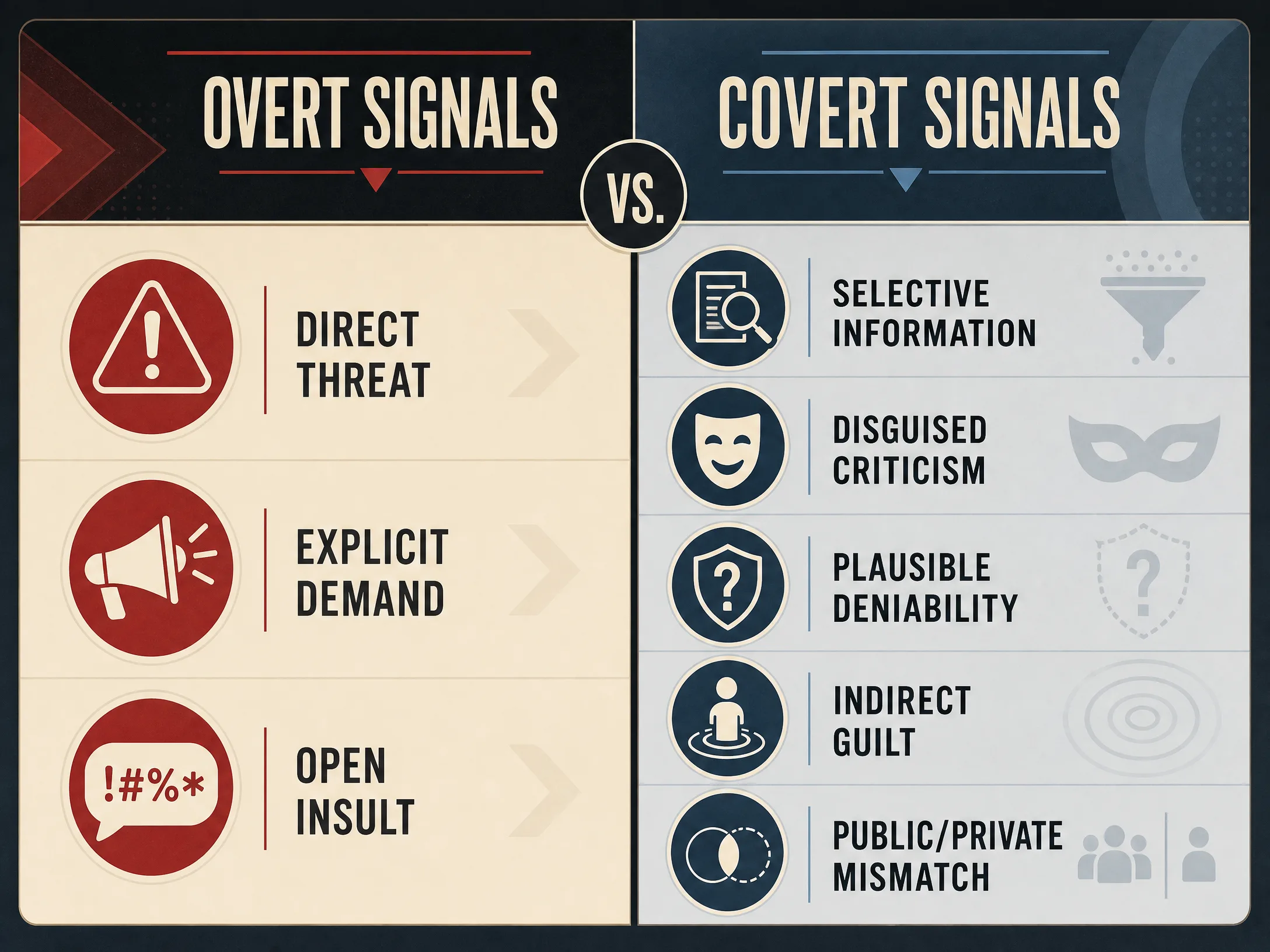
Overt pressure gives the target a clear event to name: a threat, an explicit demand, or an open insult. Covert pressure is often distributed across several small interactions. A person may say they are “only joking,” claim they were trying to help, or insist that you are free to choose while making the cost of choosing independently feel severe.
Psychology Today describes covert manipulation as subtle influence over what people think, feel, and do. Its examples include selective information, carefully chosen words, approval-seeking, flattery, and behavior that changes depending on who is watching.1 The important caution is that ordinary people can display some of these behaviors occasionally. Frequency, transparency, motive as far as it can be observed, power, and the effect on another person matter more than a checklist.
Covert behavior can also create plausible deniability. If you challenge the pressure, the other person may point to the literal words and ignore the context: “I never told you that you had to go,” even though they repeatedly punished you whenever you made plans without them. This does not mean every disagreement is gaslighting. It means the pattern should be examined as a whole.
Seven covert manipulation patterns to recognize
1. Selective information and misleading framing
A person may share only the facts that support the decision they want. They might emphasize the benefits of a restaurant, job, purchase, or plan while leaving out a cost, risk, prior agreement, or alternative. They may technically tell the truth while presenting it in a way that makes one conclusion appear inevitable.
People also omit information because they are forgetful, embarrassed, confused, or unsure what matters. Ask whether the missing information is material, whether the person corrects the record when asked, and whether you are allowed to verify the facts independently.
2. Indirect guilt and manufactured obligation
Indirect guilt can sound like a sigh, a tragic story, a statement about how much someone has sacrificed, or a reminder that “good” people would know what to do. A favor may be offered freely and later treated as evidence that you owe a decision, an apology, access, money, or loyalty.
Healthy people can express disappointment and ask for help. The concern grows when the emotional message is repeatedly designed to make a reasonable “no” feel immoral or unsafe. You are allowed to appreciate a favor without accepting an unlimited debt.
3. Disguised criticism and weaponized humor
A criticism may be hidden inside a joke, compliment, concern, or comparison: “You look great today—did you finally listen to me?” If you react, the person may say you are too sensitive and make the conversation about your reaction instead of the original insult.
One awkward joke is not proof of covert abuse. Look for repetition, contempt, whether the person stops after you explain the impact, and whether the “joke” targets a vulnerability you shared in confidence. Respectful humor can survive feedback; repeated humiliation often treats feedback as another opportunity to dismiss you.
4. Plausible deniability and minimization
Minimization reduces the importance of what happened: “It was nothing,” “You are making a big deal out of this,” or “Everyone talks that way.” Plausible deniability allows the speaker to retreat to a harmless interpretation whenever the behavior is challenged.
The key question is not whether the person can invent an innocent explanation. It is whether they show curiosity about the effect, answer reasonable questions, accept a boundary, and change the behavior. A sincere misunderstanding can be repaired. A repeated pattern of minimizing every concern can make repair impossible.
5. Image management and public-private mismatch
Some people appear unusually generous, calm, or supportive around witnesses while becoming dismissive, controlling, or cruel in private. Others tell friends that they are exhausted from “trying to help” you, positioning themselves as the reasonable person before you have described what is happening.
Different settings naturally bring out different behavior. Image management becomes more concerning when public reputation is used to discredit your account, recruit supporters, isolate you, or make you afraid that no one will believe you. Keep your description concrete: dates, messages, requests, responses, and observable consequences.
6. Strategic helplessness, resentment, and emotional debt
A person may repeatedly perform helplessness so another person takes over work, decisions, caregiving, or emotional labor. They may then become resentful when the effort is not recognized or use the resentment to pressure more compliance. A favor can become an unspoken contract that the other person never agreed to.
Genuine need is not manipulation. People can need support because of illness, disability, grief, stress, or limited skills. The concern grows when help is demanded, alternatives are refused, accountability is avoided, or resentment appears whenever the other person has an independent need.
7. Hidden isolation and resource pressure
Covert control can begin as concern: a partner says friends are a bad influence, a relative insists that outside advice is disrespectful, or a coworker quietly blocks access to information and then blames you for falling behind. Over time, you may lose access to people, money, work, transportation, accounts, or independent sources of information.
Isolation, monitoring, and financial control can be safety issues, especially when combined with threats or retaliation. For a broader relationship guide, read Types of Emotional Manipulation in Relationships. For the wider pattern of coercion, read Coercive Control and Emotional Abuse.
Covert manipulation across different relationships
Covert pressure can appear in romantic relationships, families, friendships, schools, workplaces, caregiving relationships, sales interactions, and online communities. The words and power differences change by context, but the core questions remain similar.
In a romantic relationship, the pattern may involve conditional affection, selective information, monitoring, or promises that disappear after compliance. In a family, it may involve obligation, triangulation, scapegoating, or the expectation that one person must keep everyone comfortable. In a friendship, it may appear as competitive helplessness, social exclusion, or a constant test of loyalty. At work, a colleague or manager may use image management, vague threats, selective information, or public praise and private blame to shift responsibility.
The same action can have different meanings. A manager may need confidentiality for a legitimate reason; a friend may need privacy; a partner may want reassurance. The concern grows when information is withheld to remove your ability to make an informed choice, when support is restricted, or when refusal brings disproportionate consequences.
A safer way to assess the pattern
A simple pattern review can help you avoid both minimization and over-labeling. Ask:
| Pattern question | What to examine |
|---|---|
| Repetition | Does the same pressure occur across situations or return after apologies? |
| Transparency | Are relevant facts, expectations, and consequences available? |
| Power | Does the person control money, housing, work, status, caregiving, or information? |
| Autonomy | Can you make a different choice without punishment or intimidation? |
| Support | Can you speak with trusted people and maintain outside perspective? |
| Repair | Does the person acknowledge harm and change behavior consistently? |
Do not use the table as a scorecard. The purpose is to describe the situation more clearly. A written account can include what was said, what was omitted, what you decided, what happened after you set a boundary, and whether you felt safe. If devices or accounts may be monitored, store information in a safer location or seek advice before documenting.
For documentation boundaries, read How to Document Gaslighting or Emotional Abuse Safely. Do not bait, trap, secretly record, publicly expose, or provoke someone without understanding legal and safety consequences.
What to do if covert pressure is affecting you
Start with the least risky step that preserves your options. You might pause a decision, ask for important information in writing, speak with a trusted person, protect access to essential accounts, or request a specific change. You do not need to persuade the other person to accept the phrase “covert manipulation.” You can describe the behavior instead:
“I need the full information before I decide.”
“I appreciate the favor, but I did not agree to repay it with that decision.”
“That comment was hurtful. If it continues, I will end the conversation.”
These statements are not guaranteed to make a controlling person respond safely. If there are threats, stalking, surveillance, financial dependence, property damage, or fear of retaliation, confidential support and safety planning may be more appropriate than direct confrontation. If you are in immediate danger, contact local emergency services. In the United States, the National Domestic Violence Hotline provides confidential support for people experiencing relationship abuse and control.3
For response options, read How to Respond to Emotional Manipulation Without Escalating Risk. Recovery support is discussed in Recovering From Manipulation.
Frequently asked questions
What does covert manipulation look like?
It may involve selective information, indirect guilt, disguised criticism, minimization, image management, strategic helplessness, conditional affection, hidden isolation, or resource pressure. The defining concern is not subtlety alone but a repeated pattern that reduces another person’s informed and voluntary choices.
Can covert manipulation be unintentional?
Some indirect communication may be habitual, anxious, conflict-avoidant, or poorly understood by the person using it. Intent can be difficult to establish. Focus on the observable pattern, the effect on autonomy, and whether the person can respond to feedback and change behavior.
Is covert manipulation always emotional abuse?
No. Covert manipulation is a broad everyday phrase for subtle influence. It may become part of emotional abuse when repeated behaviors are used to control, intimidate, isolate, humiliate, or undermine another person’s safety and autonomy. A single indirect behavior does not establish abuse.
How is covert manipulation different from gaslighting?
Gaslighting is a specific and debated term for repeated reality-undermining behavior that can cause someone to doubt memory, perception, or understanding. Covert manipulation is broader and may involve information control, guilt, image management, flattery, withdrawal, or hidden pressure without reality distortion. They can overlap, but they are not synonyms.
For the focused distinction, read Gaslighting: Meaning, Signs, Examples, and How It Differs From Lying.
Should I confront someone I think is covertly manipulating me?
Not automatically. If the relationship is safe and the power balance allows it, a specific boundary or request for information may clarify the situation. If there are threats, surveillance, financial control, stalking, or physical danger, seek confidential support and consider safety planning before confronting the person.
What if nobody believes me because the behavior is subtle?
You can describe observable events without proving a label. Write down what was requested, what information was available, what you said, what happened after you set a boundary, and whether the pattern repeats. Choose a trusted person or qualified professional who can listen without forcing you to make an immediate decision.
Final takeaway
Covert manipulation is difficult to recognize because pressure may be hidden inside kindness, humor, concern, helplessness, selective truth, or a carefully managed public image. Subtle behavior is not automatically abusive, and a popular label cannot diagnose another person.
Take the pattern seriously when indirect pressure repeatedly limits your choices, weakens your support, distorts important information, or makes a reasonable “no” feel unsafe. Describe the behavior, protect your access to trusted perspective, and choose the safest next step rather than trying to win an argument about someone’s motives.
References
Canonical URL: Open the canonical article page