Passive-Aggressive Manipulation: Indirect Control, Signs, and What to Do
GenZ Frontier Editorial | August 17, 2026
Passive-aggressive behavior is an indirect way of expressing anger, resistance, resentment, or hostility. Instead of naming the problem directly, a person may use sarcasm, deliberate delay, “fine” statements, sulking, strategic forgetfulness, or a visibly cold change in behavior. The phrase passive-aggressive manipulation is often used when this indirect behavior appears to pressure another person to guess, apologize, overfunction, or change their choice.
Indirect communication is not automatically manipulation or abuse. People may avoid conflict because they feel anxious, unsafe, inexperienced, or unsure how to express a need. A single sarcastic comment or delayed reply does not establish a pattern. The more useful questions are whether the behavior repeats, whether it is used to control another person’s choices, whether a direct conversation is possible, and what happens after a reasonable boundary.
Safety note: This is a behavior-recognition guide, not a diagnosis. If indirect hostility occurs alongside threats, stalking, surveillance, financial control, property damage, or physical danger, prioritize confidential support and safety planning over confrontation.
The short answer
Passive-aggressive manipulation may involve:
- saying “I’m fine” while using silence, delay, or visible hostility to punish you for a choice;
- agreeing to a task and then intentionally delaying or undermining it;
- using sarcasm or backhanded compliments to communicate anger while denying that anything is wrong;
- making you guess the hidden complaint and then criticizing you for guessing incorrectly; or
- refusing a direct conversation while creating consequences that pressure you to surrender your boundary.
These are possible indicators, not a checklist or diagnosis. For the broader communication framework, read Manipulative Communication Styles: Language Patterns, Examples, and Boundaries.
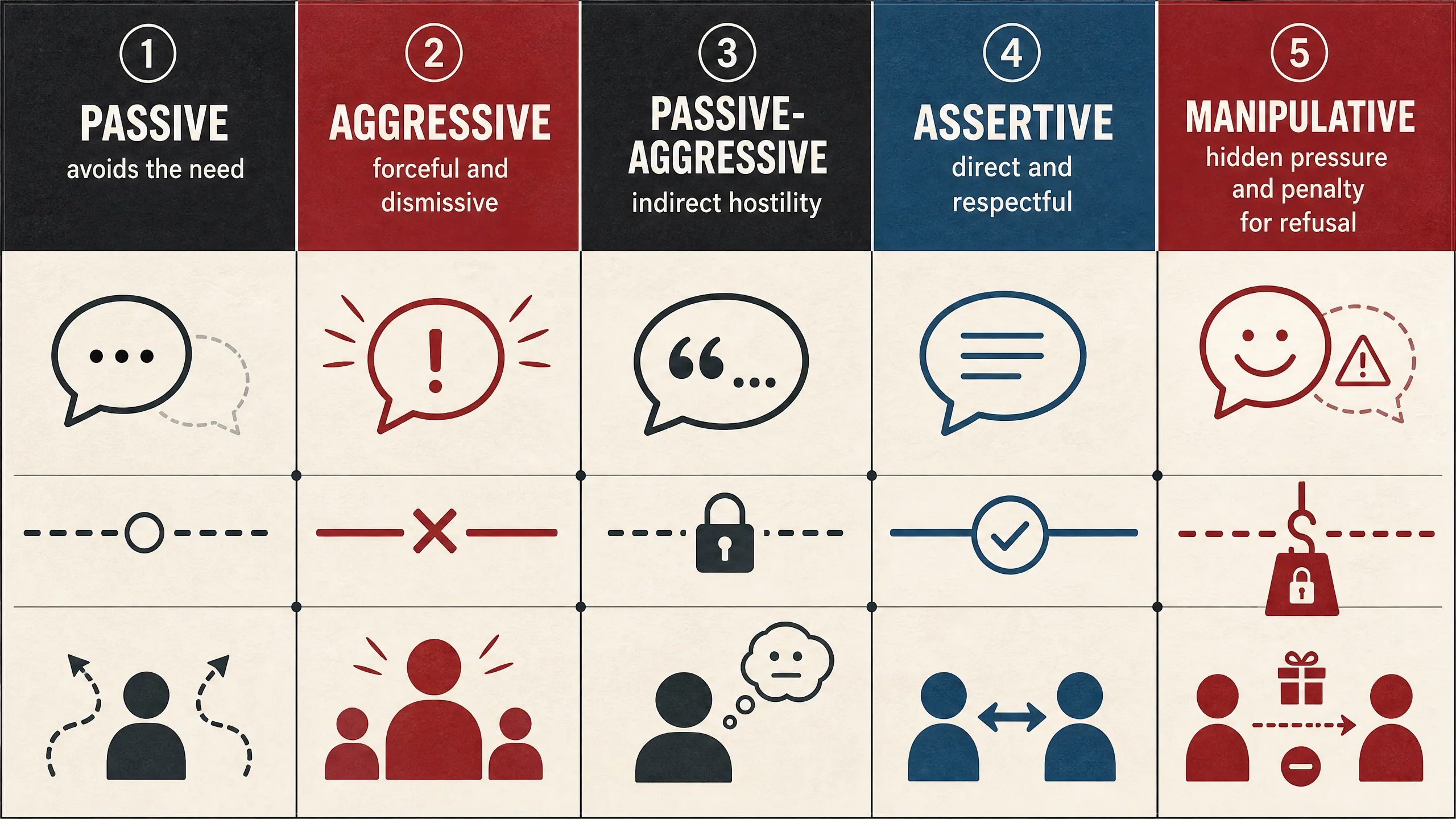
Passive, aggressive, passive-aggressive, assertive, and manipulative communication
| Communication style | Typical pattern | Main risk or strength |
|---|---|---|
| Passive | Avoids stating needs and prioritizes other people’s preferences | The speaker’s needs may remain invisible and resentment can build |
| Aggressive | Uses forceful or dismissive language while disregarding the other person’s needs | The interaction can feel intimidating or degrading |
| Passive-aggressive | Expresses negative feelings indirectly through sarcasm, delay, sulking, or resistance | The other person may be forced to guess, repair, or absorb the hidden hostility |
| Assertive | States a need, feeling, request, or limit directly and respectfully | Both people have clearer information and room to choose |
| Manipulative | Uses hidden pressure, deception, guilt, fear, dependency, or a penalty for refusal | Another person’s meaningful autonomy is narrowed |
These styles can overlap. A person may behave passively in one situation and aggressively in another. Passive-aggressive behavior is not automatically manipulative; manipulation becomes the concern when the indirect pattern is used to control another person’s behavior or avoid accountability.
For the broader influence distinction, read Psychological Manipulation vs. Persuasion.
Seven passive-aggressive patterns to recognize
1. “Fine” language that conceals a penalty
A person says “fine,” “whatever,” or “do what you want,” but follows the statement with coldness, delay, contempt, or a later accusation. The issue is not that the person feels disappointed. The issue is whether the indirect message is designed to make you reverse a reasonable choice without an honest discussion.
A safer alternative is: “I am disappointed, but I want to discuss what I need directly.” You are not responsible for guessing a complaint that the other person refuses to state.
2. Sarcasm and backhanded compliments
Sarcasm can be playful between people who understand and enjoy it. It can become hostile when it repeatedly targets a vulnerability, communicates contempt, or gives the speaker plausible deniability: “I was only joking.” Backhanded compliments work similarly: “You look good today,” or “That was surprisingly competent.”
Look for repetition, the target’s stated impact, whether the speaker stops after feedback, and whether the same “joke” appears when the speaker wants to lower confidence or regain control.
3. Strategic delay and deliberate forgetfulness
A person may agree to complete a task and then repeatedly delay it, “forget” important details, or perform it carelessly. Genuine forgetfulness, overload, disability, or unclear instructions can look similar. The concern grows when the delay appears selectively around tasks the person dislikes, continues after clear agreements, and creates predictable work for someone else.
Instead of arguing about intent, name the task, deadline, and consequence: “We agreed this would be done by Friday. If it cannot be completed, tell me today so we can make another plan.”
4. Withholding cooperation while denying resistance
Someone may technically agree while refusing the cooperation needed to make the agreement work. They may give one-word answers, obstruct access to information, or make every step so difficult that the other person gives up.
This is especially important in shared finances, caregiving, household tasks, and workplaces. A person can decline honestly. Turning agreement into hidden obstruction creates confusion and shifts the burden to someone else.
5. Sulking and mood-based pressure
A visible change in mood can be a genuine emotional response. It becomes manipulative when another person is expected to cancel plans, apologize, provide reassurance, or change a decision to restore emotional calm without being told what happened.
Ask once, directly and respectfully: “You seem upset. Do you want to discuss something?” If the person declines, you do not need to keep performing emotional labor until the mood improves. A relationship can make room for feelings without making one person responsible for regulating another person’s behavior.
6. Plausible deniability
Passive-aggressive communication often keeps the literal words defensible. The speaker can say, “I never told you not to go,” even though they made the entire interaction hostile whenever you made independent plans. They can say, “I did the task,” while ignoring that it was intentionally incomplete.
Literal deniability does not resolve the pattern. Document the observable behavior, the agreement, the response, and the consequence rather than trying to prove what the person secretly intended.
7. Resentment disguised as compliance
A person says yes while communicating that the request is unreasonable, then later uses their reluctant compliance as evidence that you owe them. They may say, “I did it, but apparently nothing I do is good enough,” or repeatedly remind you of a favor after refusing to negotiate the request directly.
People can accept a request and later realize it was too much. Healthy repair allows renegotiation. Manipulative resentment treats hidden reluctance as a debt that can be collected later.
Passive-aggressive behavior versus a communication difficulty
Not every indirect behavior is deliberate. Anxiety, trauma, cultural communication norms, neurodivergence, depression, conflict avoidance, stress, and fear of retaliation can all affect how a person expresses anger or needs. These explanations do not erase the impact, but they can change what response is safest and most constructive.
Use a pattern review rather than a label:
| Question | What to examine |
|---|---|
| Can the person name the issue when asked? | A direct answer creates a path to repair |
| Do they accept a reasonable limit? | Respect for boundaries matters more than perfect communication |
| Does the behavior repeat after feedback? | Repetition can show a stable harmful pattern |
| Who carries the repair work? | One-sided emotional labor may indicate control or avoidance |
| Is there a power imbalance? | Housing, money, employment, caregiving, or status can raise risk |
Do not diagnose a personality disorder from passive-aggressive behavior. Focus on what happened, what you need, and whether the relationship allows honest communication and safe boundaries.
Passive-aggressive manipulation in different settings
Romantic relationships
A partner may use coldness, sarcasm, delayed replies, or “you can go if you want” language to make independence feel disloyal. Conflict is normal in relationships, but a repeated pattern of indirect punishment can make one person responsible for avoiding every negative mood.
For a related topic, read Silent Treatment vs. Taking Space and Emotional Manipulation in Relationships.
Families and friendships
A relative or friend may make a cutting joke in front of others, decline to state a need, and then accuse you of not caring when you fail to anticipate it. Triangulation can add social pressure when the person recruits someone else to criticize your choices or confirm their version.
For that pattern, read Triangulation in Relationships, Families, and Friendships.
Workplaces
A coworker may agree to a shared task but withhold information, delay a handoff, or use sarcasm instead of raising a workload concern. A manager may publicly praise an employee while privately setting unclear expectations and then criticizing the result.
Workplace power matters. Keep communication factual, request priorities in writing, and use appropriate internal support if retaliation or harassment is involved. For the broader workplace context, read Workplace Manipulation and Gaslighting.
How to respond without escalating risk
Ask for direct communication once
Try: “I hear that you said yes, but your behavior suggests there is a concern. What do you want to discuss directly?” Do not keep interrogating someone who refuses to answer; repeated pursuit can make the interaction more reactive.
Separate the request from the mood
Try: “I am willing to discuss the plan. I am not going to change it simply because the conversation has become sarcastic or punishing.” This protects the decision without denying the other person’s feelings.
Use clear agreements
For work, finances, caregiving, and shared responsibilities, put the task, date, and next step in writing. Written clarity reduces the space for “I thought you meant” arguments. It should not be used to bait, trap, or secretly monitor someone.
State your boundary and follow through
A boundary describes your action: “If the conversation becomes insulting, I will pause and return later.” It does not require the other person to agree. Follow through calmly if it is safe to do so.
Seek outside perspective
A trusted person can help you distinguish a communication problem from a repeated control pattern. If a device, account, job, housing arrangement, or finances may be monitored, choose a safer way to seek support.
For response options, read How to Respond to Emotional Manipulation Without Escalating Risk. For broader safety patterns, read Coercive Control and Emotional Abuse.
Frequently asked questions
Is passive-aggressive behavior manipulation?
Not always. Passive-aggressive behavior is indirect expression of anger, resistance, or hostility. It becomes manipulative when it is used repeatedly to control another person’s choice, create a penalty for refusal, make them guess and repair, or avoid accountability.
What are common passive-aggressive signs?
Common signs can include sarcasm, backhanded compliments, “fine” statements followed by punishment, deliberate delay, strategic forgetfulness, sulking, withholding cooperation, and resentment disguised as compliance. Context and repetition matter more than one behavior.
Is passive-aggressive behavior a mental disorder?
Do not diagnose a mental disorder from indirect hostility. The behavior can have many causes, including stress, fear, conflict avoidance, communication difficulty, or a learned pattern. Focus on impact, boundaries, safety, and whether behavior changes after feedback.
How is passive-aggressive behavior different from assertiveness?
Assertiveness states a need, feeling, request, or boundary directly and respectfully. Passive-aggressive communication communicates anger or resistance indirectly, often leaving another person to guess. Assertiveness allows the other person to respond to the real issue.
Should I call someone passive-aggressive?
Usually describe the behavior instead of assigning a label: “When you agreed and then delayed the task without telling me, I was left responsible for the deadline.” A behavior-based description is clearer and less likely to turn the conversation into an argument about identity.
What if the person denies everything?
You do not need to prove the person’s intention. Record the observable agreement, action, response, and consequence when safe. Set a boundary around what you will participate in, and seek support if the pattern affects your safety, work, finances, housing, or mental wellbeing.
Final takeaway
Passive-aggressive manipulation describes a possible pattern in which indirect anger, resistance, sarcasm, delay, sulking, or plausible deniability is used to pressure another person without an honest conversation. The behavior may be harmful even when the person insists that “nothing is wrong,” but it should not be treated as a diagnosis from a checklist.
Focus on direct requests, observable agreements, safe boundaries, and the consequences of saying no. Healthy communication does not require perfect emotional control; it requires enough honesty and respect for both people to understand the issue and make meaningful choices.
References
Canonical URL: Open the canonical article page