Projection as Manipulation: Blame Transfer, Signs, and What to Do
GenZ Frontier Editorial | August 17, 2026
Psychological projection is a term for attributing one’s own feelings, impulses, motives, or traits to another person. Someone who feels jealous may accuse a partner of jealousy. Someone who is angry may insist that the other person is the angry one. Projection can occur automatically or defensively; it does not, by itself, prove deliberate manipulation or a mental-health diagnosis.
Projection becomes part of a manipulative pattern when repeated accusations shift responsibility away from observable behavior, force another person to defend against an unproven claim, or create a moral reversal in which the person raising a concern becomes the “problem.” The safest approach is to describe what happened, separate facts from interpretations, and avoid arguing about hidden motives.
Safety note: This article is a recognition guide, not a diagnostic test. If accusations occur alongside threats, stalking, surveillance, financial control, property damage, or physical danger, prioritize confidential support and safety planning over confrontation.
The short answer
Projection as manipulation may look like:
- a person who broke an agreement accusing you of being unreliable without addressing the agreement;
- someone who is monitoring your messages claiming that you are “obsessed with control”;
- a person who repeatedly insults others accusing them of being cruel whenever they receive feedback;
- a partner who creates conflict insisting that you are the source of all the drama; or
- an accusation that is so broad or emotionally loaded that you must spend the entire conversation proving your character.
An accusation can also be accurate. Do not dismiss a concern merely because projection is possible. Ask what evidence exists, whether the claim can be discussed specifically, and whether both people can examine their own behavior.
For the broader pattern guide, read Common Psychological Manipulation Tactics. For communication-language context, read Manipulative Communication Styles.
Projection as a defense mechanism versus a control pattern
Projection can be a defensive process in which a person has difficulty acknowledging an uncomfortable feeling or trait and experiences it as belonging to someone else. That explanation does not establish intent, and an online article cannot determine what is happening inside another person.
A control pattern is more observable. The person repeatedly makes unsupported accusations, refuses to discuss their own conduct, changes the subject whenever evidence is requested, recruits others to confirm the accusation, or uses the claim to restrict your choices. The pattern may be conscious, habitual, defensive, or mixed. The impact on your autonomy can still be serious.
| Question | Defensive communication may allow | A controlling pattern may do |
|---|---|---|
| Can the concern be made specific? | The person names an event, time, or behavior | The accusation stays vague and impossible to disprove |
| Can evidence be discussed? | Both people compare what they know | Questions are treated as proof of guilt |
| Is responsibility shared? | The person can acknowledge their own part | The entire problem is assigned to you |
| Can boundaries stand? | A different choice is tolerated | The accusation is used to control contact, money, work, or support |
| Can repair occur? | The person apologizes and changes | The cycle repeats after each denial or apology |
Projection versus blame shifting, DARVO, and gaslighting
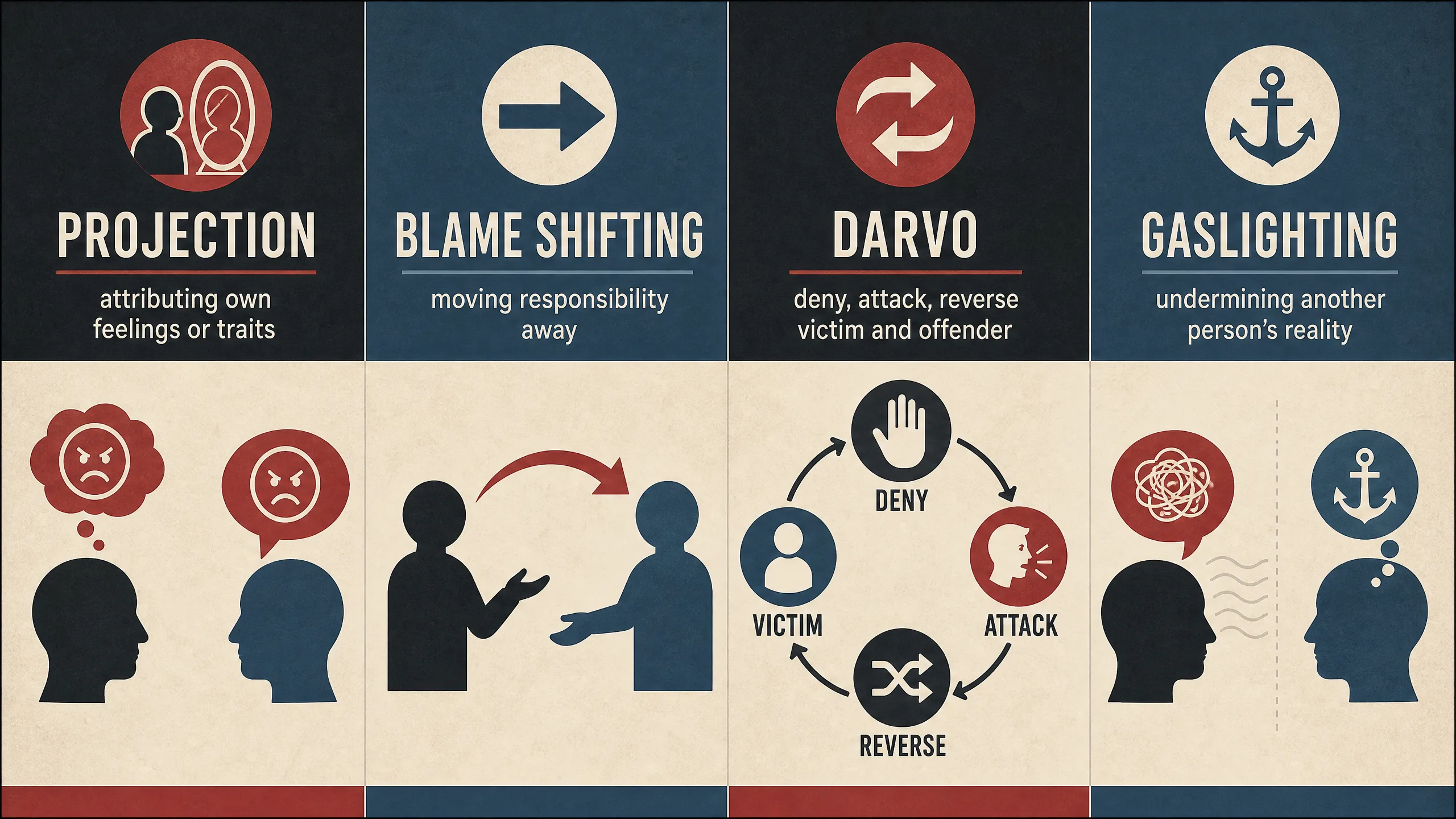
These concepts overlap in everyday writing but describe different features:
- Projection: Attributing one’s own feelings, motives, or traits to another person.
- Blame shifting: Moving responsibility for a behavior or outcome away from oneself and onto someone else.
- DARVO: Deny, Attack, and Reverse Victim and Offender; a response pattern in which a person accused of harm denies it, attacks the accuser, and presents themselves as the victim.
- Gaslighting: Repeatedly undermining another person’s confidence in their memory, perception, or understanding of events.
A conversation can contain more than one pattern. Projection is not automatically gaslighting, and an accusation is not automatically projection. For a focused explanation, read DARVO: Deny, Attack, and Reverse Victim and Offender and Gaslighting.
Five projection patterns to recognize
1. The mirror accusation
The person accuses you of doing the thing they are repeatedly doing: dishonesty, jealousy, control, hostility, or manipulation. The accusation may be true, false, or partly true; the projection concern arises when it is used to avoid a specific conversation about their conduct.
Return to the event: “We can discuss my behavior, but first I want to address the message you sent and the agreement we made.” This does not require you to deny your own mistakes.
2. Moral reversal
You raise a concern and the other person presents themselves as the injured party because you raised it. They may say that your question proves you are cruel, disloyal, or abusive. Feelings can be real, but they do not erase the original issue.
A fair conversation can address both impacts: what happened and how the discussion felt. Moral reversal becomes concerning when the original behavior is never answered.
3. Vague accusations that cannot be tested
“Everyone knows what you are like,” “You always manipulate people,” or “You make me feel unsafe” may communicate real distress, but broad claims make constructive repair difficult without concrete examples. A person can be uncomfortable without being able to explain why; you can ask for specifics without accepting an unsupported verdict.
If the person refuses detail and uses the accusation to restrict your relationships or access to support, seek outside perspective.
4. Projection used to justify monitoring or isolation
A person may accuse you of cheating, lying, or abandoning them and use that accusation to demand passwords, track your location, restrict friendships, or control your work. The accusation may be presented as proof that monitoring is necessary.
Suspicion is not consent to surveillance. Monitoring and isolation can become coercive-control issues, especially when refusal leads to threats or punishment. Read Coercive Control and Emotional Abuse.
5. Projection in groups and workplaces
Projection can spread through social or professional systems. A person who undermines a colleague may describe that colleague as “difficult.” A family member who creates conflict may tell relatives that you are the source of family drama. The claim can gain force through repetition rather than evidence.
Keep communication factual, avoid counter-campaigns, and use appropriate support channels. For workplace context, read Workplace Manipulation and Gaslighting.
How to assess an accusation without losing your footing
Do not begin by asking, “Is this person projecting?” Begin with what can be observed:
| Review question | Safer focus |
|---|---|
| What exact behavior is being discussed? | Date, words, action, agreement, or consequence |
| What evidence supports the claim? | Messages, records, direct observations, or reliable witnesses |
| What part is interpretation? | Motive, character, prediction, or mind-reading |
| Was my behavior also harmful? | Take responsibility for your own conduct without accepting unrelated blame |
| What happens after I ask for clarity? | Specific discussion and repair, or escalation and punishment |
A written note can help separate facts from conclusions, but documentation should be safe. If a device or account may be monitored, seek advice before storing sensitive information. Read How to Document Gaslighting or Emotional Abuse Safely.
How to respond to projection and blame transfer
Return to one observable issue
“Let’s discuss the message from Tuesday. I am not going to debate a general statement about my character.” A narrow scope prevents the conversation from becoming an endless defense against every accusation.
Ask for a specific example
“What did I say or do that you are referring to?” A specific example can be addressed. If the person uses the request for detail as proof that you are guilty, you can pause the conversation.
Accept accountability without accepting a false frame
You can say, “I should not have raised my voice,” and also say, “That does not make it acceptable to monitor my phone.” Responsibility can be shared; it does not have to be transferred wholesale.
Use boundaries, not counter-accusations
“I will discuss a specific concern without insults. If the conversation becomes a character attack, I will pause.” Countering “You are projecting” with another accusation often creates a second circular argument.
Seek outside support when the pattern repeats
A trusted person, qualified therapist, advocate, or appropriate workplace resource can help you identify what is happening. If you fear retaliation, choose a safer method of contact and avoid confronting the person alone.
For response guidance, read How to Respond to Emotional Manipulation Without Escalating Risk.
Frequently asked questions
What is projection in psychology?
Projection is commonly described as attributing one’s own feelings, impulses, motives, or traits to another person. It can be defensive or unintentional. An online article cannot determine whether a specific person is projecting.
Is projection always manipulation?
No. Projection can occur without a deliberate attempt to control someone. It becomes part of a manipulative pattern when repeated accusations shift responsibility, create impossible defenses, restrict autonomy, or punish a person for asking for evidence and clarity.
What is projection versus blame shifting?
Projection attributes an internal feeling or trait to someone else. Blame shifting moves responsibility for a behavior or outcome away from oneself. They can occur together, but they are not identical.
How is projection different from gaslighting?
Projection is about attributing one’s own internal material to another person. Gaslighting involves repeated behavior that undermines someone’s confidence in their memory, perception, or understanding. Projection can appear in a gaslighting pattern, but not every projection is gaslighting.
Should I tell someone they are projecting?
Usually describe the observable behavior instead: “You are accusing me of doing X, but the conversation has not addressed the evidence about Y.” A label can distract from the issue and may escalate an unsafe interaction.
What if the accusation contains some truth?
Take the true part seriously and address it specifically. You can apologize or change behavior without accepting unrelated accusations, surveillance, humiliation, or a demand to prove your innocence forever.
Final takeaway
Projection can be an ordinary defensive process, but repeated projection may become part of manipulation when accusations reverse responsibility, make you defend your character instead of discussing behavior, or are used to control your relationships and choices.
Stay with observable facts, ask for specific examples, own your part, and set boundaries around circular accusations. You do not need to diagnose another person to decide that a repeated pattern is harmful or that you need outside support.
References
Canonical URL: Open the canonical article page