Future Faking: Promises Used to Create Commitment and Control
GenZ Frontier Editorial | August 17, 2026
Future faking is an online relationship term for making grand or repeated promises about a shared future without supporting them with consistent present actions. The promises may involve marriage, moving in, children, travel, a business, a job, financial support, or a dramatically improved relationship. The pattern becomes manipulative when the promise is used to gain commitment, patience, money, labor, sex, forgiveness, or another benefit while the person avoids reasonable accountability in the present.
An unfulfilled promise is not automatically future faking. Circumstances change, plans fail, and people can be sincerely hopeful. The useful distinction is between a plan that is revised honestly and a promise that repeatedly appears when someone wants something now.
Safety note: Future faking is not a diagnosis and does not prove that someone is a narcissist. If promises are connected to threats, financial control, stalking, housing dependence, or physical danger, prioritize confidential support and safety planning.
The short answer
Possible future-faking patterns include:
- making increasingly grand promises whenever you ask for clarity or consider leaving;
- asking you to provide money, sex, housing, work, forgiveness, or secrecy now in exchange for a vague future reward;
- describing a shared future in detail while avoiding basic present commitments;
- repeatedly postponing concrete steps and replacing each missed deadline with a more dramatic promise; or
- using the promised future to dismiss current harm: “Once we move, I will change,” or “When we are married, this will not happen.”
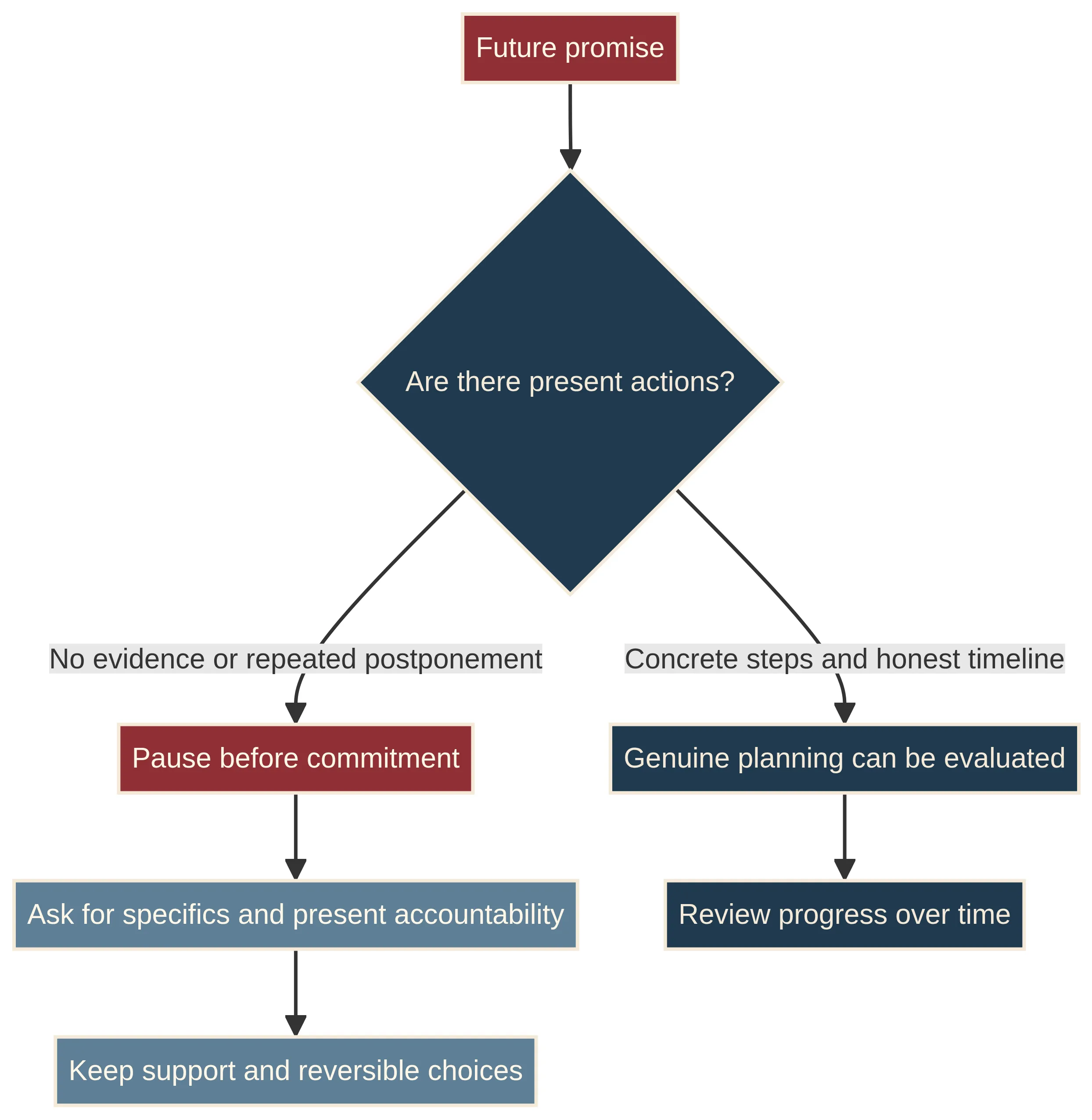
A genuine plan does not need to be perfect, but it can usually be discussed in terms of present actions, realistic constraints, shared consent, and revision.
For related relationship patterns, read Love-Bombing vs. Genuine Affection and Emotional Manipulation in Relationships.
Future faking versus genuine future planning
| Genuine future planning | Possible future faking |
|---|---|
| Discusses hopes alongside current responsibilities | Uses the future to avoid discussing current behavior |
| Identifies practical steps and realistic limits | Uses vivid promises without verifiable steps |
| Allows questions, hesitation, and renegotiation | Treats questions as disloyalty or pressure |
| Changes the plan transparently when circumstances change | Replaces each missed step with a bigger promise |
| Does not require irreversible commitment immediately | Demands money, labor, secrecy, sex, or forgiveness now |
| Shows progress through consistent present behavior | Offers temporary reassurance after conflict, then repeats the pattern |
No table can determine intent. Use it as a prompt to examine the pattern and protect your options.
Why future promises can feel persuasive
A future promise can connect present uncertainty to hope. It may offer a picture of safety, belonging, stability, status, family, or relief. Hope is not foolish. It is part of how people make plans and remain committed during difficulty.
The risk arises when the promised future becomes a substitute for present evidence. If a person repeatedly asks you to accept current harm because the relationship will supposedly improve later, the promise may be functioning as pressure rather than planning.
Five patterns to recognize
1. Grand promises with no present steps
The person describes a remarkable future but cannot explain what they are willing to do now. There is no timeline, shared decision, budget, application, conversation, or other realistic next step. When you ask, the answer becomes another story about the future.
Ask: “What is one specific, voluntary, and realistic step we can take now?” You are allowed to make present decisions based on present evidence.
2. Promises that appear after conflict
A person may promise marriage, a new home, therapy, fidelity, financial support, or a complete personality change after you raise harm or consider leaving. The promise may be sincere, but its credibility is shown by sustained action, not emotional intensity in the crisis moment.
For a related cycle, read Intermittent Reinforcement.
3. Benefits demanded before commitment is mutual
The person asks you to move, lend money, quit work, keep secrets, provide unpaid labor, or accept sexual pressure because “we are building a future together.” Shared plans should be mutually chosen and proportionate to the evidence available now.
Do not make an irreversible decision simply to prove love or loyalty. Seek independent advice for housing, finances, employment, or legal concerns.
4. Repeated postponement and moving goalposts
A wedding date becomes an engagement date, then a promise to begin planning, then a claim that your questions are the reason the plan cannot proceed. A business opportunity is always “almost ready,” but you keep supplying money or work.
Track what was promised, what was done, what changed, and who carried the cost. Patterns become clearer when each new explanation is compared with the previous one.
5. The future used to dismiss the present
“Once we have children, I will stop lying.” “When we move, I will stop controlling you.” “When you trust me completely, I will give you access to the account.” A promised future does not make current harm acceptable, and major life changes often increase rather than solve existing control patterns.
You can ask whether the behavior is safe and respectful now, without waiting for a hypothetical transformation.
Future faking outside romantic relationships
Friendships
A friend may repeatedly promise collaboration, travel, repayment, or a deeper commitment while asking you to provide money, labor, or emotional support now. A friendship can survive a changed plan; it should not require you to keep paying for a future that never receives concrete attention.
Family relationships
A relative may promise reconciliation, inheritance, housing, or changed behavior in order to obtain silence, access, or forgiveness. Family history does not remove your right to verify present arrangements and make independent choices.
Workplaces
An employer or manager may promise a promotion, ownership, training, or a future role while requesting unpaid work or asking you to tolerate present conditions. Request expectations, compensation, timelines, and decision authority in writing where appropriate.
For the workplace context, read Workplace Manipulation and Gaslighting.
How to slow down safely
Separate hope from commitment
You may hope that a person changes without agreeing to a financial, sexual, housing, employment, or relationship commitment today. “I hope this improves, but I am not making that decision yet” is a complete answer.
Ask for present evidence
Ask what has changed already, what step will happen next, who is responsible, and what happens if the plan changes. A reasonable question is not a betrayal.
Keep choices reversible when possible
Do not combine housing, money, passwords, employment, immigration, or social isolation with a promise that cannot be verified. Keep access to your own documents, funds, contacts, and support where it is safe.
Set a time-based boundary
A boundary can be: “I will consider this after the agreed present step is completed,” or “I am not lending money based on a future promise.” A boundary does not need to persuade the other person.
Seek an outside perspective
Ask a trusted person to review the concrete facts rather than the promise’s emotional appeal. If your devices or accounts may be monitored, use a safer contact method before documenting or seeking help.
For response guidance, read How to Respond to Emotional Manipulation and Recovering From Manipulation.
Frequently asked questions
What is future faking?
Future faking is a relationship term for making grand or repeated promises about a shared future that are not supported by consistent present actions and may be used to gain commitment or another benefit.
Is every broken promise future faking?
No. Plans fail for many reasons. The concern grows when promises are repeated, become more dramatic after conflict, have no practical steps, demand benefits now, and are followed by the same missed commitments.
Is future faking a narcissistic behavior?
Some online sources connect future faking to narcissism, but a promise pattern cannot diagnose a personality disorder. Focus on observable actions, accountability, impact, power, and safety.
How is future faking different from love bombing?
Love bombing usually refers to intense attention, praise, gifts, or affection. Future faking focuses on promises about a shared future. They can overlap, especially when promises are used to create rapid commitment, but they are not synonyms.
What should I say to someone who keeps making promises?
Try: “I hear the promise, but I am making this decision based on what is happening now. What specific step will happen next, and what will I do if the plan changes?” You do not have to debate intent to set a present boundary.
Can future faking happen at work?
Yes. A manager, employer, or business partner may promise a future promotion, role, ownership interest, or payment while asking for present work or money. Request concrete terms and avoid irreversible commitments based only on verbal promises.
Final takeaway
Future faking is not simply a failed plan. It is a possible manipulation pattern when vivid promises about tomorrow are used to obtain commitment today while present actions remain inconsistent, vague, or harmful.
You can value hope while requiring evidence. Slow down major decisions, ask for concrete steps, preserve independent support, and judge change by sustained behavior rather than the emotional power of a promise.
References
Canonical URL: Open the canonical article page