Negging vs. Teasing: How to Recognize Confidence-Undermining Manipulation
GenZ Frontier Editorial | August 17, 2026
Negging is a popular term for backhanded compliments or subtle insults used to lower another person’s confidence, create insecurity, or gain social leverage. The term appears most often in dating advice, but confidence-undermining comments can occur in friendships, families, workplaces, and online communities.
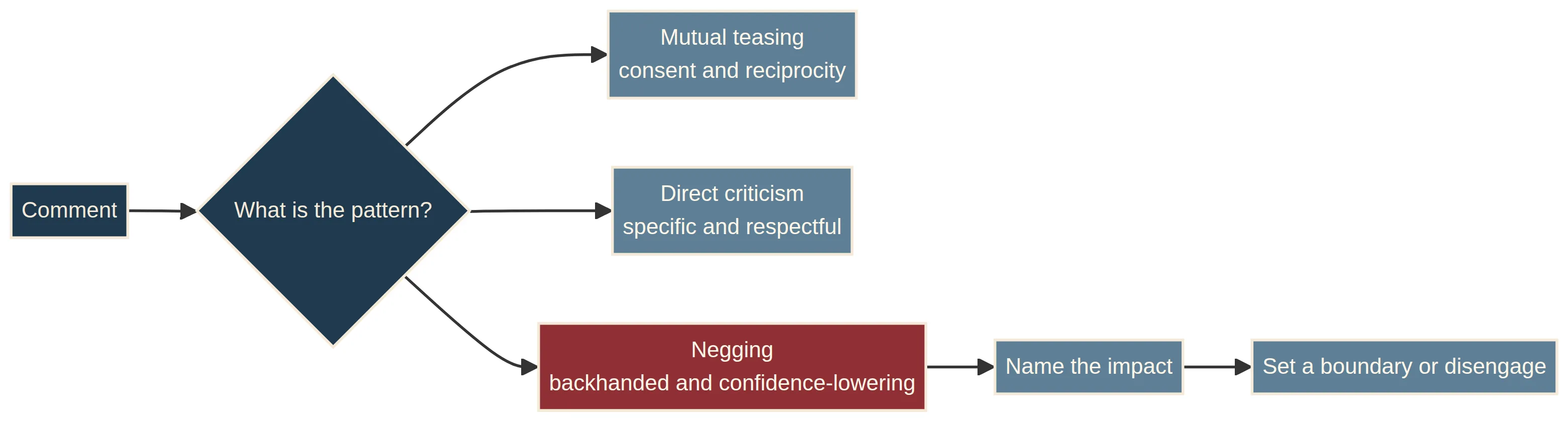
Not every awkward joke is negging. Teasing can be mutual, affectionate, and welcome. A fair analysis looks at the pattern, the target, the power relationship, the impact, and what happens after someone says the comment was uncomfortable.
Safety note: This article is for recognition and response. It does not teach dating “techniques” or ways to lower another person’s confidence. If comments occur with threats, isolation, stalking, or coercive control, prioritize safety and outside support.
The short answer
A comment may be negging when it combines praise with a status-lowering jab, targets a known insecurity, appears designed to make someone seek approval, or continues after discomfort is expressed. Examples for recognition include “You look good today—finally,” “You are surprisingly interesting,” or “I usually do not date people like you.” The wording alone is not proof; context and repetition matter.
For broader language patterns, read Manipulative Communication Styles and Passive-Aggressive Manipulation.
Negging versus teasing, criticism, and direct compliments
| Pattern | Typical features | What happens after discomfort? |
|---|---|---|
| Mutual teasing | Both people enjoy the exchange, the joke is not built around a vulnerability, and power is reasonably balanced | The person stops or repairs without retaliation |
| Direct criticism | Names a specific behavior or problem without attacking worth | The issue can be discussed and corrected |
| Direct compliment | Expresses appreciation without a hidden comparison or insult | The recipient does not have to earn more approval |
| Negging | Backhanded praise, subtle insult, status comparison, or confidence-lowering remark | The speaker denies impact, escalates, or uses insecurity as leverage |
Teasing is not defined only by the speaker’s intention. Mutual enjoyment, consent, reciprocity, and repair are important. “It was just a joke” does not end the conversation when the same joke repeatedly targets one person.
Five patterns to recognize
Backhanded compliments
The comment sounds positive but carries a put-down: “You are much more articulate than I expected.” Notice whether the praise depends on lowering the target or establishing the speaker as the evaluator.
Personal insecurity as entertainment
The speaker repeatedly comments on weight, appearance, age, intelligence, money, accent, history, or social status. A private vulnerability becomes a recurring punchline, especially in front of others.
Comparisons that create competition
The person compares you with an ex, friend, coworker, or imagined “better” option to make you compete for approval. A relationship does not become healthier because one person keeps trying to win a ranking system.
Approval followed by withdrawal
A compliment is offered, then removed when the target does not comply or show enough gratitude. This can overlap with intermittent reinforcement and emotional manipulation.
Denial after a boundary
The person says you are too sensitive, cannot take a joke, or are imagining the insult. A misunderstanding can be repaired; a repeated pattern of denying impact and escalating the same behavior deserves attention.
For signs guidance, read Signs of Manipulation.
How to respond to negging
You do not need to prove that a comment meets a perfect definition. Name the observable behavior and the boundary: “That comment was insulting. Do not speak to me that way.” You can also ask, “What did you mean by that?” and observe whether the person answers directly or turns the question into an attack.
If the behavior continues, reduce access to the conversation, leave the date or group, mute or block an account, document workplace conduct safely, or seek support. In a power-imbalanced relationship, a direct confrontation may not be the safest first step.
Do not respond by insulting the person back or trying to lower their confidence. A boundary is about what you will do, not a counterattack.
For relationship responses, read How to Respond to Emotional Manipulation.
Frequently asked questions
What is negging?
Negging is a common term for backhanded compliments or subtle insults used to lower confidence, create insecurity, or gain leverage. The term is not a diagnosis, and one awkward comment does not prove a pattern.
How is negging different from teasing?
Mutual teasing is welcome, reciprocal, and repairable. Negging tends to target a vulnerability or status, create insecurity, and continue after discomfort is expressed. Context, repetition, and response to a boundary matter.
Is negging always emotional abuse?
No single comment establishes emotional abuse. Repeated confidence-undermining comments can be part of emotional abuse when combined with control, humiliation, isolation, threats, or punishment for asserting needs.
What should I say to someone who negs me?
Try: “That sounded like an insult, not a compliment. Please do not comment on me that way.” You can disengage without persuading the person to agree with your interpretation.
What if I am not sure whether it was a joke?
Ask what the person meant, notice your own response, and observe what happens after you explain that it was uncomfortable. You can set a boundary even when intent is uncertain.
Final takeaway
Negging is confidence-undermining communication disguised as praise, humor, or flirtation. Teasing is not automatically harmless, and negging is not established by one imperfect joke. Look for consent, reciprocity, repeated targeting, power, impact, and repair.
You do not have to accept an insult to appear confident, attractive, funny, or easygoing. A healthy interaction leaves room for dignity and a clear “that is not okay.”
References
Canonical URL: Open the canonical article page