Financial Manipulation and Economic Abuse: Signs, Examples, and Safer Support
GenZ Frontier Editorial | August 17, 2026
Financial manipulation can mean using money, work, property, debt, benefits, or economic information to pressure another person’s choices. Economic abuse is a broader safety term for controlling, restricting, exploiting, or sabotaging access to financial resources and participation in economic life. It can happen in marriages, dating relationships, families, caregiving arrangements, and other relationships involving dependence or shared resources.
Unequal income, different spending habits, or a mutually chosen budget is not automatically abuse. The concern is whether money is being used to create dependence, punish independence, prevent work, force debt, control basic needs, or make it harder for someone to leave or seek help.
Safety note: Financial abuse can increase danger and make leaving more difficult. Do not suddenly confront a controlling person, close shared accounts, or move money if that could trigger retaliation. Seek confidential, qualified support and make changes safely.
The short answer
Possible financial or economic abuse patterns include:
- withholding money for food, medication, transportation, or housing as punishment;
- interfering with work, education, benefits, or access to professional opportunities;
- forcing debt, opening accounts, taking wages, or using credit without informed consent;
- controlling passwords, documents, bank access, property, or financial information;
- demanding receipts, location data, or constant explanations for ordinary spending; or
- promising money or financial security while requiring present dependence, secrecy, labor, or obedience.
A single disagreement does not establish abuse. Look at control, repetition, impact, power, and whether a person can safely say no.
For the wider coercive pattern, read Coercive Control and Emotional Abuse. For relationship context, read Emotional Manipulation in Relationships.
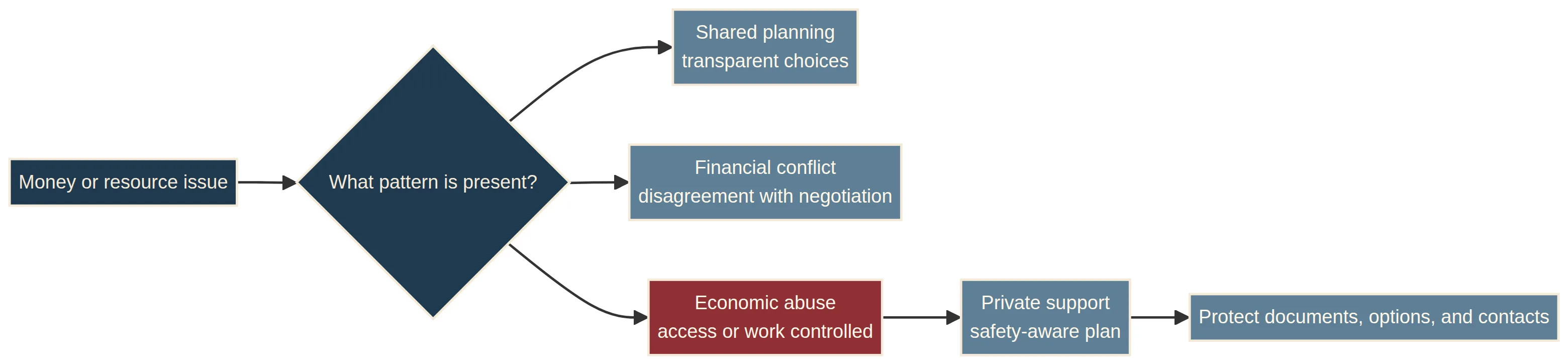
Shared finances, financial conflict, and economic abuse
| Pattern | What it may look like | What happens after disagreement? |
|---|---|---|
| Shared financial planning | Information, responsibilities, and limits are discussed transparently | Each person retains meaningful input and access to support |
| Financial conflict | People disagree about spending, saving, debt, or priorities | They can negotiate, pause, seek advice, or separate finances safely |
| Economic abuse | Money, work, property, or credit is controlled to restrict choices | Refusal triggers punishment, deprivation, threats, surveillance, or sabotage |
Consent matters even when finances are shared. Joint accounts do not automatically give one person the right to hide transactions, take all funds, or prevent the other person from understanding the household’s financial position.
Common signs across money and resources
Restricting basic access
A partner or family member may control money for food, transportation, medication, phone service, or housing. They may provide an allowance that is deliberately insufficient or require humiliating explanations for ordinary needs.
Interfering with work or education
A person may prevent you from working, sabotage interviews, demand that you quit, create childcare or transportation barriers, or punish you for attending school. Economic control can operate through time and opportunity, not only cash.
Creating or exploiting debt
Forced credit use, hidden accounts, pressure to sign documents, taking out loans in another person’s name, or refusing to pay agreed bills can create long-term dependence. Do not sign or transfer anything you do not understand simply to prove trust.
Controlling documents and accounts
A person may keep identification, tax records, benefit information, passwords, devices, or account access. Secure documents and accounts only in ways that do not increase immediate risk. A trusted advocate or qualified professional can help plan safer steps.
Monitoring and punishment
Constant receipt checks, transaction surveillance, threats to withdraw funds, or sudden financial deprivation can make a person feel that every choice requires permission. Shared budgeting should not become a system of intimidation.
Financial promises used as leverage
A person may promise housing, repayment, investment, inheritance, or financial support while demanding present secrecy, unpaid work, sex, loyalty, or dependence. Evaluate what exists now and keep major decisions reversible where possible.
For related promise patterns, read Future Faking.
Why economic abuse can be difficult to identify
Financial control is often hidden inside ordinary responsibilities. One person may handle bills because they have more experience, a disability may require assistance, or a couple may choose one account for convenience. The concern is not who pays a bill; it is whether the arrangement is transparent, consensual, reviewable, and safe to change.
Economic abuse can also be gradual. A person may first offer help, then create debt, then restrict access to the resources needed to become independent. Shame and fear of not being believed can make it harder to discuss.
Safety-aware steps
Seek private support
Contact a domestic-violence advocate, economic-abuse service, trusted person, or qualified professional through a safer device or account if monitoring is possible. In the United States, the National Domestic Violence Hotline provides confidential support at 800-799-SAFE (7233) and thehotline.org. If you are in immediate danger, call 911.
Protect information carefully
When safe, identify important documents, account details, debts, benefits, and property. Do not store a safety plan where another person can easily find it. An advocate can help you decide what to copy, where to store it, and when changes are safest.
Preserve independent options
If safe and lawful in your situation, maintain access to trusted contacts, identification, transportation, communication, and professional advice. Do not make sudden financial moves that could reveal a safety plan or trigger retaliation without support.
Get specialized advice
Financial, legal, benefits, tax, and housing rules vary by state and situation. This article is not personalized legal or financial advice. Consult a qualified professional or advocate before signing documents, moving assets, changing accounts, or taking on debt.
Document safely
A factual record of dates, transactions, threats, account changes, or work interference may help a qualified advocate understand the pattern. Avoid recording information in a way that creates more risk. Read How to Document Gaslighting or Emotional Abuse Safely and Recovering From Manipulation.
Frequently asked questions
What is financial manipulation in a relationship?
It is using money, debt, work, property, credit, benefits, or financial information to pressure another person’s choices. It may be part of economic abuse when it creates dependence, restricts autonomy, or punishes independence.
Is unequal income financial abuse?
No. Partners can have different incomes or divide responsibilities differently. The concern is whether the arrangement is transparent, voluntary, and changeable, or whether one person uses economic power to control or deprive the other.
What are common signs of economic abuse?
Signs can include withholding basic funds, interfering with work, forcing debt, controlling documents or accounts, monitoring spending, hiding financial information, sabotaging benefits, and using money or property as punishment.
Should I open a new account or move money immediately?
Safety and legal considerations vary. If someone may retaliate or monitor accounts, sudden changes can increase risk. Seek confidential advice from an advocate or qualified professional before taking action when possible.
How does financial abuse connect to coercive control?
Money and economic resources can be used to isolate a person, restrict movement, prevent work, control housing, or make leaving more difficult. Economic abuse may be one part of a broader coercive-control pattern.
Where can someone in the United States seek help?
The National Domestic Violence Hotline is available at 800-799-SAFE (7233), by texting START to 88788, or through thehotline.org. If using these services could be monitored, consider a safer method of contact. Immediate danger requires emergency services.
Final takeaway
Financial manipulation and economic abuse are about more than money disagreements. The key question is whether a person uses economic resources, work, debt, property, or information to restrict another person’s choices, create dependence, or punish independence.
Focus on safety, transparency, meaningful consent, independent support, and qualified advice. You do not need to confront someone or prove a label before seeking confidential help.
References
Canonical URL: Open the canonical article page