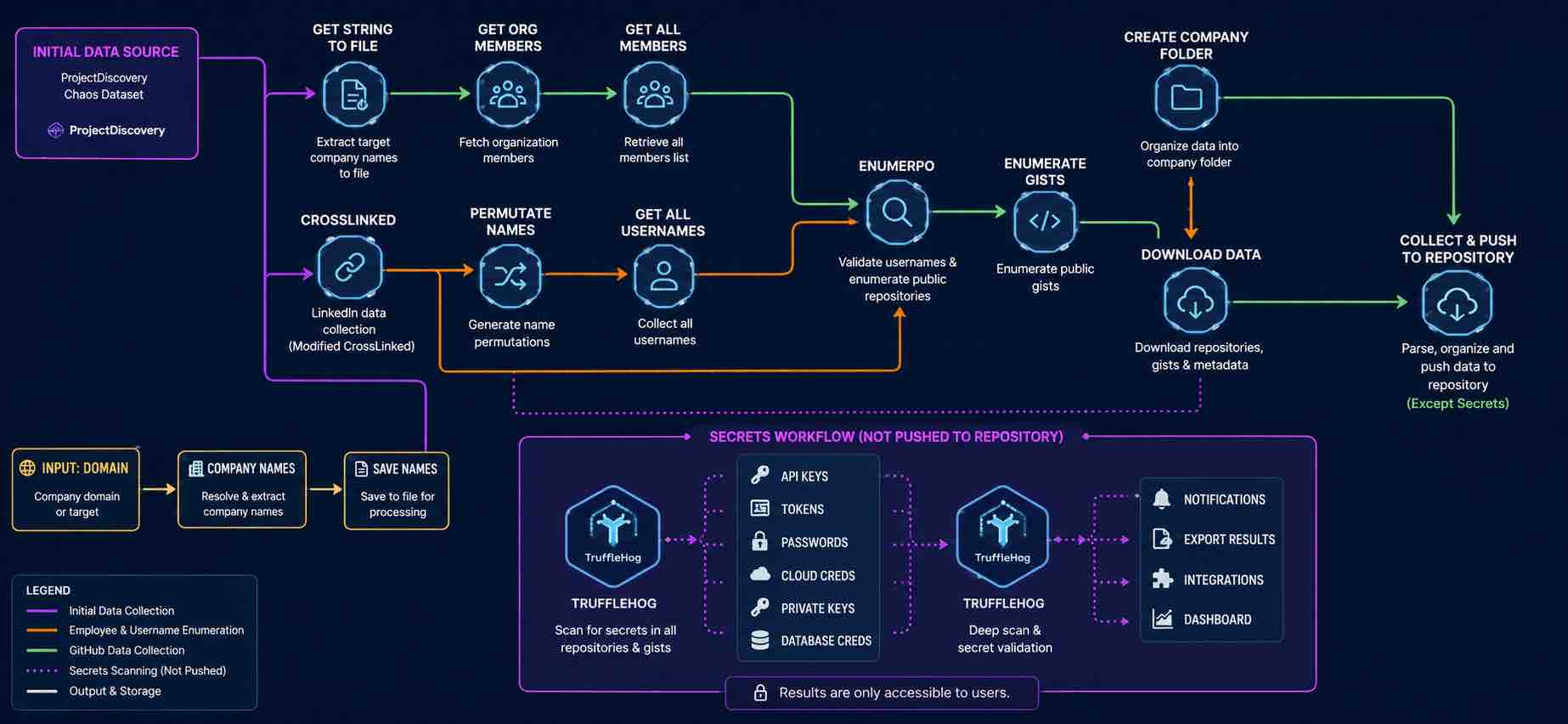
The Hidden Attack Surface: How Public Data, LinkedIn, GitHub, and OSINT Can Expose Organizations
Special Correspondent | June 2, 2026
In today’s digital-first world, organizations invest millions of dollars in cybersecurity technologies, endpoint protection, firewalls, intrusion detection systems, cloud security solutions, and compliance programs. Yet many organizations continue to overlook one of the fastest-growing sources of security exposure: publicly available information.
Every day, employees create LinkedIn profiles, publish code on GitHub, participate in open-source projects, share technical content, upload scripts, and leave digital footprints across numerous platforms. Individually, these actions may appear harmless. Collectively, however, they create a detailed map of an organization’s attack surface.
This is where Open Source Intelligence (OSINT) becomes critically important. OSINT is not hacking. It is not unauthorized access. It is the process of collecting, analyzing, and correlating publicly available information to gain actionable intelligence. Security teams use OSINT to identify risks before adversaries do. Unfortunately, threat actors use the exact same information for reconnaissance.
The difference is not the data itself. The difference is who finds it first.
Strategic Breakdown * How It Works: Threat actors use automated scrapers to passively collect fragmented data points from social platforms and code repositories, compiling them into a comprehensive target profile. * Why It Matters: Organizations spend heavily on internal defenses but leave their external, publicly visible layer entirely undefended. This creates a "path of least resistance" for attackers to map the network. * Recommended Strategy: Conduct a baseline external footprint audit today using simple search engine dorks (advanced search operators) to see exactly what an unauthenticated user can discover about your corporate infrastructure.
What Is OSINT?
Open Source Intelligence (OSINT) refers to the collection and analysis of information from publicly accessible sources. These sources may include public websites, corporate domains, LinkedIn profiles, GitHub repositories, public cloud resources, social media platforms, public datasets, technical documentation, DNS records, search engines, open-source projects, public code repositories, paste sites, and public APIs.
OSINT has become one of the most powerful disciplines in modern cybersecurity because organizations continuously expose information about themselves without realizing its cumulative impact. A single employee profile might reveal very little. Thousands of profiles analyzed together can reveal an organization’s structure, technologies, internal naming conventions, development practices, and even security weaknesses.
Strategic Breakdown * How It Works: Advanced OSINT frameworks ingest structured and unstructured data from DNS records, APIs, and public forums, linking seemingly unrelated details into a cohesive organizational map. * Why It Matters: The cumulative effect of minor data leaks is massive. Organizations often inadvertently publish their own infrastructure blueprints, essentially handing attackers a free network diagram. * Recommended Strategy: Utilize visual mapping tools like Maltego or SpiderFoot to graph the connections between your public corporate assets and your employees' digital footprints. Seeing the web of data helps visualize the true risk.
Why Attackers Start With OSINT
Before any sophisticated attack begins, reconnaissance typically occurs. Threat actors want answers to questions such as: Who works for the organization? What technologies are used? Which cloud providers are deployed? What programming languages are common? Which repositories are public? What email formats are used? Are there exposed credentials? Are employees discussing internal projects publicly?
OSINT provides answers to these questions without requiring any intrusion. This makes it highly attractive for attackers. The less effort required to gather intelligence, the lower the risk for the attacker.
Strategic Breakdown * How It Works: This represents the "passive reconnaissance" phase of the cyber kill chain. Attackers gather intelligence without ever sending a single packet to your company's servers. * Why It Matters: Because it is entirely passive, OSINT gathering triggers absolutely zero alerts in your SOC (Security Operations Center) or intrusion detection systems. The attacker remains completely invisible. * Recommended Strategy: Adopt an "Assume Breach" mindset for your public data. Assume that threat actors already know your tech stack, and build your internal access controls (like Zero Trust) based on that assumption.
LinkedIn: The Organizational Directory Nobody Intended to Build
LinkedIn has become one of the most valuable sources of organizational intelligence. Employees frequently share job titles, departments, technologies used, certifications, team structures, project descriptions, employment history, and management hierarchy.
From a recruitment perspective, this information is valuable. From a security perspective, it can also reveal significant intelligence. For example, if dozens of employees mention AWS, Kubernetes, Terraform, Azure, Google Cloud, Jenkins, or GitHub Actions, an attacker can begin constructing a detailed understanding of the organization’s infrastructure. Even more importantly, employee names can be correlated with other public platforms.
Strategic Breakdown * How It Works: Employees list specific software versions, internal project codenames, and server architectures to optimize their profiles for recruiters and search algorithms. * Why It Matters: There is a direct conflict between the incentives of professional networking (maximizing visibility) and the principles of operational security (minimizing exposure). * Recommended Strategy: Draft and enforce a "Safe Social Media Guide." Encourage your engineering and IT staff to list general skills (e.g., "Cloud Infrastructure Management") rather than specific proprietary stacks or exact software version numbers.
Employee Enumeration
Employee enumeration refers to identifying individuals associated with an organization through public sources. Security researchers commonly analyze LinkedIn profiles, public conference speakers, open-source contributors, technical blogs, GitHub accounts, and public forums.
The objective is not to invade privacy. The objective is to understand the organization’s publicly visible footprint. For defenders, this helps identify unnecessary exposure. For attackers, this provides a target list. This is why employee enumeration is often one of the earliest stages of reconnaissance.
Strategic Breakdown * How It Works: Analysts extract massive employee lists and cross-reference them with third-party data broker databases and previously breached password lists. * Why It Matters: Humans are the weakest link in any security chain. Identifying the specific people who hold administrative keys is significantly faster than trying to break enterprise encryption. * Recommended Strategy: Run a highly targeted, simulated phishing campaign specifically designed around the public information your high-level employees (Admins, HR, Finance) have shared on their professional profiles to test their awareness.
Username Discovery and Identity Correlation
People frequently reuse usernames across platforms. An employee might use johndoe, john.doe, jdoe, or john_doe across multiple services. By generating common username permutations, analysts can identify related accounts on GitHub, GitLab, Bitbucket, developer forums, and community platforms.
Identity correlation can reveal technical interests, public projects, development activity, and open-source contributions. When viewed individually, these accounts may seem unrelated. When correlated, they can provide substantial organizational intelligence.
Strategic Breakdown * How It Works: Specialized scripts (like Sherlock or Namechk) scan hundreds of web platforms simultaneously to check where a specific username permutation has been registered. * Why It Matters: Humans are creatures of habit who reuse identities. This bridges the gap between highly secure corporate environments and insecure personal hobby sites or gaming forums. * Recommended Strategy: Mandate entirely different naming conventions for internal administrative accounts versus public-facing corporate identities, making it mathematically harder for attackers to guess admin logins.
GitHub: A Goldmine of Security Intelligence
GitHub is one of the most valuable resources for both defenders and attackers. Millions of developers publish code publicly. Organizations often encourage open-source participation. While this benefits innovation, it also introduces risks.
Public repositories can reveal internal tooling, infrastructure code, deployment methods, API integrations, development practices, technology stacks, and configuration files. Even when repositories do not contain sensitive data, metadata itself can provide useful intelligence.
Strategic Breakdown * How It Works: Automated bots constantly monitor the GitHub firehose, analyzing new commits, pull requests, and issue comments for proprietary logic, IP, or infrastructure blueprints. * Why It Matters: Developers naturally prioritize speed, collaboration, and troubleshooting. In the rush to meet deadlines, they often accidentally push internal configurations into public spaces. * Recommended Strategy: Set up GitHub organization alerts that notify your security team immediately if any internal repository's visibility status is ever changed from "Private" to "Public."
Public Repository Enumeration
Repository enumeration involves identifying repositories associated with employees, contractors, departments, and corporate GitHub organizations. This process helps uncover active projects, abandoned projects, testing repositories, infrastructure code, and experimental applications. Security teams use repository enumeration to understand what information is publicly accessible. Attackers use it for the exact same reason.
Strategic Breakdown * How It Works: Scripts recursively map out all repositories owned by a specific corporate user or organization, checking personal forks, legacy branches, and code snippets (gists) that might have been forgotten. * Why It Matters: Forgotten, "abandoned," or experimental repositories are rarely patched. They often contain outdated security practices or legacy credentials that still have active access rights. * Recommended Strategy: Implement an automated quarterly audit of all developer repository forks to ensure no proprietary corporate code has been cloned or left sitting in personal, unmanaged GitHub accounts.
The Secret Exposure Problem
One of the most common security issues found during repository analysis is exposed secrets. Examples include API keys, access tokens, database credentials, cloud credentials, authentication secrets, service account keys, and webhook tokens.
Many developers accidentally commit sensitive information during development due to poor Git hygiene, misconfigured CI/CD pipelines, testing shortcuts, forgotten configuration files, or inadequate code review processes. Even if a secret is removed later, Git history may still contain the exposed value.
Strategic Breakdown * How It Works: Keys are hardcoded into scripts for rapid local testing, accidentally committed to version control, and become permanently etched in the Git commit history—even if they are deleted in the very next commit. * Why It Matters: Setting up secure environment variables and enterprise vaults takes time. Developers often take temporary security shortcuts that rapidly become permanent organizational liabilities. * Recommended Strategy: Use historical deep-scanning tools (like TruffleHog or Gitrob) to recursively scan the entire history of your repositories. Ensure no secrets are buried deep within commits from years ago.
Secret Scanning and Automated Detection
Modern security tools continuously scan repositories for exposed credentials by analyzing source code, commit history, configuration files, environment variables, and infrastructure templates. The goal is simple: Identify sensitive information before it can be abused.
Organizations increasingly integrate automated secret detection into CI/CD pipelines, source control systems, security monitoring platforms, and DevSecOps workflows.
Strategic Breakdown * How It Works: Scanning engines utilize Regular Expressions (Regex) and Shannon entropy algorithms to flag high-entropy text strings that are statistically likely to be randomized passwords or API keys. * Why It Matters: Manual code reviews are fundamentally incapable of consistently catching a random 64-character string buried within thousands of lines of dense application code. Automation is required. * Recommended Strategy: Deploy tools like
git-secretsorpre-commitlocally on every single developer's workstation. This ensures secrets are caught and blocked before they ever leave the developer's laptop.
Attack Surface Management (ASM)
Attack Surface Management (ASM) is the continuous process of discovering, monitoring, and reducing an organization’s externally visible assets. Traditionally, security teams focused on servers, domains, and IP addresses. Modern attack surfaces are much broader, including employee identities, GitHub repositories, cloud resources, public documentation, social media presence, developer ecosystems, and third-party integrations.
Strategic Breakdown * How It Works: ASM platforms continuously crawl the internet to map domains, open ports, cloud storage buckets, and digital identities, actively comparing them against known vulnerabilities. * Why It Matters: The digital perimeter is dynamic. Cloud instances spin up and down in minutes, making static asset inventory spreadsheets obsolete the moment someone hits "save." * Recommended Strategy: Adopt an ASM solution that integrates directly with your cloud provider's API (AWS/Azure/GCP). This allows you to automatically discover and map shadow IT resources spun up without security's knowledge.
Why Continuous Monitoring Matters
The internet changes every day. New employees join organizations, developers create repositories, credentials are accidentally exposed, and infrastructure evolves. A security assessment performed once per year is no longer sufficient. Organizations require continuous visibility to identify changes as they occur rather than months later.
Strategic Breakdown * How It Works: Automated scanners run on a scheduled, continuous loop and generate "diffs" (differences) to alert the security team to exactly what changed since the last hour or day. * Why It Matters: A credential leaked on GitHub today will be actively exploited by bots within seconds. Waiting for an annual penetration test means you will find the vulnerability 11 months too late. * Recommended Strategy: Set up webhook integrations directly into your Slack or Microsoft Teams channels. Notify the security operations team the absolute millisecond a new public asset or repository is detected.
The Role of Automation
Manual analysis cannot scale effectively. Large organizations may have thousands of employees, repositories, and cloud assets. Automation enables security teams to discover new assets, enumerate repositories, monitor changes, identify exposed secrets, generate alerts, and produce actionable reports.
Strategic Breakdown * How It Works: APIs and serverless functions are used to string together discovery, scanning, and alerting tools into a frictionless, zero-touch operational workflow. * Why It Matters: The sheer volume of telemetry data generated by modern development teams far exceeds the cognitive capacity of any human security team to review manually. * Recommended Strategy: Build a SOAR (Security Orchestration, Automation, and Response) playbook that automatically revokes compromised AWS or Azure keys the moment they are detected in a public scan, requiring zero human intervention.
False Positives and Data Validation
One challenge in OSINT collection is accuracy. Username generation and identity correlation can occasionally produce false positives due to similar names or unrelated developer accounts. Security decisions should never be based solely on automated findings. The most effective programs combine automated discovery, automated correlation, human validation, and risk assessment.
Strategic Breakdown * How It Works: Security analysts manually review flagged alerts to distinguish between a highly critical, legitimate API key and a similarly structured placeholder string (like
test_key_123). * Why It Matters: "Alert fatigue" is incredibly dangerous. If security teams are continuously bombarded with fake or irrelevant alerts, they will eventually begin ignoring real threats. * Recommended Strategy: Implement a strict "confidence score" system for your alerts. Only page your on-call engineers after hours for alerts that have a 90%+ confidence rating of being a true, critical credential leak.
Best Practices for Organizations
To reduce OSINT-related exposure, organizations should adopt several best practices: 1. Monitor Public Repositories: Continuously monitor repositories associated with employees and corporate organizations. 2. Implement Secret Scanning: Integrate automated secret detection into development workflows. 3. Educate Developers: Teach secure coding practices, Git hygiene, and credential management. 4. Conduct Regular OSINT Assessments: Analyze what information is publicly visible. 5. Adopt Attack Surface Management: Maintain a continuously updated inventory of all public assets. 6. Review Public Employee Information: Encourage employees to avoid oversharing sensitive technical details.
Strategic Breakdown * How It Works: This creates a layered defense (Defense-in-Depth) approach that seamlessly combines rigid corporate policy, continuous human education, and automated technological guardrails. * Why It Matters: Relying on just a single security control will always fail the moment an employee finds a creative, undocumented workaround for convenience. * Recommended Strategy: Gamify your organizational security. Create an internal "Bug Bounty" program that financially rewards employees who proactively spot and report exposed corporate data or open digital resources.
The Future of OSINT and Organizational Security
OSINT will continue to grow in importance. Artificial Intelligence is making data collection, correlation, and analysis significantly more efficient. Future platforms will be capable of mapping organizational structures automatically and discovering exposed assets in real-time. Organizations that embrace proactive visibility will gain a significant security advantage.
Strategic Breakdown * How It Works: Machine learning and Large Language Models (LLMs) process massive amounts of unstructured data to extract deep organizational intelligence. * Why It Matters: The global volume of data is rapidly outgrowing traditional indexing methods. Attackers are already using AI to find the actionable needle in the digital haystack. * Recommended Strategy: Start experimenting with enterprise-grade AI summarization tools to rapidly analyze large dumps of public corporate data, breached databases, or extensive technical documentation for potential risks.
Real-World Lessons from Public Exposure Incidents
Over the last decade, some of the most significant cybersecurity incidents did not begin with sophisticated malware or advanced zero-day exploits. Instead, they started with publicly available information. A developer accidentally commits an API key. An engineer publishes infrastructure code publicly. An employee shares detailed technical information on social media.
The modern attacker rarely begins with exploitation. They begin with observation. This is why organizations must treat publicly accessible information as part of their security perimeter.
Strategic Breakdown * How It Works: Attackers meticulously piece together seemingly disconnected digital footprints—a tweet here, a GitHub commit there, a LinkedIn update—to construct a highly reliable and undefended attack vector. * Why It Matters: It is significantly safer, quieter, and cheaper for an attacker to exploit public data than to trigger alarms by probing highly monitored perimeter firewalls. * Recommended Strategy: Study the public post-mortem reports of recent major breaches (like Uber or LastPass). Analyze exactly how OSINT reconnaissance and credential leaks were leveraged against companies similar to yours.
Building a Mature OSINT Defense Program
Many organizations invest heavily in offensive security testing while neglecting continuous exposure monitoring. An effective OSINT defense program typically includes: Brand Monitoring, Employee Exposure Monitoring, Public Repository Monitoring, Credential Leak Detection, Domain/Subdomain Enumeration, Cloud Asset Discovery, and Third-Party Risk Monitoring.
Strategic Breakdown * How It Works: Establishing a systematic, continuous monitoring architecture that seamlessly spans across brands, employees, domains, and multi-cloud environments. * Why It Matters: Ad-hoc Google searches are entirely insufficient. True operational maturity requires systematic, repeatable, and scalable processes that do not rely on an individual analyst's memory. * Recommended Strategy: Start small to score an early security win. Fully automate your domain and subdomain enumeration processes before attempting to tackle highly complex identity correlation programs.
The Security Team of the Future
Modern security teams must understand Open Source Intelligence, Threat Intelligence, Cloud Infrastructure, Identity Correlation, Digital Risk Protection, Exposure Management, and Security Automation. Cybersecurity is no longer just about blocking attacks. It is about understanding exposure before attacks happen.
Strategic Breakdown * How It Works: Security teams are actively transitioning from strictly managing endpoint agents and firewalls to proactively hunting external risks and managing digital exposure. * Why It Matters: The perimeter is no longer the physical network edge. The perimeter is now wherever your data, your code, and your employees live online. * Recommended Strategy: Provide your security analysts with dedicated time, budget, and resources to pursue specialized OSINT certifications or hands-on external threat investigation courses.
The Growing Importance of Attack Surface Intelligence
Attack Surface Intelligence shifts security from reactive to proactive. Instead of asking, "What happened?", organizations begin asking, "What could happen?" That mindset shift alone can dramatically improve security outcomes.
Strategic Breakdown * How It Works: Fundamentally shifting the security operation's core focus from reactive incident response to proactive exposure identification and mitigation. * Why It Matters: Anticipating and resolving "what could happen" entirely prevents the devastating, exhausting, and costly reality of dealing with "what happened." * Recommended Strategy: Create a simple, one-page "Exposure Dashboard." Report on newly discovered public assets, shadow IT, and repository risks at your weekly IT leadership team meetings.
Why GitHub Security Deserves Executive Attention
For security leaders, GitHub should be viewed as an extension of the corporate attack surface. Monitoring it should be considered a business requirement rather than a technical preference.
Strategic Breakdown * How It Works: Translating deeply technical developer risks into quantifiable business risks for the C-suite. * Why It Matters: Executives control the budget and corporate policy. If they do not understand the business risk of leaked code, they will not fund the necessary software solutions to fix it. * Recommended Strategy: Present your executives with a sanitized, real-world example of an exposed API key or credential found in your own repositories to visibly demonstrate the immediate impact.
The Human Element Remains the Biggest Variable
Most public exposures originate from human behavior: sharing too much information publicly, improper credential management, poor repository hygiene, and a lack of security awareness. The best security tools in the world cannot prevent mistakes people do not recognize.
Strategic Breakdown * How It Works: Acknowledging that misconfigurations and data oversharing are fundamentally psychological and behavioral issues, not just technical glitches in a system. * Why It Matters: No software tool can definitively stop a highly privileged employee who deliberately bypasses security controls due to deadline pressure or convenience. * Recommended Strategy: Implement "blameless post-mortems" when an employee accidentally leaks data. Focus entirely on fixing the systemic process that allowed the leak rather than punishing the individual.
A Practical Framework for Organizations
Organizations looking to strengthen their exposure management strategy can follow a simple 7-step framework: 1. Discover: Identify publicly visible assets. 2. Inventory: Create a continuously updated inventory. 3. Monitor: Implement automated monitoring. 4. Validate: Review findings to eliminate false positives. 5. Prioritize: Focus remediation on risk impact. 6. Remediate: Remove unnecessary exposure. 7. Repeat: Exposure management is a continuous process.
Strategic Breakdown * How It Works: Operating a continuous, 7-step operational loop of Discover, Inventory, Monitor, Validate, Prioritize, Remediate, and Repeat. * Why It Matters: Security is a continuous lifecycle, not a final destination. Structured frameworks ensure no critical steps or forgotten assets are skipped. * Recommended Strategy: Start exclusively with Step 1 (Discover). Give your team a strict 30-day timeline to map exactly what the internet currently knows about your organization before moving to remediation.
Conclusion and Final Thoughts
The modern attack surface extends far beyond servers and firewalls. Every employee profile, public repository, cloud asset, and exposed credential forms a living representation of an organization's attack surface. The solution is not secrecy. The solution is visibility.
The organizations that succeed in the coming years will not be those with the most tools. They will be the organizations with the greatest visibility. Because in modern cybersecurity, visibility creates awareness. Awareness enables action. And action reduces risk.
The internet is continuously collecting information about your organization. The only question is: Are you monitoring it as carefully as everyone else is?
Strategic Breakdown * How It Works: Embracing total visibility to finally turn the tables on attackers, shifting from a defensive posture to actively owning your digital narrative. * Why It Matters: Because the internet never sleeps and automated bots never stop scraping your data. You cannot afford to stop monitoring it. * Recommended Strategy: Share this article and your newly defined OSINT strategy with your senior leadership team today to spark an immediate, proactive culture change across the enterprise.
#CyberSecurity #OSINT #AttackSurfaceManagement #GitHubSecurity #ThreatIntelligence #CloudSecurity #DevSecOps #InformationSecurity #DigitalRiskProtection #ExposureManagement #SecurityResearch #CyberDefense