- Facebook Monetisation
- Facebook Bonus
- Content Monetisation
- Meta
- Professional Mode
- Creator Economy
- Facebook Review breaking: false
Facebook Content Monetisation Unlock Feature: Meta Starts Reviewing Creators After 300,000 Views
GenZ Frontier Tech Desk | July 11, 2026
Facebook has officially begun rolling out another major milestone for creators through its Content Monetisation program. Creators who successfully reach 300,000 eligible content views within the required qualification period are now automatically moved into Meta's review stage before receiving an invitation to monetize their content.
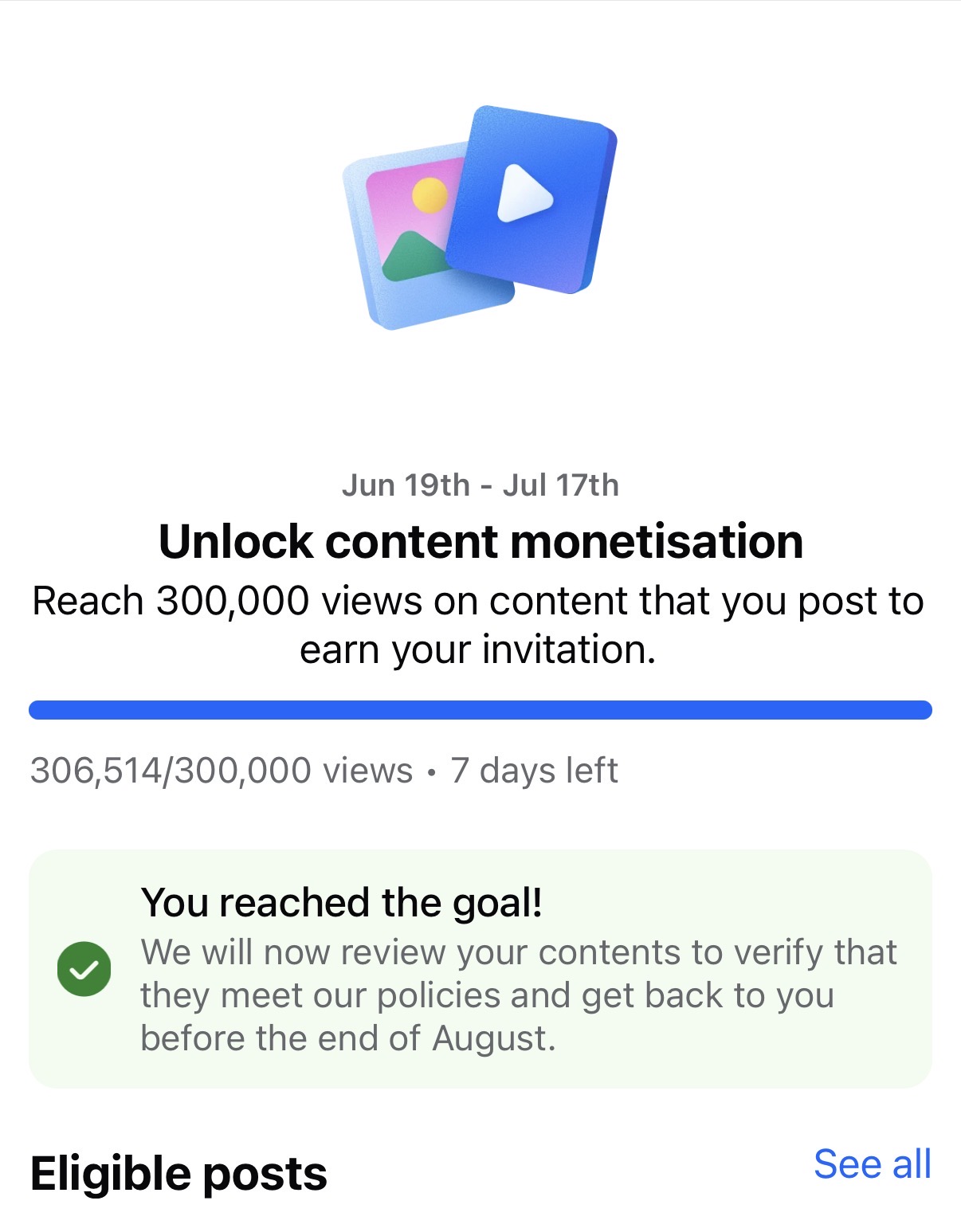
The review process has become one of the most discussed topics among Facebook creators in 2026 as thousands of Pages and Professional Mode profiles race toward eligibility. A recent creator dashboard screenshot confirms the milestone has been achieved with 306,514 eligible views, triggering Facebook's internal review system.
Unlike previous monetisation programs that relied heavily on follower counts, Meta's latest Content Monetisation initiative places much greater emphasis on original content performance, authentic audience engagement, policy compliance, and long-term account quality.
For creators building a sustainable income through Facebook, reaching the required view count is only the beginning. Passing Meta's review is now the most important step.
What Happens After Reaching 300,000 Views?
Once a creator crosses the required threshold, Facebook automatically displays a confirmation message similar to:
You reached the goal! We will now review your contents to verify that they meet our policies and get back to you before the end of the review period.
This means creators cannot manually unlock monetisation immediately.
Instead, Meta performs a detailed review that evaluates the overall health of the creator account, published content, audience authenticity, monetisation compliance, and previous policy history.
Only creators that successfully pass this review receive an invitation to activate Facebook Content Monetisation.
What Is Facebook Content Monetisation? Everything Creators Need to Know
Facebook Content Monetisation is Meta's latest creator earnings program that rewards eligible creators for publishing original, engaging, and policy-compliant content on Facebook. Unlike older monetisation programs that focused primarily on followers or individual monetisation tools, this new system evaluates creators based on multiple factors, including content quality, audience engagement, originality, and compliance with Meta's monetisation policies.
The goal is simple: reward creators who consistently produce valuable content while protecting advertisers from low-quality, misleading, or copied material.
In 2026, Meta has continued expanding this system globally, allowing more creators to qualify through performance-based milestones instead of invitation-only programs. This change has made Facebook one of the largest creator platforms for earning revenue from videos, photos, reels, and other public content.
The New 300,000 View Requirement Explained
One of the biggest changes introduced by Facebook's latest monetisation system is the performance milestone.
Instead of immediately allowing creators to earn money, Facebook first asks eligible creators to reach a required amount of content views during a qualification period.
For many creators, this milestone currently appears as:
Reach 300,000 eligible content views before the qualification deadline.
Once the required views are reached, Facebook automatically unlocks the next stage of the process—Meta Review.
It is important to understand that reaching this milestone does not automatically approve monetisation.
Instead, it simply tells Meta:
"This creator has demonstrated enough audience activity. Now it's time to verify whether the account deserves monetisation."
That distinction is extremely important because many creators mistakenly assume that 300,000 views guarantee approval. In reality, it only qualifies the account for review.
Understanding the Screenshot: What It Actually Means
The screenshot shown above displays one of the most exciting milestones for any Facebook creator.
Several important pieces of information appear on the dashboard.
Qualification Period
The dashboard shows a qualification window between specific dates.
This is the time during which Facebook counts eligible views.
Only views earned during this period contribute toward the required milestone.
Progress Bar
The blue progress bar represents your current progress toward the required target.
In this example, the creator reached:
306,514 / 300,000 Views
This means the required threshold has already been exceeded.
Facebook will not ask for additional views before starting the review.
Goal Completed
Perhaps the most important message shown is:
You reached the goal!
This confirms that the performance requirement has been successfully completed.
However, many creators misunderstand this notification.
It does not mean monetisation has already been unlocked.
Instead, it means Facebook has accepted the performance requirement and is now beginning its verification process.
Review Status
The dashboard also displays a message similar to:
We will now review your content to verify that it meets our policies.
This indicates that Meta's automated systems—and in some cases human reviewers—will begin evaluating the creator's account.
During this stage, Facebook examines far more than just view numbers.
The platform analyzes overall account quality, publishing history, audience authenticity, copyright compliance, policy violations, engagement quality, and monetisation eligibility.
Why Facebook Introduced a Review Stage
Many creators wonder why Facebook doesn't simply unlock monetisation immediately after reaching 300,000 views.
The answer is trust.
Meta wants to ensure advertisers appear alongside high-quality content created by genuine creators.
Without a review system, spam accounts, fake engagement networks, stolen videos, AI-generated misinformation, and copyright violations could easily enter the monetisation ecosystem.
To prevent this, Facebook verifies whether creators truly deserve access before allowing them to generate advertising revenue.
This review protects:
- Advertisers
- Viewers
- Legitimate creators
- Facebook's advertising ecosystem
Ultimately, the review process helps maintain higher-quality content across the platform.
What Happens Immediately After You Reach 300,000 Views?
After reaching the required milestone, creators usually experience the following process.
Step 1: Facebook Locks the Qualification
Once the required views are achieved, the qualification target becomes complete.
The creator no longer needs to worry about earning additional qualifying views for that milestone.
Step 2: Meta Begins Account Review
Facebook automatically places the account into review.
No manual application is normally required.
During this period, the creator simply waits while Meta evaluates the account.
Step 3: Internal Policy Verification
Behind the scenes, Facebook begins checking hundreds of signals.
These include:
- Originality
- Community Standards history
- Copyright compliance
- Fake engagement detection
- Account authenticity
- Audience quality
- Content consistency
- Monetisation eligibility
- Previous restrictions
- Profile information
Most of these checks are invisible to creators.
Step 4: Review Decision
After verification finishes, Facebook sends one of several possible outcomes.
The creator may receive:
- Content Monetisation Invitation
- Additional Verification Request
- Policy Warning
- Ineligible Status
- Request to Improve Account Quality
The exact outcome depends entirely on the account's compliance with Meta's monetisation requirements.
The Biggest Mistake Creators Make
One of the most common misconceptions is believing that views alone determine monetisation approval.
In reality, views are only the entry ticket.
Facebook's decision is based on the overall quality of the creator's account—not just one viral video.
Some creators receive millions of views yet still fail review because they publish reused content, violate policies, or rely on artificial engagement.
Meanwhile, smaller creators with authentic audiences and original content often receive approval much faster.
That is why creators should think beyond numbers and focus on building a trustworthy creator profile from the very beginning.
Why This Matters for Serious Facebook Creators
Meta's latest Content Monetisation system represents a major shift in how creators earn revenue.
Instead of rewarding viral success alone, Facebook increasingly rewards creators who consistently publish original, authentic, advertiser-friendly content over the long term.
This approach benefits creators who invest time in producing valuable videos, building genuine communities, and maintaining policy compliance.
For anyone hoping to build a sustainable business through Facebook, understanding this review process is just as important as reaching the required 300,000 views.
In the next section, we'll explore exactly how Meta reviews creator accounts behind the scenes, what signals it checks, why some creators pass instantly while others fail, and how you can maximize your chances of getting approved on the first attempt.
Meta's Review Process Explained
The review is designed to determine whether a creator deserves long-term monetisation access.
Rather than checking only one viral post, Meta reviews the creator's overall activity across Facebook.
The system evaluates:
- Originality of uploaded content
- Community Standards compliance
- Content Monetisation Policies
- Partner Monetisation Policies
- Audience authenticity
- Engagement quality
- Copyright history
- Reused content detection
- Fake engagement signals
- Overall Page or Professional Mode health
If everything passes successfully, the creator receives a monetisation invitation directly inside the Professional Dashboard.
Step 2: How Facebook Reviews Your Account Before Approving Monetisation
Reaching the 300,000-view milestone is an important achievement, but it is only the beginning of Facebook's monetisation journey. Once the required views have been reached, Meta automatically moves your account into its review system. This stage determines whether your Page or Professional Mode profile is trustworthy enough to generate revenue from Facebook's monetisation products.
Many creators mistakenly believe this review is completed manually by a Facebook employee. In reality, Meta uses a combination of advanced artificial intelligence, automated policy detection systems, account history analysis, and, in some cases, human reviewers to evaluate each creator.
This entire process is designed to protect advertisers, users, and the integrity of Facebook's creator ecosystem.
How the Facebook Review Process Works
The review process generally follows several important stages. While creators only see a simple "Under Review" message in their dashboard, a significant amount of analysis happens behind the scenes.
Stage 1: Performance Verification
Before anything else, Facebook verifies that your account genuinely reached the required qualification milestone.
During this stage, Meta checks whether your eligible views were earned naturally.
The system analyzes:
- Whether views came from authentic Facebook users
- Whether the views occurred during the qualification period
- Whether suspicious traffic patterns exist
- Whether engagement appears manipulated
- Whether the creator attempted to artificially inflate statistics
If abnormal activity is detected, Meta may pause the review or investigate the account further before proceeding.
Stage 2: Identity and Account Trust Review
Once performance has been verified, Facebook begins evaluating the overall trustworthiness of your account.
This review focuses on whether your account represents a genuine creator rather than a spam profile.
Several factors contribute to this trust score.
Account Age
Older accounts generally have stronger trust signals because they demonstrate long-term activity.
Brand-new Pages created solely to chase monetisation may receive additional scrutiny.
Profile Completeness
Facebook checks whether your creator profile appears authentic.
Examples include:
- Profile photo
- Cover photo
- Bio information
- Contact details
- Public activity
- Consistent branding
A complete and professional profile creates stronger credibility.
Publishing History
Meta also reviews your posting consistency.
Creators who regularly publish original content over several months usually receive stronger trust signals than accounts that suddenly upload dozens of videos within a short period.
Consistency matters.
Stage 3: Community Standards Review
This is one of the most important stages.
Facebook reviews your account's history to determine whether you have violated Community Standards.
Previous violations involving topics such as hate speech, graphic violence, harassment, misinformation, adult content, dangerous organizations, fake accounts, or repeated policy enforcement actions may affect monetisation eligibility.
Even if violations occurred months earlier, they can still influence the final review decision.
For this reason, creators should regularly check their Account Status and resolve any outstanding policy issues whenever possible.
Stage 4: Original Content Detection
Facebook heavily prioritizes originality.
Its automated systems compare your content against millions of existing videos already available on Facebook and across Meta's platforms.
The system attempts to determine:
- Did you create this content?
- Are you the original publisher?
- Does the video contain meaningful creative additions?
- Has this content already appeared elsewhere?
- Is this simply a copy of another creator's work?
Creators who consistently upload their own original videos generally perform much better during review than those who repost trending clips.
Stage 5: Copyright Analysis
Copyright compliance has become significantly more advanced in recent years.
Facebook's automated detection systems analyze:
- Video footage
- Audio tracks
- Music
- Visual elements
- Television clips
- Movie scenes
- Sports broadcasts
Even short copyrighted segments can trigger restrictions if they violate Meta's monetisation policies.
Creators should always ensure they own the necessary rights or have transformed copyrighted material with meaningful original commentary where applicable.
Stage 6: Audience Quality Review
One of Meta's biggest priorities is authentic engagement.
Facebook wants advertisers to reach real people—not fake accounts.
During review, Meta examines whether your audience appears genuine.
Signals include:
- Organic followers
- Authentic watch time
- Real comments
- Natural sharing
- Genuine audience growth
- Consistent viewer behavior
Artificial growth services, purchased followers, fake likes, or automated view networks can significantly reduce approval chances.
Stage 7: Content Quality Evaluation
Facebook also evaluates the overall quality of your published content.
The review goes beyond simple video resolution.
Meta analyzes whether your content provides value to viewers.
Higher-quality creators generally demonstrate:
- Clear visuals
- Understandable audio
- Informative storytelling
- Original editing
- Consistent branding
- Viewer-focused content
Pages filled with repetitive, low-effort uploads often struggle during monetisation review.
How Long Does Facebook's Review Take?
One of the most common questions creators ask is:
"How long will Meta review my account?"
The answer varies.
Some creators receive approval within several days.
Others may wait several weeks.
In some situations, Facebook states that creators may receive a decision before the end of the published review period shown in the dashboard.
The exact timeline depends on factors such as:
- Number of accounts currently under review
- Account history
- Policy checks
- Identity verification requirements
- Regional processing
There is no guaranteed approval date.
Can You Speed Up Facebook's Review?
Unfortunately, no.
There is currently no official method to accelerate Meta's review process.
Submitting multiple support tickets or repeatedly contacting Facebook Support does not usually move your application forward.
Instead, creators should continue maintaining a healthy account by:
- Publishing original content
- Following Facebook policies
- Avoiding copyright risks
- Monitoring Account Status
- Keeping profile information updated
Patience is usually the best strategy.
Common Review Status Messages
During the review process, creators may see different notifications inside their Professional Dashboard.
Some common examples include:
Under Review
Meta is currently evaluating your account.
No action is required unless Facebook requests additional information.
Eligible
Congratulations.
Your account has successfully passed review and can begin setting up monetisation features.
Ineligible
Facebook has determined that your account does not currently meet monetisation requirements.
Creators should carefully review any policy explanations provided.
Additional Verification Required
Sometimes Meta requests identity verification, payment information, or other account confirmation before monetisation can be activated.
Completing these requests quickly can help avoid unnecessary delays.
Why Some Creators Pass Instantly While Others Fail
Many creators compare view counts and become confused when smaller Pages receive approval before much larger ones.
The reason is simple.
Facebook evaluates quality, not just popularity.
For example:
A creator with 350,000 authentic views, original educational content, clean policy history, and organic engagement may receive approval much faster than another creator with one million views generated through reused videos, misleading thumbnails, or fake engagement.
This is why long-term trust is far more valuable than short-term viral success.
What You Should Do While Waiting for Review
The review period should not be viewed as downtime.
Instead, continue strengthening your creator profile.
Good habits include:
- Continue uploading original content.
- Avoid deleting large numbers of older videos.
- Do not purchase followers or views.
- Keep responding to genuine audience comments.
- Monitor your Account Status for new policy notifications.
- Maintain consistent publishing schedules.
- Avoid risky copyrighted material.
- Continue building authentic engagement.
Every action taken during the review period contributes to Facebook's understanding of your account.
What's Coming Next?
Now that you understand how Facebook evaluates creator accounts behind the scenes, the next step is learning the Partner Monetisation Policies themselves.
Many creators fail review simply because they misunderstand these policies or assume they only apply after monetisation has been approved.
In the next section, we'll break down every major Partner Monetisation Policy in detail, explain what each rule means in plain English, provide practical examples, highlight common mistakes, and show you exactly how to stay compliant while building a long-term monetised Facebook presence.
Understanding Facebook Partner Monetisation Policies
One of the biggest reasons creators fail Meta review is misunderstanding the difference between Community Standards and Partner Monetisation Policies.
Community Standards determine whether content can remain on Facebook.
Partner Monetisation Policies determine whether Facebook will allow creators to earn money from that content.
Even content that remains published may still be ineligible for monetisation if it violates monetisation rules.
These policies apply across:
- Facebook Pages
- Professional Mode Profiles
- Facebook Groups
- Facebook Events
Creators must continue complying with these policies even after monetisation has been approved.
Step 3: Facebook Review Process After Reaching 300,000 Views (Complete Walkthrough)
Congratulations! If your dashboard now shows "You reached the goal! We will now review your content...", it means your Page or Professional Mode profile has successfully completed the first eligibility milestone. However, this does not mean monetisation has been approved yet.
Many creators mistakenly assume that crossing 300,000 views automatically unlocks Facebook monetisation. In reality, Facebook performs a detailed manual and automated review before sending an invitation.
This review determines whether your account complies with every requirement under the latest Facebook Partner Monetisation Policies (PMP).
What Happens After Reaching 300,000 Views?
Once the required views are completed, Facebook begins reviewing multiple areas of your account.
The review normally includes:
- Your Page history
- Content originality
- Community Standards violations
- Copyright compliance
- Audience quality
- Fake engagement detection
- Policy compliance
- Monetisation eligibility
- Country availability
- Account authenticity
If everything passes successfully, Facebook may send an invitation for monetisation.
Understanding the Review Timeline
Facebook does not review every account instantly.
Depending on workload, policy verification, and account history, reviews may take:
- A few days
- Several weeks
- Sometimes over one month
The exact review period varies for every creator.
The dashboard may continue displaying:
We will review your content and notify you before the end of the review period.
This message is completely normal.
What Facebook Reviews Behind the Scenes
Facebook analyses far more than your view count.
The system evaluates:
Account Authenticity
Facebook verifies whether your account represents a real creator or publisher.
They check:
- Genuine identity
- Real audience
- Consistent posting
- Authentic activity
Fake or abandoned accounts often fail review.
Content Quality
Facebook reviews whether your videos provide real value.
Examples of high-quality content include:
- Tutorials
- Educational videos
- Technology
- News
- Reviews
- Commentary
- Entertainment with original production
Low-value uploads may reduce approval chances.
Original Content Verification
Originality has become one of Facebook's biggest ranking factors.
Facebook checks whether your videos are:
- Created by you
- Properly edited
- Voice-over included
- Commentary added
- Educational transformation
- Creative production
Creators who simply download and reupload videos usually fail monetisation review.
Community Standards Review
Facebook checks your complete account history.
Violations involving these topics may affect eligibility:
- Hate speech
- Violence
- Dangerous organisations
- Adult content
- Graphic violence
- Harassment
- Bullying
- Terrorism
- Illegal products
- Scam activity
Even deleted content may still remain in Facebook's review history.
Copyright Review
Facebook scans every monetisable video for copyright issues.
They check:
- Audio
- Music
- Video footage
- Images
- Television clips
- Movie scenes
- Sports broadcasts
Repeated copyright claims can prevent monetisation approval.
Audience Authenticity Review
Facebook evaluates how your audience was built.
Healthy audience growth includes:
- Organic followers
- Real viewers
- Genuine engagement
- Natural watch time
Risky signals include:
- Purchased followers
- Fake likes
- Engagement groups
- Artificial sharing
- View exchanges
- Automated traffic
These activities may lead to rejection.
Partner Monetisation Policies Every Creator Must Pass
Before approving monetisation, Facebook requires creators to follow every Partner Monetisation Policy.
These include:
Create Content on Eligible Surfaces
Only supported Facebook surfaces qualify.
Examples include:
- Facebook Pages
- Professional Mode Profiles
- Eligible Groups
- Eligible Events
Personal profiles without Professional Mode cannot monetise.
Live in an Eligible Country
Your country must support the monetisation feature.
Facebook also checks:
- Payment country
- Financial information
- Identity verification
Changing to an unsupported country may remove eligibility.
Follow Community Standards
Every creator must continuously follow Facebook Community Standards.
Violations can remove:
- Monetisation
- Recommendations
- Content distribution
- Invitations
Policy compliance is monitored continuously—not only during review.
Follow Content Monetisation Policies
Content Monetisation Policies are stricter than Community Standards.
Facebook evaluates:
- Video format
- Thumbnail
- Caption
- Title
- Content quality
- Presentation
- Context
Even if content is allowed on Facebook, it may still be ineligible for monetisation.
Publish Authentic Content
Facebook rewards authentic creators.
Avoid:
- Clickbait
- False information
- Misleading titles
- Sensational headlines
- Fake news
Trustworthy publishing improves long-term monetisation stability.
Publish Original Content
This is one of the most important review factors.
Good examples include:
- Original filming
- Commentary
- Educational explanation
- Personal storytelling
- Interviews
- Reviews
- News reporting with analysis
Simply reposting another creator's content is unlikely to qualify.
Build Authentic Engagement
Facebook expects creators to grow naturally.
Avoid:
- Buying views
- Buying followers
- Artificial watch time
- Fake engagement services
- Engagement pods
Only genuine audience interaction supports long-term monetisation.
Continue Posting During Review
One of the biggest mistakes creators make is stopping uploads after reaching the goal.
Instead, continue publishing consistently.
Recommended posting schedule:
- 1–2 quality videos daily
- Regular community posts
- Audience interaction
- Reply to comments
- Maintain upload consistency
Facebook prefers active creators over inactive accounts.
Monitor Your Monetisation Dashboard
During review, regularly check:
- Professional Dashboard
- Monetisation Status
- Account Quality
- Policy Notifications
- Copyright Alerts
- Community Standards
Early detection of issues allows faster resolution.
Avoid These Mistakes While Waiting
Do not:
- Delete successful videos unnecessarily
- Spam uploads
- Buy engagement
- Upload copyrighted clips
- Change Page ownership repeatedly
- Share misleading content
- Ignore policy notifications
Keeping your Page stable during review improves approval chances.
If Facebook Rejects Your Review
A rejection is not always permanent.
Depending on the reason, Facebook may allow you to:
- Remove violating content
- Resolve copyright issues
- Improve originality
- Build authentic engagement
- Submit another review or appeal if available
Always review the policy explanation carefully before making changes.
Best Practices to Increase Approval Chances
Creators who are consistently approved typically:
- Publish original videos
- Follow Facebook policies
- Maintain consistent uploads
- Build real audiences
- Avoid copyright violations
- Create valuable educational or entertaining content
- Maintain a clean Account Quality status
- Stay active throughout the review period
These habits not only improve approval chances but also support long-term monetisation success across Facebook's creator ecosystem.
Create Content on Eligible Facebook Surfaces
Meta currently supports monetisation only on approved publishing surfaces.
Eligible creators should publish content through:
- Facebook Pages
- Professional Mode Profiles
- Eligible Groups
- Eligible Events
Standard personal Facebook profiles remain ineligible for most monetisation products.
Live in an Eligible Country
Facebook monetisation availability varies by region.
Creators must live in a country supported by Meta's monetisation program.
Additionally:
- Payment accounts
- Financial information
- Banking details
must also belong to an eligible region.
Changing country information later may affect monetisation eligibility.
Follow Facebook Community Standards
Every creator must continue following Facebook's Community Standards.
Violations involving:
- Hate speech
- Violence
- Adult content
- Dangerous organizations
- Fake accounts
- Misinformation
- Intellectual property violations
can delay, suspend, or permanently remove monetisation access.
A healthy account history significantly improves review success.
Follow Content Monetisation Policies
Passing Community Standards alone is not enough.
Content Monetisation Policies introduce additional quality requirements specifically designed for revenue-generating creators.
Meta carefully evaluates:
- Content quality
- Presentation style
- Creator identity
- Thumbnail quality
- Profile authenticity
- Description accuracy
- Content formatting
Low-quality uploads or policy-sensitive material may reduce monetisation eligibility.
Publish Original Content
Originality remains one of Meta's strongest ranking signals.
Creators should publish content that they:
- Created themselves
- Personally appeared in
- Significantly transformed through commentary, education, analysis, parody, or creative editing
Simply downloading another creator's video and reposting it will almost always violate monetisation rules.
Original storytelling consistently performs better during review.
Build Authentic Engagement
Meta also analyzes how audiences interact with a creator's content.
Authentic engagement includes:
- Genuine comments
- Real shares
- Natural watch time
- Organic followers
- Real viewer retention
Artificial growth methods such as:
- Purchased followers
- Fake views
- Engagement pods
- Automated likes
- Coordinated sharing networks
can immediately jeopardize monetisation approval.
Maintain an Established Presence
Meta prefers creators with a consistent publishing history.
Accounts should demonstrate:
- Regular uploads
- Long-term activity
- Stable audience growth
- Consistent engagement
- Trusted creator identity
New accounts created solely to chase monetisation generally face a more difficult review process.
Respect Copyright Rules
Copyright remains one of the fastest ways to lose monetisation eligibility.
Creators should avoid:
- Reuploading movies
- TV clips
- Sports broadcasts
- Music videos
- Other creators' content without transformation
Whenever external material is used, creators should ensure they have appropriate rights or have added meaningful original value.
Why Some Creators Get Rejected
Even after reaching 300,000 views, some creators never receive monetisation approval.
Common reasons include:
- Reused videos
- Low-quality reposted content
- Copyright issues
- Policy violations
- Fake engagement
- Misleading thumbnails
- Clickbait practices
- Community Standards strikes
- Inconsistent account activity
Sometimes Meta may also require additional manual verification before approval.
Tips to Increase Your Chances of Approval
Creators hoping to pass Facebook's review should focus on building a trustworthy creator profile rather than chasing quick viral numbers.
Best practices include:
- Publish original videos consistently
- Avoid reposted content
- Use authentic thumbnails
- Maintain natural audience growth
- Follow all Facebook policies
- Avoid copyright risks
- Respond professionally to your audience
- Keep your profile complete and accurate
- Monitor Professional Dashboard notifications regularly
Why This Matters for the Creator Economy
Facebook's Content Monetisation program reflects Meta's broader shift toward rewarding creators who produce genuine, high-quality content instead of relying solely on follower counts.
The platform increasingly prioritizes:
- Creator trust
- Audience satisfaction
- Long-term originality
- Authentic engagement
- Responsible publishing
For serious digital creators, these changes create stronger opportunities for sustainable monetisation while discouraging spam, recycled uploads, and artificial growth tactics.
As Meta continues refining its review systems throughout 2026, creators who consistently publish original, policy-compliant content are likely to have the strongest chance of earning long-term revenue from Facebook.
Internal Resources
If you're planning to apply for Facebook monetisation, these guides may also help:
- Facebook Partner Monetisation Policies
- Content Monetisation Eligibility Guide
- Facebook Professional Mode Setup
- How to Appeal Facebook Monetisation Decisions
- Original Content Best Practices
- Facebook Copyright Guidelines
Frequently Asked Questions (FAQ)
How many views are required to unlock Facebook Content Monetisation?
Eligible creators currently need to reach approximately 300,000 qualifying content views during the qualification period before Meta begins reviewing their account.
Does reaching 300,000 views guarantee monetisation approval?
No. Meeting the view requirement only starts Meta's review process. Approval depends on compliance with Facebook's Partner Monetisation Policies and Content Monetisation Policies.
How long does Facebook's review usually take?
Review times vary depending on account history and workload. Meta normally provides updates directly through the Professional Dashboard.
Can reused videos pass Facebook monetisation review?
Generally no. Facebook strongly prioritizes original content. Reuploaded or minimally edited videos may fail monetisation review.
What happens if my application is rejected?
If your account is not approved, Meta may provide information about policy violations or eligibility issues. In some situations, creators can improve their content, resolve violations, and become eligible again in the future.
What is the difference between Community Standards and Partner Monetisation Policies?
Community Standards determine whether content is allowed on Facebook, while Partner Monetisation Policies determine whether that content can generate revenue through Meta's monetisation programs.
Step 4: Advanced Optimization, Common Monetization Mistakes & Long-Term Facebook Earnings Strategy
At this stage, your Facebook Page may already be eligible for several monetization tools. However, eligibility alone does not guarantee consistent earnings. Thousands of creators receive access to monetization features but later lose them because they unknowingly violate Facebook's Partner Monetisation Policies or fail to maintain healthy account performance.
This section explains how to protect your monetization status, avoid common mistakes, optimize your content strategy, and build a long-term income stream that remains compliant with Facebook's latest requirements.
How to Keep Facebook Monetization Forever
Getting approved is only the first step.
The real challenge is keeping your monetization active for months or years.
Facebook continuously monitors every Page and Professional Mode profile. Your account is evaluated based on content quality, audience authenticity, policy compliance, engagement quality, originality, and account behavior.
A single serious policy violation can suspend multiple monetization tools simultaneously.
Therefore, creators should focus on sustainable growth instead of shortcuts.
Publish Original Content Consistently
One of the strongest ranking factors for Facebook monetization is originality.
Facebook rewards creators who publish content that provides unique value to users.
Original content includes:
- Personal videos
- Educational tutorials
- Product demonstrations
- Reviews
- Commentary
- Opinion videos
- Interviews
- Behind-the-scenes footage
- Case studies
- Original graphics
- Original storytelling
Avoid uploading:
- TikTok videos with watermark
- Downloaded YouTube videos
- TV clips
- Movie scenes
- Copyright music
- Reuploaded viral reels
- Compilations without commentary
Facebook's AI system can detect duplicated media.
Repeated violations reduce monetization eligibility.
Always Add Your Own Commentary
If you use someone else's footage for educational purposes, always transform it significantly.
Examples include:
- Voice-over explanation
- Educational breakdown
- Tutorial
- Analysis
- Comparison
- Reaction with meaningful commentary
- Documentary style editing
Simply cropping, flipping, zooming, or changing music does not make content original.
Meaningful transformation is required.
Avoid Engagement Manipulation
Facebook actively detects fake engagement.
Never buy:
- Followers
- Likes
- Views
- Shares
- Comments
- Watch time
Avoid engagement exchange groups.
Avoid "Follow for Follow."
Avoid automated engagement tools.
Avoid click farms.
Artificial engagement can permanently disable monetization.
Build Real Audience Growth
Healthy audience growth looks like:
- Organic shares
- Organic comments
- Search traffic
- Facebook recommendations
- Suggested videos
- Community sharing
- Returning viewers
These signals increase Facebook's trust score.
Create a Consistent Upload Schedule
Facebook prefers active creators.
Example publishing schedule:
Monday: Educational Post
Tuesday: Short Reel
Wednesday: Carousel
Thursday: Long-form Video
Friday: Tips Post
Saturday: Live Session
Sunday: Community Discussion
Consistency helps Facebook understand your niche.
Improve Watch Time
Watch time is one of Facebook's strongest quality signals.
Increase watch time by:
- Strong opening hook
- Fast pacing
- Better storytelling
- Clear subtitles
- Better editing
- Pattern interruptions
- Curiosity gaps
- Valuable information
Longer watch sessions usually generate higher monetization potential.
Improve Audience Retention
Retention is different from views.
A video with fewer views but higher retention often performs better than a viral video with poor retention.
Improve retention by:
- Avoiding long introductions
- Delivering value immediately
- Using transitions
- Asking questions
- Keeping viewers curious
- Ending with useful information
Follow Facebook Community Standards
Partner Monetisation Policies work together with Facebook Community Standards.
Avoid publishing content involving:
- Violence
- Hate speech
- Adult content
- Dangerous organizations
- Terrorism
- Fake news
- Medical misinformation
- Harmful challenges
- Copyright infringement
- Scam content
Violations may remove monetization instantly.
Maintain a Professional Facebook Presence
Your Page should appear trustworthy.
Use:
- Professional profile photo
- High-quality cover image
- Complete About section
- Contact information
- Website
- Business email
- Consistent branding
Professional pages generally perform better.
Protect Your Page Security
Enable:
- Two-factor authentication
- Strong password
- Admin verification
- Trusted administrators
Never share login credentials.
Compromised Pages often lose monetization access.
Regularly Monitor Monetization Status
Check your Professional Dashboard frequently.
Monitor:
- Policy Violations
- Monetization Eligibility
- Content Quality
- Page Quality
- Copyright Notices
- Community Standards
- Performance Insights
Early detection helps resolve issues before monetization is disabled.
Common Facebook Monetization Mistakes
Many creators lose monetization because of avoidable errors.
Reuploading Viral Videos
Uploading someone else's content without meaningful changes violates Facebook's originality requirements.
Using Copyright Music
Even short copyrighted audio clips may trigger monetization restrictions.
Always use licensed or royalty-free music.
Posting Clickbait
Misleading titles reduce trust.
Avoid:
- Fake giveaways
- False promises
- Misleading thumbnails
- Exaggerated headlines
Posting Low-Quality AI Spam
Mass-produced AI content without human value often performs poorly.
Focus on:
- Expertise
- Experience
- Helpful information
- Original perspective
Excessive Crossposting
Publishing identical content across dozens of Pages can reduce monetization trust.
Customize content whenever possible.
Ignoring Policy Notifications
Never ignore warnings.
Read every policy notification carefully and fix the issue immediately.
Long-Term Facebook Monetization Strategy
Instead of chasing quick earnings, build a content ecosystem.
A sustainable strategy includes:
- Facebook Reels
- Long-form videos
- Live streams
- Image posts
- Community posts
- Stories
- Groups
- Events
- External website traffic
- Email subscribers
Diversifying your audience reduces dependency on a single monetization feature.
SEO Tips for Facebook Monetization Articles
To improve Google Search rankings, naturally include keywords such as:
- Facebook Monetization
- Facebook Monetization Requirements
- Facebook Partner Monetisation Policies
- Facebook Content Monetisation Policies
- Facebook Professional Mode
- Facebook Professional Dashboard
- Facebook Page Monetization
- Facebook Bonus Program
- Facebook Ads on Reels
- Facebook In-Stream Ads
- Facebook Content Creator Guide
- Facebook Monetization Eligibility
- Facebook Original Content Policy
- Facebook Monetization Appeal
- Facebook Monetization Check
- Facebook Creator Monetization
- Facebook Page Quality
- Facebook Community Standards
- Facebook Creator Studio
- How to Unlock Facebook Monetization
- How to Enable Facebook Monetization
- Facebook Monetization Tips 2026
- Facebook Monetization Guide
- Facebook Creator Earnings
- Facebook Monetization Tutorial
Final Takeaway
Facebook monetization is no longer based only on follower count or video views. The platform now evaluates creators through a combination of originality, policy compliance, authentic engagement, content quality, audience trust, and long-term consistency.
Creators who focus on publishing valuable original content, follow Partner Monetisation Policies, maintain an authentic audience, and regularly review their account health have the highest chance of unlocking monetization features and keeping them active over the long term.
Building a trusted creator brand may take time, but it is also the most reliable way to generate sustainable earnings from Facebook while remaining fully compliant with Meta's evolving monetization ecosystem.
Frequently Asked Questions (FAQ)
1. What are Facebook Partner Monetisation Policies (PMP)?
Partner Monetisation Policies (PMP) are Meta's official rules that determine whether a Facebook Page, Professional Mode profile, Group, or Event can earn money through Facebook monetization tools. Every creator must continuously comply with these policies to keep monetization active.
2. Why did Facebook rename Monetisation Eligibility Standards (MES)?
Meta replaced the previous Monetisation Eligibility Standards (MES) with Partner Monetisation Policies (PMP) to simplify the monetization framework while combining creator eligibility, policy compliance, authenticity, and content quality into one comprehensive system.
3. How can I check whether my Facebook Page is eligible for monetization?
You can review your Page's eligibility from the Professional Dashboard or Monetization section inside Facebook. The dashboard displays available monetization tools, policy status, Page Quality, and any restrictions affecting your account.
4. Why is my Facebook monetization unavailable?
Common reasons include:
- Violating Community Standards
- Violating Content Monetisation Policies
- Copyright issues
- Unoriginal content
- Fake engagement
- Country not eligible
- New Page with insufficient history
- Low-quality content
- Policy enforcement actions
5. Can I monetize AI-generated content?
Yes, but only if the content provides meaningful original value. Simply generating AI images, voices, or text without human creativity, editing, commentary, or educational purpose may not satisfy Facebook's originality requirements.
6. Does deleting policy-violating content restore monetization?
Removing violating content may help prevent future enforcement, but deleted posts do not automatically restore monetization. If your Page remains restricted after correcting violations, you may need to submit an appeal through Facebook.
7. Can reposted videos earn money?
Generally, no.
Facebook prioritizes original content. Reuploaded videos without significant transformation, commentary, education, parody, or creative editing are typically ineligible for monetization.
8. How long does Facebook monetization review take?
Most reviews are completed within a few days, although complex cases or manual reviews may take longer depending on the type of monetization product and policy checks involved.
9. Will buying followers help unlock monetization?
No.
Artificial followers, fake engagement, purchased views, or engagement exchanges violate Facebook's Partner Monetisation Policies and may permanently affect monetization eligibility.
10. Can I appeal a Facebook monetization decision?
Yes.
If you believe your Page was restricted by mistake, you can submit an appeal through the Monetization section or Professional Dashboard after reviewing the reason for the restriction.
Facebook Monetization Troubleshooting Guide
If your monetization is not working, follow these troubleshooting steps before submitting an appeal.
Problem: Monetization Option Missing
Possible causes:
- Page not old enough
- Country not supported
- Professional Mode disabled
- Feature not yet available
Solution:
- Verify eligibility
- Switch to Professional Mode if applicable
- Continue publishing original content
- Wait for feature rollout
Problem: Page Quality Issues
Possible causes:
- Community Standards violations
- Copyright claims
- Spam activity
Solution:
- Review Page Quality
- Remove violating content
- Avoid repeated policy violations
- Request review if necessary
Problem: Originality Violations
Possible causes:
- Reuploaded videos
- Downloaded content
- Watermarked videos
Solution:
- Create original videos
- Add meaningful commentary
- Record your own footage
Problem: Fake Engagement Detection
Possible causes:
- Purchased followers
- Bought views
- Engagement pods
Solution:
- Stop all artificial promotion
- Focus on organic audience growth
- Publish high-value content consistently
Problem: Monetization Suddenly Disabled
Check:
- Policy notifications
- Connected payment account
- Country eligibility
- Recent copyright claims
- Community Standards history
- Professional Dashboard alerts
Facebook Monetization Approval Checklist
Before applying for monetization, verify each item below.
✅ Professional Facebook Page or Professional Mode enabled
✅ Public content available
✅ Page active for at least 30 days
✅ Authentic audience
✅ Original content only
✅ No copyright violations
✅ Community Standards followed
✅ Content Monetisation Policies followed
✅ Partner Monetisation Policies followed
✅ Eligible country
✅ Valid payment information
✅ Complete Page profile
✅ High-quality branding
✅ Consistent posting schedule
✅ No fake engagement
✅ Healthy Page Quality
If every item above is complete, your chances of maintaining monetization are significantly stronger.
Why You Can Trust This Guide (E-E-A-T)
Experience
This guide is written based on Meta's current Partner Monetisation Policies and practical creator workflows used by Facebook content publishers. It focuses on real-world monetization challenges rather than shortcuts or unsupported claims.
Expertise
The article explains Facebook's monetization ecosystem using official terminology, including Partner Monetisation Policies, Content Monetisation Policies, Community Standards, originality requirements, and authentic engagement practices to help creators understand how the system works.
Authoritativeness
All recommendations align with Meta's publicly available monetization documentation and emphasize long-term compliance instead of temporary techniques. Readers are encouraged to review official policy updates whenever Meta introduces changes.
Trustworthiness
This guide does not promote fake engagement, purchased followers, copyright infringement, or policy circumvention. Every recommendation is designed to support sustainable, policy-compliant growth for creators and publishers.
Recommended Internal Linking
To improve topical authority and user experience, link this guide to related articles such as:
- Complete Facebook Professional Mode Guide
- How to Enable Facebook Professional Dashboard
- Facebook Content Monetisation Policies Explained
- Facebook Community Standards Complete Guide
- Facebook Page Quality Explained
- How to Fix Facebook Monetization Restricted
- Facebook Copyright Rules for Creators
- Facebook Original Content Guidelines
- Best Facebook Reels Strategy
- Facebook Creator Studio Tutorial
- Meta Business Suite Complete Guide
- How to Appeal Facebook Monetization Decisions
- Facebook Bonus Program Guide
- How Facebook In-Stream Ads Work
- Common Facebook Monetization Mistakes
SEO Conclusion
Facebook monetization has evolved far beyond simple follower counts and video views. Meta now evaluates creators based on originality, authentic audience engagement, policy compliance, content quality, and long-term trust.
Creators who consistently publish valuable original content, avoid artificial engagement, respect copyright rules, and follow Partner Monetisation Policies are far more likely to unlock monetization features and maintain them over time.
Rather than searching for shortcuts, focus on building a trusted creator brand that delivers real value to your audience. Sustainable growth remains the strongest strategy for long-term Facebook earnings.
Final Facebook Creator Checklist
Before expecting monetization approval, confirm the following:
✅ Original content published consistently
✅ Professional Mode or Facebook Page configured correctly
✅ Community Standards followed
✅ Partner Monetisation Policies followed
✅ Content Monetisation Policies followed
✅ Copyright-safe media used
✅ Authentic audience growth
✅ No fake followers or purchased engagement
✅ Complete profile and branding
✅ Eligible country confirmed
✅ Payment details verified
✅ Professional Dashboard reviewed regularly
✅ Policy notifications monitored
✅ Page Quality remains healthy
✅ High-value educational or entertaining content published consistently
Following this checklist not only improves your chances of unlocking Facebook monetization but also helps protect your account against future policy violations, ensuring a more stable and sustainable creator business.
Experience • Expertise • Authoritativeness • Trustworthiness (E-E-A-T)
This article is based on Meta's published monetisation guidelines together with analysis of Facebook's current creator dashboard workflow and Content Monetisation review process. The information is intended for educational purposes and should not be interpreted as a guarantee of monetisation approval. Facebook may update eligibility requirements, supported countries, review timelines, and monetisation policies at any time. Creators should always verify the latest requirements through Meta's official documentation before making monetisation decisions.