- AI
- Artificial Intelligence
- In the Weights
- Thomas Dimson
- Joey Flynn
- GPT
- Gemini
- Claude
- Llama
'In the Weights': The AI Vanity Search Tool Measuring Your Digital Footprint
GenZ Frontier Tech Desk | June 21, 2026
How In the Weights Is Measuring Your AI Fame in 2026
IMAGE CREDITS: IN THE WEIGHTS
For years, people have used Google as a quick way to measure their online presence. Typing your own name into a search engine became a modern ritual, revealing articles, social media profiles, interviews, achievements, and sometimes embarrassing remnants of the internet's past. A strong Google presence often served as a rough indicator of influence, visibility, and relevance.
However, the internet is changing rapidly.
In 2026, millions of people are no longer beginning their information journey with a search engine. Instead, they are increasingly turning to artificial intelligence assistants such as ChatGPT, Claude, Gemini, Grok, and other large language models. Rather than scrolling through links, users are asking direct questions and receiving conversational answers.
This shift has sparked an entirely new question:
If AI becomes the primary source of information, how much do these systems actually know about you?
That question inspired a fascinating project called In the Weights, a platform designed to measure how deeply a person's identity exists within modern AI models.
The End of the Google Vanity Search Era
Anyone who has searched for their own name recently may have noticed that the experience no longer feels as important as it once did.
Traditional search engines still play a massive role in discovering information, but they are no longer the only gateway to knowledge. AI-powered assistants are becoming increasingly popular because they provide instant summaries, explanations, recommendations, and answers without requiring users to click through multiple websites.
As more internet traffic shifts toward large language models, many experts believe online visibility is being redefined.
Thomas Dimson, one of the creators behind In the Weights, believes that "Google vanity searches" may no longer be the best way to measure digital relevance. If people are asking AI systems instead of search engines, then understanding how AI models perceive individuals becomes increasingly important.
This changing landscape created the perfect opportunity for an experiment that attempts to quantify AI recognition.
What Is In the Weights?
In the Weights is an online platform created by former OpenAI employees Thomas Dimson and Joey Flynn.
The name comes from the "weights" that exist inside artificial intelligence models. In machine learning, weights are numerical parameters that help AI systems learn patterns, recognize information, and generate responses.
The creators describe the project as a way to determine whether a person's identity has become embedded within these mathematical structures.
According to the website, being "in the weights" means that your existence was important enough to become encoded within the training process of advanced artificial intelligence systems.
While the statement is intentionally humorous, it reflects a serious idea: modern AI models contain vast amounts of information learned from books, websites, articles, research papers, forums, and countless other public sources.
The project attempts to measure how strongly an individual appears within that learned knowledge.
How Does In the Weights Work?
The methodology behind In the Weights is surprisingly simple.
The platform queries multiple AI systems and asks them a question similar to:
Who is this person? Provide up to ten results with short descriptions and confidence levels.
The models involved reportedly include:
- GPT models
- Claude
- Gemini
- Grok
- Llama
- Various smaller language models
Instead of performing live internet searches, the AI systems must rely on information already learned during training.
Once the responses are collected, the platform analyzes them by grouping similar answers together. It then compares confidence levels, recognition rates, and consistency across different AI models.
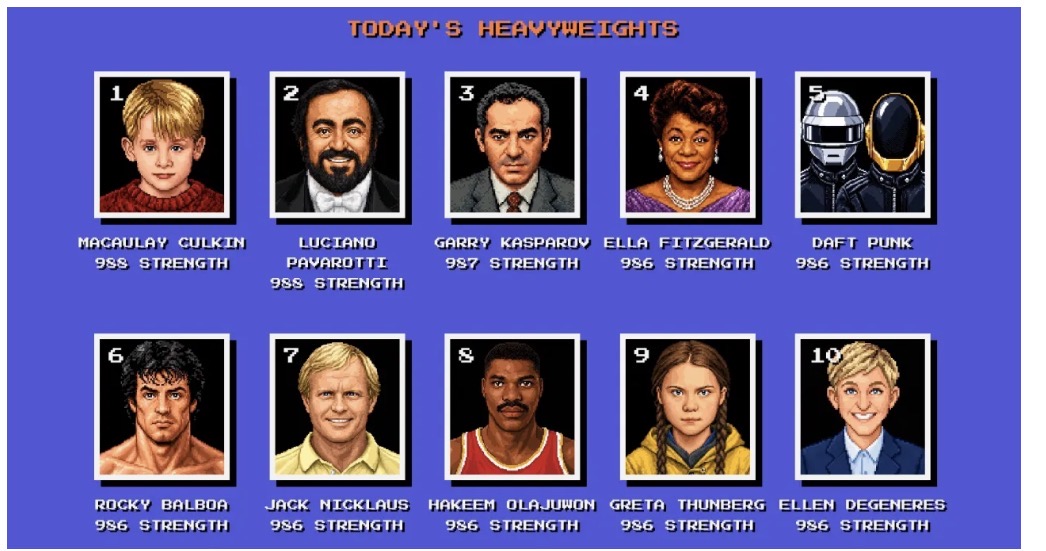
The final result is a "strength score" intended to represent how recognizable a person is within artificial intelligence systems.
A higher score suggests that multiple AI models consistently recognize and describe the same individual.
A New Kind of Popularity Score
What makes In the Weights so interesting is that it introduces an entirely new metric for online influence.
Historically, internet popularity has been measured through:
- Search engine rankings
- Website traffic
- Social media followers
- Engagement statistics
- News coverage
- Wikipedia presence
In the Weights introduces another category:
AI recognition.
Instead of measuring how many people know who you are, the platform measures how many AI systems know who you are.
This distinction may sound trivial, but it becomes increasingly important as AI systems become central to information discovery.
If future generations rely on AI assistants to learn about people, businesses, creators, researchers, and public figures, then being accurately represented inside AI systems could become an important form of digital visibility.
The Curious Case of AI Memory
One reason the project has gained so much attention is that it provides a glimpse into how AI "memory" works.
Unlike humans, AI systems do not store facts in a traditional database. Instead, information exists as patterns distributed across billions or even trillions of parameters.
When a model recognizes a person, it is not retrieving a dedicated file containing their biography.
Instead, it is reconstructing information based on relationships learned during training.
This makes AI memory both fascinating and unpredictable.
Some individuals are recognized instantly and accurately.
Others receive incomplete descriptions.
Some names generate conflicting responses depending on which model is asked.
In certain cases, AI systems may even hallucinate entirely incorrect information.
These inconsistencies reveal both the power and limitations of modern language models.
The Score That Sparked Competition
Perhaps unsurprisingly, people quickly became competitive.
The moment users discovered they could compare AI recognition scores, the platform transformed from a research experiment into a social phenomenon.
Many users began searching for:
- Their own names
- Friends
- Colleagues
- Journalists
- Entrepreneurs
- Researchers
- Celebrities
The platform effectively created a new leaderboard for AI visibility.
For example, TechCrunch journalist Anthony Ha reportedly received a score of 641, placing him within the top six percent of recognized names on the platform.
While that score sounds impressive, it becomes even more interesting when compared with others.
The leaderboard has changed frequently as the platform evolves, creating ongoing curiosity among users eager to see where they rank.
Why Celebrities Dominate
At one point, actor Macaulay Culkin, best known for his role in Home Alone, occupied the top position on the leaderboard with a score approaching 988.
Opera legend Luciano Pavarotti also appeared near the very top.
These examples demonstrate that AI recognition extends beyond internet fame.
A person may receive a high score because they have:
- Significant historical importance
- Extensive media coverage
- Academic influence
- Cultural relevance
- Long-term public visibility
The rankings reveal how much information about these individuals exists throughout the datasets used to train AI models.
When AI Gets Things Wrong
One of the platform's most useful features is its ability to expose hallucinations.
The results show exactly which models produced specific descriptions for a given name.
This transparency helps users understand how different AI systems interpret the same individual.
For example, one model reportedly described Anthony Ha as an ambiguous name that could refer to multiple people sharing similar initials.
While relatively harmless, such errors highlight a broader challenge facing artificial intelligence.
AI systems can appear highly confident even when they are partially incorrect.
Projects like In the Weights help visualize these limitations in an accessible way.
From Side Project to Viral Hit
According to Thomas Dimson, the project began as a creative experiment following his departure from OpenAI.
Dimson and Joey Flynn had previously joined OpenAI through the acquisition of their design startup, Global Illumination.
After leaving the company, they wanted to explore new ideas and reignite their creative energy.
Neither expected the platform to attract major attention.
Instead, the response was immediate and overwhelming.
Users were fascinated by the idea of discovering whether they had become part of AI's collective memory.
The concept touched on something deeply human: the desire to be remembered.
The Dream of Digital Immortality
The platform playfully suggests that being represented within AI models provides a form of digital permanence.
While few experts would argue that AI recognition guarantees immortality, the idea resonates with many users.
Throughout history, people have sought lasting impact through:
- Literature
- Art
- Scientific discoveries
- Journalism
- Innovation
- Public service
Today, artificial intelligence introduces another potential layer of memory.
If future AI systems continue learning from historical data, then information about individuals may persist in new and unexpected ways.
Whether this represents true digital immortality remains open to debate.
However, it undeniably raises fascinating philosophical questions.
What Researchers Can Learn
Beyond entertainment, In the Weights could become a valuable research tool.
Dimson has expressed interest in exploring questions such as:
- Why do similar models return different answers?
- Which groups receive stronger recognition?
- What biases exist inside AI systems?
- Which notable individuals lack sufficient online documentation?
- Who deserves a Wikipedia article but does not have one?
The answers could reveal important insights about representation, training data, and AI behavior.
Researchers may eventually use similar methods to evaluate fairness and visibility across different communities and professions.
The Future of Online Identity
In the Weights arrives at a pivotal moment for the internet.
For decades, search engines determined how information was discovered.
Today, AI assistants are increasingly performing that role.
As this transition continues, entirely new forms of visibility and influence are likely to emerge.
Search rankings may remain important, but AI recognition could become equally valuable.
Projects like In the Weights offer an early glimpse into that future.
Whether viewed as a serious research experiment, a social game, or a philosophical thought exercise, the platform forces us to consider a new question:
Not "Can Google find me?"
But rather:
"Does artificial intelligence know who I am?"
Topics
- AI
- In the Weights
- Joey Flynn
- Thomas Dimson
- Artificial Intelligence
- GPT
- Claude
- Gemini
- Grok
- Llama
- Machine Learning
- AI Recognition
- Digital Identity